

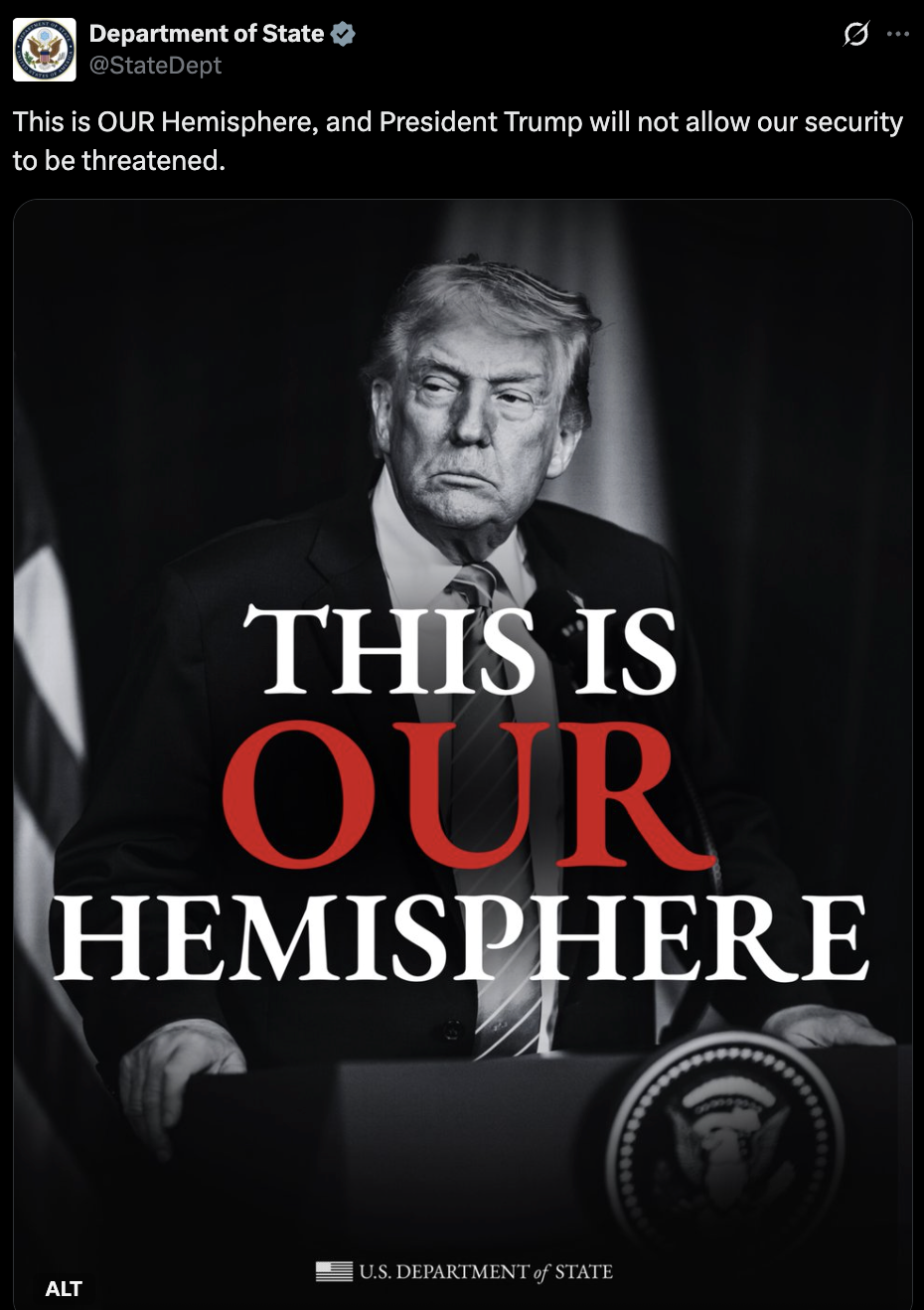
Just before noon on Monday, which is to say just before Nicolas Maduro was arraigned in a Manhattan courtroom, the US State Department posted a dramatic, high contrast picture of Donald Trump to its official social media accounts. The image was accompanied by a message: “This is OUR hemisphere.”
The propaganda piece was a truncated, shareable, meme version of a dozen or so bullet points summarizing Marco Rubio’s recent cameos on mainstream US media, where he set about justifying the administration’s decision to kidnap another country’s leader (legitimate or not) from a foreign capital in the middle of the night.
“This is the Western Hemisphere. This is where we live,” one of those bullet points reads, referencing Rubio’s chat with NBC. “And we’re not going to allow the Western Hemisphere to be a base of operation for adversaries, competitors and rivals of the United States.”
Make no mistake (and to his “credit,” if that’s the right word, Trump hasn’t made a secret of this), the US is after Venezuela’s oil. Or “our” oil, as The White House sometimes calls it, a reference to the legacy claims of Exxon and ConocoPhillips, who are owed nearly $10 billion between them in connection with Hugo Chavez’s nationalization push.
Even if it’s mostly about oil, Rubio’s not lying when he says Maduro’s capture was part and parcel of a reinvigorated Monroe Doctrine, which apparently supersedes international law (and absolutely takes precedence over decorum) in the eyes of The White House.
Maduro had reportedly already agreed to facilitate US access to his country’s oil reservers, and US special forces didn’t just kidnap him because Trump got sick of the famously buffoonish strongman’s dancing, although that was apparently part of it. (According to multiple sources who spoke to the mainstream US media, Maduro’s cringeworthy bop to a techno song which included the lyrics “Yes peace, no to crazy war!” was the last straw.)
The problem is that in some respects, oil and/or Maduro’s objectively bad dancing would’ve been more universally agreeable excuses for removing him from power compared to the supposed necessity of proving Trump means what he says when it comes to backyard bullying in pursuit of hemispheric militant jingoism.
Unless you count China’s token purchases of sanctioned Venezuelan crude (that buying was a lifeline for Maduro, but the amounts were trivial in the grand scheme of things), no one’s actually threatened the US in its own backyard since Nikita Khrushchev. Trump didn’t need to “prove” anything to anybody. It’s not as if the PLA was placing nuclear missiles in Caracas.
In terms of national security, Trump hasn’t actually accomplished much with Maduro’s ouster if he’s accomplished anything at all. Certainly not in the way of deterring “foreign adversaries” (Rubio ludicrously suggested on Meet The Press that Saturday’s raid to capture Maduro was at least partially motivated by a desire to keep Hezbollah out of Latin America, as if the group, which Israel decimated in 2024, retains the capacity to project influence 6,500 miles across two major bodies of water), and likely not in the way of drug trafficking either.
Yes, we’re living in a so-called “golden age” of cocaine, as discussed at great length in “Dope.” Coca bush cultivation in Colombia in 2023 was 253,300 hectares, more than five times what it was when Pablo Escobar was killed. But Venezuela simply isn’t a primary transit point, let alone a major producer or refiner.
The new indictment against Maduro, released on Saturday, contained only two direct references to “Cartel de Los Soles,” the supposed coke ring led by Maduro and his deputies. By contrast, the original 2020 indictment mentions the cartel nearly three-dozen times. Why the disparity? Well, because as I and countless others have pointed out over the past half decade, there is no “Cartel de Los Soles.” It’s not a real thing.
The new indictment tacitly concedes as much, noting that, “the profits of illegal [drug] activity flow to corrupt rank-and-file civilian, military and intelligence officials, who operate in a patronage system run by those at the top referred to as the Cartel de Los Soles or Cartel of the Suns, a reference to the sun insignia affixed to the uniforms of high-ranking Venezuelan military officials.” The operative words there are “referred to.”
Who’s doing the referring, you might ask? As The New York Times helpfully points out, Cartel de Los Soles is “actually a slang term, invented by the Venezuelan media in the 1990s, for officials who are corrupted by drug money.” So, when Scott Bessent designated the “cartel” as a foreign terrorist organization on July 25, 2025, he was designating a slang term.
Of course, that doesn’t mean the US is lying to suggest Maduro’s regime conspired with actual Latin American drug cartels. (They did, do and will continue to do so.) But what it does mean is that the regime isn’t a cartel itself. Even if you want to call it a meaningful (because, again, “major” doesn’t work here as an adjective) enabler of the cocaine trade, America doesn’t have a cocaine problem. I mean, it does, but not like it did in the 1980s. The issue is fentanyl, and exactly nobody claims Maduro was a major player in that market.
So, it’s hard to see what Trump’s actually accomplished for the US from a national security perspective — tangibly, I mean, I’m talking about tangible accomplishments — by seizing Maduro. And although leaving the rest of the regime completely intact was a smart move if your only goal is to strong-arm the country out of its oil, it’s not a lot of help on the democracy front. As Bloomberg noted in its daily mailer, Venezuela’s government is “flashing warning signs that a new wave of repression has begun [with] heavily armed security forces and pro-government motorcycle gangs seen roaming the capital.”
If you think Ukraine and Taiwan matter to US national security, you could argue Trump’s actually done himself, and by extension America, a disservice. Remember: Russia was prepared to give Maduro up during Trump’s first term in exchange for a US promise that America would cut Ukraine loose, according to Fiona Hill.
“Team Trump is tough and cynical in advancing its country’s interests,” Dmitri Medvedev wrote on January 4. “Removing Maduro had nothing to do with drugs — only oil, and they openly admit this,” he went on. “Lex fortissimum is clearly stronger than ordinary justice.”
Later, in remarks to state media, Medvedev said the US now has “no grounds to reproach our country” for the war in Ukraine. Presumably, China’s thinking the same thing vis-à-vis Taiwan.


If “This is OUR hemisphere”, then we better feed OUR people. Because they don’t have enough food down there and that is leading to complete chaos, no rule of law, stealing, and utter desperation.
By some reports, over 90% of the country lives in poverty without adequate food or medical care. GDP per capita is about $3,300. It has been in that range for over a decade. Down from a high of $12,700 in 2012.
Now our Generalissimo in Charge is saying US taxpayers may have to subsidize any oil companies foolish enough to reenter Venezuela and rehabilitate their oil industry. Left unsaid but understood is who will provide security. Viva la Revolution
You break it, you own it.
Trump is making America, a once great International superpower (1944-2024), and making it into a Regional superpower (pre-1944). I guess that’s what he meant by MAGA.
Trump has an 80’s fixation: trade wars, tariffs, the Mar-a-Lago Accord (the Plaza Accord), tax cuts for the wealthy, Iran, oil, cocaine trafficking, and now Maduro (Noriega and/or Grenada). Even “(Let’s) Make America Great Again” was an old Ronald Reagan political slogan. It is a shame he has not studied the Gipper’s approach on Russia much more closely.
Stephen Miller is a scary, unhinged Imperialist now, too.