

The friend
I checked into the Perry Lane in downtown Savannah on December 5 around two, and out around noon on December 7.
The hotel was hospitable, the weather not as much. If the sky were a Crayola color it would’ve been “Bleak Grey.” Unceasing drizzle made the cobblestone streets and uneven brick sidewalks a minefield of small pools.
There were wardrobe casualties: The hems on some John Elliott jeans, Chrome Hearts socks I knew better than to wear in the rain and two pair of Supreme Air Force 1s. (Fortunately, I bring a fresh pair of those for every day of any given trip.)
The rain dampened everything but the mood, which was irrepressibly warm and familiar, consistent with the company. Ostensibly, the sojourn was a Christmas gift to my longtime accomplice, G, but it doubled as a theatrical indulgence in the nostalgia that’s slowly killing me — a historical reenactment of a past that never was.
“This is the kind of thing I always wanted to do for us,” I said, waxing wistful as she untied the Bolduc ribbon around an orange Hermès package placed strategically on the suite’s dinette table next to the complimentary macarons. It was the first time I’d seen her in person since 2022.
Rain aside, the trip was everything I needed it to be. Or didn’t need it to be if excessive reminiscence is, as the medical community once believed, a kind of malady. The ease of conversation and effortless rapport with someone I’ve known half my life (and more than half of hers) was confirmation bias for my determination that old friends are the only ones worth having. And the only good and real ones.
When we checked out, I bid her adieu with a double cheek kiss and waited with a luggage rack on the curb for the valet, who was stuck at the back of a four-car line on the narrow, one-way side street between the hotel’s two “towers” (they’re not exactly towering).
I took the initiative and rolled the rack up the sidewalk towards the car, exposing expensive sundries to the elements. “Sorry about that,” the valet murmured, looking ruefully at a wet Saint Laurent garment bag as though the nylon were sanctified. “That’s what garment bags are for,” I reminded him.
When everything was loaded I reached into my pockets for a tip and realized I’d handed out my last $20 the previous evening at The Grey. The valet was fixated on a stack of shoeboxes behind my driver’s seat. “You got the Supremes?!” he effused, pointing to three Nike boxes emblazoned with the small, but nevertheless unmissable, red Supreme logo. “Oh I keep extra Forces,” I said, with a chuckle.
“Listen, I don’t wanna have to go back in and use the ATM. What size are you?” He was confused. I patted my pockets for emphasis. “I need to tip you and I’m out of cash. What size?” I pointed to the shoes. He looked down at his feet as if he needed to consult them. “11.” “Can you do 10.5?” I didn’t let him answer. I was in a hurry and even if I weren’t, it was starting to rain harder. “You can do 10.5. The Supremes run big. Black or white?”
I opened the back passenger side door, reached over and grabbed the box on top. “White–” he stammered from behind me. “Great.” I whirled around and shoved the box into his chest. “Here. That’s your tip. They’re brand new. Look.” I opened the lid to show him. “Maaan, you sure?” he asked, incredulous, shielding the shoes, but not my head, with a small umbrella. “Yep, I got plenty. Merry Christmas.”
And with that, I was off and over The Talmadge Memorial Bridge to the island.
The demanding moment
While introducing her 2018 collection Feel Free, Zadie Smith delineated between the sociopolitics of ascendant right-wing populism and the last years of the neoliberal world order it supplanted.
“These essays you have in your hands were written in England and America during the Obama presidency and so are the product of a bygone world,” Smith wrote, in a foreword dated January 18, 2017.
We do that instinctually: Describe the popular discontent which finally dislodged an entrenched centrist consensus as more akin to an untracked asteroid suddenly colliding with the Earth than a readily observable rising tide of disaffection that finally breached the levees.
Even those of us who’ve painstakingly chronicled the myriad socioeconomic factors which, when taken together, explain the demise of the Western political center, habitually characterize Brexit, Donald Trump’s ascendance and so many other political coups since 2015 as a series of black swans which, however statistically improbable, splashed down in succession.
That flawed framing allows us to draw a bright line distinction between now and then — between a new, illiberal present foisted upon us out of the clear blue and a “bygone world” of halcyonic liberal democracy.
A kind of corollary to the pre-/post- framing is the notion that those of us who understand what’s happened and what’s at stake are compelled to rise up and do something — anything — to “stop the spread,” to employ a phrase popularized by the pandemic, an event which did appear out of nowhere even if pandemics aren’t properly black swans.
“It is of course hardly possible to retain any feelings of ambivalence — on either side of the Atlantic — in the face of what we now confront,” Smith went on, adding that “millions of more or less amorphous selves will now find themselves solidifying into protesters, activists, marchers, voters, firebrands, impeachers, lobbyists, soldiers, champions, defenders, historians, experts, critics.”
Seven years later, Ezra Klein held up that passage as the quintessential encapsulation of the West’s political moment both as that moment existed on the eve of Trump’s first inaugural and the eve of his second election victory.
“Sometimes you stumble across a line in a book and think, ‘Yeah, that’s exactly how that feels,'” Klein said, referencing Smith’s January 2017 musings in September of 2024. “She’s talking about the political stakes… and the way you could feel it changing people.”
Of course, neither Smith nor Klein are unaware that Brexit, Trump and all the rest are manifestations of long simmering dissatisfaction with a system which failed to deliver for an ever growing share of the electorate — and a protest against a political center which was derelict in recognizing and counteracting those failures. That, as opposed to unpredictable outliers which no one could’ve anticipated.
Their September 2024 discussion centers mostly around the extent to which Smith’s latest book, “The Fraud,” despite being a historical novel set in Victorian England, can be read as a commentary on contemporary sociopolitics. The book tells the (real and entertaining) story of a commoner’s fraudulent claim on being the heir to an aristocratic family fortune. Although the man’s claim is dubious, the movement that grows up around it has validity.
In her chat with Klein, Smith compared it to the OJ Simpson trial. “[T]he fact that in the OJ case, even though the subject of it was a lie, there was a larger truth being told, which was that America had run a court system that was institutionally racist,” she said. “So that larger truth was told around a lie.”
The read-across to Brexit, Trump and so on is clear. The “larger truth” — that the neoliberal world order failed everyday people, particularly blue collar workers, in Western democracies — is “told around a lie” — in America’s case, the notion that a narcissistic billionaire real estate developer whose only real success as a businessman came in playing one on a reality TV show, was the middle-class messiah.
As Smith put it, of the case at the center of her 2023 novel, the Simpson trial and, implicitly, Brexit and Trump, “It’s not the way I would ever want justice to come about, but it’s a recognition sometimes that when all other outlets seem blocked, populism rears its head.”
That’s certainly true, and it (ironically) speaks to my disinclination towards the sort of call to arms Klein read into Smith’s 2017 remarks on the shifting political sands. He describes a “moment when politics feels like it demands we put aside our internal conflict, our uncertainty, and solidify ourselves into what the cause or the moment needs us to be.”
There’s tension here. I don’t necessarily buy the notion that justice — in this case the forced recognition of failure among the institutions which defined the neoliberal consensus — needs to be countered, or even nullified, just because it came about dishonestly. We all knew the system wasn’t working. Trump was our comeuppance. His presidency didn’t happen upon us overnight. It was 30 years in the making.
For that reason, among others, I’ve generally found the ambivalence Smith described in 2017 as “hardly possible” to be eminently so.
But in 2025, things took a decisive turn. The first year of Trump’s second term did indeed mark a bifurcation of American history which can now properly be divided into an illiberal present and a “bygone” era of liberal democracy. That, in turn, brings us closer to Klein’s “demanding” moment.
2025 was the year America ceased to be a democracy in earnest. The US is now a competitive authoritarian regime, in the terminology of Steven Levitsky and Lucan Way, and might’ve already gone some way beyond that. Now, it is indeed difficult — or anyway more difficult than it used to be — to be ambivalent, let alone indifferent.
The prisoner
“Last month, prosecutors produced a 3,379-page indictment seeking to lock me away for good with a sentence of more than 2,000 years,” Ekrem Imamoglu dryly remarked, writing for Foreign Affairs late last year.
Presumably, Imamoglu’s December 11, 2025, essay was penned from a jail cell. He was arrested that March on nebulous charges of corruption and terrorism. Just days earlier, Turkish strongman Recep Tayyip Erdogan had Imamoglu’s college diploma revoked in a naked attempt to render him ineligible for the next presidential election.
Fearing bureaucratic bullying might prove insufficient to derail Imamoglu’s presidential ambitions, Erdogan decided to simply jail Istanbul’s popular mayor. Imamoglu’s detention came just as he was set to accept his party’s nomination for the 2028 ballot, a candidacy that’d jeopardize Erdogan’s two-decade reign.
Technically, Erdogan can’t run in 2028. Under the constitution as it’s currently written (note the emphasis), Erdogan can serve another term only if he can engineer an early election. Failing that, he could work to amend the constitution, which he’s done before.
In 2017, Erdogan famously, narrowly and, many say, illegitimately, won a referendum seeking to abolish the office of the Turkish prime minister and jettison the parliamentary system in favor of an executive presidency, a move which concentrated more power in the office he held.
Although citizens could vote against the measure (and at least half of them did), Erdogan leveraged the tools of the state to subdue the “No” vote, likened those opposed to his presidential system to terrorists and suggested “No” voters were sympathetic to the prior year’s failed coup, which Erdogan skillfully exploits as a foil.
The referendum allowed Erdogan to serve a third term, which is to say he’s already served one more term than even his revised constitution allows for. Although he’s dominated Turkish politics for nearly a quarter century (he was prime minister from 2003 to 2014, a period during which the presidency was functionally subordinate), his presidency dates to 2014. Erdogan was reelected in 2018, a year after the referendum that abolished the office of the prime minister. This is where the math gets a little murky, but the bottom line is that when he ran again in 2023, Erdogan and his supporters argued that at the very least, his first term didn’t count towards the two-term limit because it was served under the old system.
Although Erdogan appeared to suggest in March of 2024 that he won’t attempt to serve a fourth term, and despite claiming last year that he “has no interest in being re-elected or running for office again,” scarcely anyone believes him. Skeptics and critics cite the push to rework Turkey’s constitution as a warning sign.
Last July, Erdogan argued that the current constitution, because it was ratified during a military junta in the early 1980s, isn’t fit for purpose in the 21st century. “In such a rapidly changing world, is it possible to get anywhere with a constitution that was written under the conditions of a coup?” he wondered.
It’s a good question, but Erdogan’s not the guy you want asking it, certainly not at a time when he’s approaching the end of what, according to Turkish law, must be his final presidential term. You’d be naive to think a new governing covenant drafted by Erdogan won’t include a mechanism that allows him to stay in power, even if it’s buried in a footnote somewhere.
Two months after jailing Imamoglu, Erdogan tasked 10 people described as “legal experts” to start work on the new constitution. “For 23 years, we have repeatedly demonstrated our sincere intention to crown our democracy with a new civilian and libertarian constitution,” Erdogan declared, in a speech.
All of this — the jailing of Imamoglu on a farcically long list of equally farcical charges, the underhanded machinations aimed at scheming up ways for Erdogan to stay in power and the generalized sense that the composition of Turkey’s executive is no longer up to voters, even if elections are held and closely-contested — is the culmination of one of the world’s longest-running autocratic transitions.
In his letter from jail published by Foreign Affairs, Imamoglu described Erdogan’s Turkey as it exists today. “The institutions that once made Turkey a trusted partner have been weakened [and] the bureaucracy has lost its competence and diplomacy its discipline,” he wrote, calling his own plight indicative of a government determined to “engineer a political landscape in which Erdogan faces no competition.”
Over the course of Erdogan’s two-decade rule, “Turkey’s governance has deteriorated at the country’s own expense,” he went on, adding that in well-functioning democracies, “independent courts, protected rights and a predictable public administration in which key decisions follow rules rather than personal discretion instill confidence and create favorable conditions for foreign direct investment,” whereas in Erdogan’s Turkey, “arbitrary verdicts, politicized prosecutions and sudden regulatory shifts have done the opposite.”
He proceeded to call for reform to insulate “the judiciary, the central bank” and a bevy of other mission-critical institutions from “partisan pressure” on the way to warning on the perils of Erdogan’s foreign policy, which is increasingly “erratic, reactive and personalized,” diminishing Turkey’s “influence within multilateral forums” and hurting the country’s reputation among “foreign partners.”
If that all sounds familiar to many Americans — and to everyone observing America’s democratic backsliding from abroad — it should. Imamoglu could just as easily be talking about Trump’s America, but for one thing: The pace of the metamorphosis is dramatically accelerated in the US.
Although Trump’s first term was fraught, to put it politely, American democracy weathered the storm. Not so well during the first year of Trump’s second term, though. It took Turkey more than 20 years to get to this point under Erdogan. In 2025, Trump managed in just 11 months to institute a replica of the competitive authoritarianism exemplified by Erdogan’s Turkey and Viktor Orban’s Hungary.
Commenting last year in the days after Imamoglu was jailed, one political analyst previewed what comes next. Turkey’s “moving away from the model of competitive authoritarianism to enter an assumed autocracy,” he said. “Authorities are no longer content with influencing the electoral game; they now want to choose the rules, the arbiters and the opponents.”
The metamorphosis
In 2019, former New York Democratic congresswoman Elizabeth Holtzman presciently warned that although American democracy could pull through one Trump presidential term, it might not endure a second.
“The Constitution will stand,” Holtzman, who served on the House Judiciary Committee during the Watergate scandal, said. “What the country will look like is another story.”
Her remarks were published as part of a roundtable discussion with Democracy, a self-styled “journal of ideas” published quarterly and dedicated to the (apparently futile) pursuit of “a vibrant and vital liberalism for the 21st century.”
“Maybe we’ll survive in some way, shape, or form one term of Donald Trump,” she went on. “But if he’s got another four years to add more judges to the ranks, I’m very worried.”
Those sentiments were echoed countless times over the ensuing years, including in the lead-up to the 2024 election. The problem for Democrats — and those opposed to Trump more generally — was that the “Trump as a threat to democracy” pitch was too nebulous to resonate nearly four years on from the sacking of the Capitol and on the heels of an acute inflation crisis which, by contrast, was a tangible, everyday reality for voters.
But the writing was on the wall. Or, more specifically, on the page. Project 2025 was a blueprint for autocracy masquerading as a tome-length policy document. Published in 2023 by the Heritage Foundation, America’s foremost right-wing think thank, the manifesto initially flew under the radar. It’s official title, “Mandate for Leadership: The Conservative Promise,” sounded innocuous enough, but the details were so full of devils that Trump felt obliged to publicly disavow any connection to the initiative, parts of which he called “absolutely ridiculous and abysmal.” “Anything they do, I wish them luck,” he once said. “But I have nothing to do with them.”
A little over a year later, after spending the first nine months of his second term enacting a domestic program which, in places, was identical to the Heritage Foundation’s prescriptions, Trump dropped the pretense. During the second day of what would eventually become the longest government shutdown in US history, Trump lauded Russ Vought for his role in crafting Project 2025, which contains a lengthy section lamenting the existence of what Vought called, “a sprawling federal bureaucracy that all too often is carrying out… the policy plans and preferences of a radical, supposedly ‘woke’ faction of the country.”
By the end of the year, quite a few of the boxes on the Heritage Foundation’s 2025 checklist were ticked. And American democracy wasn’t just weakened as a result, it was usurped and supplanted by the kind of hybrid regime the above-mentioned Levitsky and Way first described in 2010.
Writing in December for the January/February print edition of Foreign Affairs, Levitsky and Way, along with Daniel Ziblatt, another mainstay of the debate around the future of American democracy and Levitsky’s co-author on How Democracies Die and Tyranny of the Minority: Why American Democracy Reached the Breaking Point, expressed shock and dismay at the speed of democratic backsliding in America.
Many Americans, including those within what we still call “the establishment,” shrugged off Trump’s reelection, Levitsky, Way and Ziblatt wrote, noting that for all the concern, Trump won both the Electoral College and the popular vote, a clear mandate to govern. And besides, “democracy had survived the chaos of his first term, including the shocking events [of] January 6, 2021,” so it stood to reason that the country would, or at least could, survive a second term.
Alas, “that was not the case,” as they put it, straight away. Holtzman was right in 2019. American democracy not only failed to survive a second Trump term, it didn’t even survive the first year of his second term.
“The United States has descended into competitive authoritarianism,” Levitsky, Way and Ziblatt stated flatly. “Not only did the [country] follow a similar path under Trump in 2025 [as Hugo Chavez’s Venezuela, Recep Tayyip Erdogan’s Turkey, Viktor Orban’s Hungary and Narendra Modi’s India], but its authoritarian turn was faster and farther-reaching than those that occurred in the first year of these other regimes.”
The rapidity of America’s descent into autocracy can be explained in part by “good” planning, exemplified by Project 2025, whose authors had the benefit of hindsight — namely Trump’s first term, which they analyzed to determine who and what was responsible for stymieing the effort to consolidate a more powerful executive — and a model to draw upon for inspiration — namely Orban’s self-described “illiberal democracy” in Hungary.
As tipped by Vought, who once said of America’s bureaucracy, “When they wake up in the morning, we want them to not want to go to work, because they are increasingly viewed as the villains,” the first and most important step was the civil service purge.
In the language of autocrats, the civil service is often described in nefarious terms — as a “deep state” that works to subvert the popular will by undermining the populist authoritarian. In truth, authoritarians don’t want to get rid of the bureaucracy, they want to commandeer and control it. To quote Levitsky, Way and Ziblatt, “To weaponize the state, elected autocrats must purge and then pack it.”
It’s not clear whether Elon Musk was fully aware of the extent to which Trump, Vought and the rest may have viewed DOGE more as a means to that end — rather than an initiative to cut government waste and address runaway spending — but the proof, as they say, is in the eating: As the Cato Institute indelicately noted, “DOGE did not reduce spending, but it did reduce federal employment by 9% in less than 10 months” in what amounted to “the largest peacetime workforce cut on record.”
The New York Times summed it up as a question: “How Did DOGE Disrupt So Much While Saving So Little?” read the enticing headline for an exhaustive analysis of the program’s efforts published in December. In places, the Times‘s work suggests DOGE was more comedy of errors than anything else, but the bottom line was that “on DOGE’s watch, federal spending did not go down at all. It went up.”
Meanwhile, thousands of long-time public servants were forced out of government or incentivized to resign, leaving open positions which, in theory anyway, could be filled by administration loyalists. A beholden bureaucracy can bring the organs of the state — everything from tax authorities to regulatory bodies to the law enforcement apparatus — to bear against the executive’s enemies, both real and perceived.
Levitsky, Way and Ziblatt list nearly a dozen examples of Trump’s weaponized bureaucracy leaning on his political rivals including mortgage fraud allegations like those leveled by Bill Pulte against Fed governor Lisa Cook. In January, Pulte convinced Trump to threaten Jerome Powell with criminal charges ostensibly related to renovations at the Fed’s D.C. headquarters, a transparently ridiculous ruse Powell described, generously, as a “pretext.”
For the better part of a decade, I warned in these pages that in soft autocracies — as opposed to hard authoritarian regimes like Saddam Hussein’s Iraq — the regime favors bureaucratic bullying over wanton displays of political repression, the latter being too risky for nations which need to keep up democratic appearances. The mortgage fraud cases against Cook, Letitia James and Adam Schiff are good examples. So was Erdogan’s invalidation of Imamoglu’s college diploma in Turkey.
“Most of those singled out face petty charges [because] as every autocrat knows, if determined investigators look long and hard enough, they can invariably find some infraction committed by a person he wants to target,” Levitsky, Way and Ziblatt wrote, describing the tried-and-true strategy. “Even if few prosecutions result in convictions or prison time, such investigations are themselves a powerful form of harassment [as] targets are forced to spend their savings on lawyers and to devote substantial time and mental energy to their defense.”
The same goes for Trump’s asinine lawsuits against television networks, media outlets and the leveraging of government grant money to secure concessions from colleges and universities. On almost every account and in almost every case, Trump’s legal arguments are tenuous at best. And yet fighting him — either as a civilian plaintiff or as the embodiment of the US government — simply isn’t worth the hassle. Better to settle and hope he’s satisfied enough to leave you alone.
In another page from the autocrat’s playbook, Trump sought in 2025 to cut off funding to his political opposition, first by instructing the Justice Department to launch an investigation into ActBlue, the fund-raising platform which “powers virtually every Democratic candidate and cause,” as the The New York Times put it, calling the probe “a threat to one of the key financial cogs of the left, potentially hindering Democrats’ ability to compete in elections.”
Five months later, Trump and key members of his administration cynically exploited the assassination of conservative booster Charlie Kirk, using the murder as a pretext to “go after,” to quote JD Vance, the Ford Foundation, George Soros’s Open Society and other nonprofits and NGOs seen as supporting causes not aligned with Trump’s avowedly illiberal agenda.
“We are going to go after the NGO network that foments and facilities and engages in violence,” Vance said, while hosting Kirk’s podcast in September from the White House. On the same show, Stephen Miller described liberal NGOs as a “terrorist network” that needed to be “uproot[ed].” In similar remarks, Pam Bondi blamed “left-wing radicals” for Kirk’s assassination, which she said was the end result of “an organized campaign.”
None of those allegations were evidence-based, which is to say they were bald-faced lies. Kirk was killed by a lone, 22-year-old gunman whose grandmother later told The Independent, “My son, his dad, is a Republican for Trump. Most of my family members are Republican. I don’t know any single one who’s a Democrat.”
In response to the administration’s threats, more than 100 nonprofits issued a joint statement decrying the Trump administration’s “attempts to exploit political violence to mischaracterize our good work or restrict our fundamental freedoms.”
Like Erdogan in Turkey (who habitually blames external actors, Kurdish militants and a shadowy network of dissidents with ties to the late Fethullah Gulen for everything that goes wrong domestically) and Orban in Hungary (for whom Soros is a perpetual foil), Trump was (and still is) creating a scapegoat by framing Democrats not as legitimate political actors entitled to contest power in a democratic system, but as a party representing an amorphous conspiracy of nefarious actors whose organizational infrastructure must be dismantled in the name of combatting domestic “terrorism.”
All of this is, to reiterate, by the autocratic playbook — it’s straight from the Project 2025 blueprint, which was itself modeled on Orban’s long-term project for de-liberalizing Hungary. But in places, Trump’s second-term presidency looks like something worse than competitive authoritarianism.
For example, Trump’s grievance politics has sharpened such that his appeals to nostalgia and cynical exploitation of globalization’s “losers” appear as more than the expedient machinations of a political opportunist. References to the alleged “betrayal” of everyday Americans by elites who, in concert with a globalist cabal, strip-mined the country’s industrial heartland and outsourced blue collar jobs to China while imposing a set of perverse, “metropolitan” social mores meant to supplant traditional values, echo early Nazi propaganda and, on some vectors, Vladimir Putin’s revanchist evangelizing.
At the same time, Trump’s efforts to circumscribe culture by setting guidelines and rules for what counts as properly “American” feel uncomfortably totalitarian. From the figurative and literal whitewashing of American history on government websites to the administration’s programmatic “review” of the curatorial process at Smithsonian museums to the complete takeover of the Kennedy Center in the interest of promoting what Trump calls “a golden age of American arts,” the administration seems bent on establishing a uniform aesthetic — right down to what is and isn’t architecturally acceptable for federal buildings.
Totalitarian creep’s also evident in Trump’s efforts to dictate what late-night television hosts are allowed to say and, relatedly, what kind of political humor crosses the line into illegal slander of the executive. Less intrusive, but in some ways more unnerving, is the administration’s attempt to instill the idea of Trump as a larger-than-life, almost omnipotent, presence, with conspicuously displayed portraits, including a three-story banner hung from the Department of Labor building.
Finally, Trump’s made himself completely synonymous with US foreign policy such that there’s no distinction between his personal agenda and the interests of the country. As one Columbia scholar put it, “the United States [now] has the foreign policy of a personalist dictatorship.”
Just as Trump succeeded in instituting competitive authoritarianism in America on a vastly accelerated time line compared to Turkey and Hungary, he appears to be decades ahead of the game on marking a transition from autocrat to quasi-totalitarian dictator.
If that’s accurate — and I think it is — it means the window’s closing. In their December piece, Levitsky, Way and Ziblatt wrote that just because the US “has crossed the line into competitive authoritarianism does not mean that its democratic decline has reached a point of no return.” Indeed, they went on to emphasize, “the existence of avenues for contestation is in the very nature of competitive authoritarianism.”
That’s true, but by most appearances Trump’s not satisfied with competitive authoritarianism. He wants the “presumed autocracy” Erdogan achieved after two decades presiding over Turkey. Or perhaps Trump wants something even more oppressive, like the dictatorial kleptocracy of Putin who, I should note, eventually imposed an ideology and an ethos on Russians, thereby abandoning his regime’s only redeeming quality: Relative freedom to act and think as long as you didn’t contest for power.
Commenting this month on the shooting of Renee Good by an ICE agent in Minneapolis, M. Gessen, an expert on autocracy in Putin’s Russia, delivered a stark warning to Americans. “As autocracy establishes itself, the space available for action shrinks very rapidly,” Gessen said. “I talk about this a lot when I do public speaking and people ask me: ‘What should we do?’ And I say: ‘Well, do something. Because whatever you can do today, you’re not going to be able to do tomorrow.'”
The Hungarian
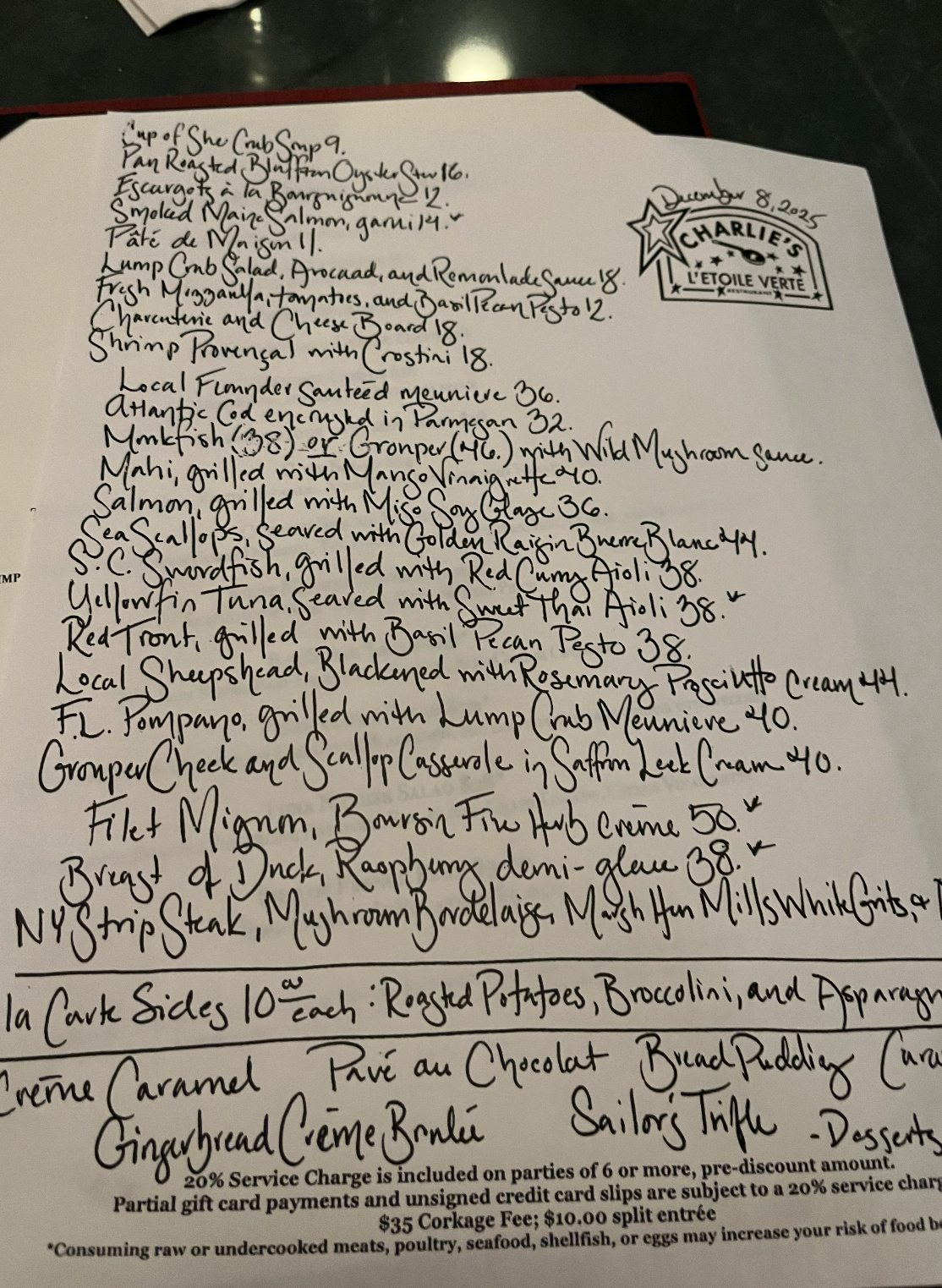
The best restaurant on the island’s a French spot called Charlie’s L’Etoile Verte.
It’s not out of the way exactly, but it is tucked away on a little side road in an all-white, low-slung bungalow “which many mistake for a welcoming Southern home,” as the owners put it on their website.
During the day, you could drive by the place a hundred times and never know it’s a business. At night, the full parking lot’s a giveaway, but even then you could just as easily assume someone’s hosting a well-attended dinner party.
Residential camouflage was no excuse for the belated nature of my culinary epiphany, though. I was in my late thirties by the time I discovered Charlie’s L’Etoile Verte. By then I’d spent a third of my adult life on the island, and it’s only a dozen miles long and half that wide. For a self-styled epicure, the oversight was embarrassing. And the committed alcoholic in me was equally mortified to have missed out on a bustling, if a bit geriatric, bar scene.
It was far too late for any imbibing by the time I finally darkened Charlie’s L’Etoile Verte’s doorstep in 2021. I’d been dry for half a decade by then. But it was better late than never for the food which was, in a word, great. Not divine, nor any grandiloquent synonym thereof. Just uniformly great from start to finish. Unfortunately for my palate, I moved off the island that very same year, but I’ve been back more times than I can count, and every time I make a point of eating at Charlie’s L’Etoile Verte.
Charlie Golson died on September 27, 2024. By then, he’d long since handed the reins of his namesake restaurant to his children, one of whom — his daughter — greeted me at the door when I showed up for dinner on December 8.
I cut a curious figure in middle age and my demanding intonation, rendered in a Southern inflection that clashes badly with an expansive vocabulary, can be discomposing. “Can I sit at the bar?” Then, before she could answer: “Is there any room at the bar?”
She looked me up and down, her hostess did too, each trying, and failing, to pretend I wasn’t wearing a slim-fitting denim jacket over a distressed Givenchy hoodie and shoulder-carrying a Celine Folco backpack. The backpack was right at home, even if they didn’t realize it. The Celine monogram’s famously inspired by the chain around the Arc de Triomphe, and as one local paper noted upon his passing, Charlie named his restaurant in honor of “a tiny, unpretentious [eatery] on a corner alley” near the very same iconic Paris monument.
There was no room at the bar, but the daughter graciously (and begrudgingly) indulged the insinuation that I was someone whose demands should be accommodated. After conferring with the bartender she told me two couples were finishing up and that it’d just be a few minutes. I’d have to wait, but not long. Which was acceptable.
I sat on the end of a couch behind the bar and fished a recent issue of The New Yorker from the backpack, where a bottle of alkaline water, a copy of Russell’s “History of Western Philosophy,” an Enfants Riches Déprimés agenda (the one with the logo-stamped padlock) and an M&P Bodyguard rounded out my on-the-go essentials. I crossed my legs and read, bathing in my own supercilious aura.
My conceit was ironic, but at least I was aware: Given the restaurant’s proximity to the island’s most exclusive enclave (where Rolls Royces roam and tourists snap selfies in front of other people’s yachts) the odds heavily favored me being the “poorest” person in the room, and by a considerable distance. No matter: I looked like I might be the richest and besides, I was definitely the youngest, no small boast and anyway something I can’t say very often anymore.
After 10 or so minutes, a seat opened up at the bar and then two more beside it. I took one and a couple waiting on the same couch promptly occupied the spots next to me. A bartender of the sort every small, family-owned restaurant keeps as a pet (pushing 60, leather skin, implausibly black hair and a gold ring unrelated to any nuptials) gave us menus, hand-written specifically for that evening’s service, as usual.
“Whatcha havin’?” one half of the couple to my right asked. “The mahi with the mango vinaigrette,” I sighed. “It’s good,” the bartender called over his shoulder, not looking up from the wine glasses he was polishing.
I didn’t want the mahi. In fact, I wanted everything except the mahi, but it sounded like the lightest, healthiest option. I’m determined that even if my buzzed hair’s destined to grey and my facial features fated to narrow such that my 27-year-old self might ask, urgently, “Who’s that guy?” upon seeing his older reflection in a mirror, I will retain more or less the same physique even if I have to give up everything that tastes good and hire a personal trainer. In some ways, that’s a financial imperative. I invested too much in my wardrobe for any of it to stop fitting properly.
“I’m gettin’ the scallops,” he told me, as if I’d asked. Then he turned to his wife: “I’m gettin’ the scallops.” She rolled her eyes. “You always get scallops. Scallops and scallops and scallops.” Her accent was very heavy, and I couldn’t place it. “Can I ask where you’re from?” “Budapest,” she said. Then, in case I was as geographically bereft as every other American: “Hungary.”
The husband was from the Dominican Republic, an origin belied by his quintessentially American appearance and even more so by his mastery of demotic English. “How does that happen?” I wondered aloud, of the unlikely pairing. They competed to tell the story of a long-running romance, talking over one another. Her’s was the louder voice, and by some measure, so he let her take the lead, filling in the blanks when she hit the limits of her English vocabulary.
I don’t remember most of the story, but they met at an airport in Canada while boarding a connecting flight to somewhere. She was terrified of flying, he wasn’t, they held hands and the rest is history. How they ended up on the island escapes me just now, and if I’m honest, I probably forgot as soon as they told me. A good listener I’m not.
What I do remember, though, is her impassioned response when the political scientist in me couldn’t resist asking her opinion on Orban and specifically whether Hungarians conceive of their country the same way over-educated, arrogant Western Europeans and Americans characterize it — namely as an authoritarian state which, like Erdogan’s Turkey, is perilously close to becoming an “assumed autocracy.”
It was difficult to make out most of what she said — imagine an American trying to explain, in broken Magyar, every twist and turn in the sordid tale of Trump’s political rise to someone at a bar in Hungary — but the gist of it was that whatever there was to like about Orban in the beginning, there wasn’t a lot to like now.
The language barrier made it impossible for me to press her on the extent to which she does or doesn’t regard her country’s democracy as a lost cause. Her husband wasn’t a lot of help — he’d plainly heard enough about Orban over the course of their marriage to last him several lifetimes, and was probably wondering how he got so unlucky as to stumble across the only person on the island who knew enough about Hungarian politics to get her started.
Eventually, the wife hit on a hopeful note which she delivered with finality. “He will lose,” she said, apparently referring to this year’s parliamentary election in Hungary. That elicited a response from her husband. “No he won’t,” he scoffed, smirking and shaking his head.
I ate, they ate, they drank, I didn’t. Adept as she clearly was at holding her liquor, the husband suggested she not have a fourth drink. Or at least not in public. She agreed and proceeded to tease him, squeezing his cheeks until his mouth puckered: “You take such good care of me, yes?”
He shook my hand as they got up to leave and it was only then I learned they were themselves restaurateurs on the island. They owned Taste of Europe, which I’d seen but never tried, the name being too nondescript to pique my interest. (When I got back to the resort I read the reviews. They were glowing. Apparently, Charlie’s wasn’t my only culinary oversight in seven years of calling myself a local. All that time I could’ve been eating authentic hortobagyi and goulash.)
As she gathered her things to follow him out the door, she addressed me again. “Orban!–” she declared. I waited for the rest. She’d lost her train of thought. “Ah!” She rediscovered the thread. “Trump is Orban.” The husband came back over to usher her away. She brushed his hand from her elbow and drove home the point: “Trump is Orban.” He smiled sheepishly, she laughed drunkenly, and I bid them a good evening.
The inevitable
For many Americans, Smith’s contention rings true: It’s “hardly possible,” which is to say it’s impossible, to be ambivalent about the metamorphosis of our politics and the extent to which Trump’s social engineering project is negating decades of progressive momentum and recasting the world’s foremost democracy as a necessarily authoritarian bulwark against the supposed perversion of traditional values by liberalism run amok. Either you’re proudly on board with that and prepared to suspend democracy to see it through, or you’re aghast and willing to risk life and limb to see it stymied.
Not me, though. Judge me derelict in my civic duty if you will, but all I see in the grotesque carnival of 21st century fascist populism is a reflection of the futile tragicomedy that is the human condition more generally. Proof (more of it, as if any extra were needed) that for all our accomplishments as a species, particularly over the last 150 years, our conceits and prejudices, our superstitions and recriminations, our bigotry and cruelty, will lead us inevitably to ruin by and by.
Levitsky, Way and Ziblatt warn against resignation — against fatalism in America’s “authoritarian moment.” “[T]he gravest danger is not repression but demobilization,” they write, exhorting the public not to “treat a Trump dictatorship as a fait accompli and repression as inevitable,” because to do so is to risk “a self-fulfilling prophecy.” I suppose I’m doing just that, but my equivocation and prevarication (Smith’s impossible ambivalence) in the face of autocratic conversion goes to something deeper than complacency.
As I get older, I’m compelled, as we all are, to ponder the inevitability of death. As that inevitability grows incrementally proximate, sundry causes du jour feel commensurately insignificant. Or anyway not worth the trouble as every waking second becomes ever more precious.
A corollary to that is a prevailing sense of detachment from social movements or even from society itself — and an attendant compulsion to grasp instead at the only connections which make my lived experience seem meaningful and real as opposed to a fleeting, futile fit of consciousness.
As I drove from Charlie’s back to the resort I listened in the car to the tail-end of Klein’s 2024 interview with Smith. It’s become one of my favorite exchanges for the haunting juxtaposition between her searingly accurate description of the human condition as we age and the airy cadence of her delivery.
“I think there is a deep isolation in people. I think it’s existential. I think it’s a feeling of being lost in the world sometimes,” she says. “I’ve become more aware of how difficult it is to have genuine relations with other humans. A good friend is a rare, rare thing that we don’t get many [of] in our lives. You can have acquaintances, but friendship is something else.”


Reading this brilliant essay was both horrifying and uplifting; on one hand I was newly shocked that such an idiot could pull off this level of chaos and destruction with such speed, and on the other hand, acknowledging that Minneapolis was developing a scalable model of resistance in even greater speed. Minnesotans are, in real time, demonstrating their willingness to defeat the “might makes right” order of the day. We should all be taking good notes.
“ Not me, though. Judge me derelict in my civic duty if you will, but all I see in the grotesque carnival of 21st century fascist populism is a reflection of the futile tragicomedy that is the human condition more generally.”
I have expressed a very similar view to both real friends and “acquaintances” in several occasions, particularly recently as people around me voice the need to resist, to do more. When I respond that I have no faith in the US or its population to overcome what is coming and detail the reasons behind my assertion I usually get the “you should not be so cynical and pessimist” reaction. I might be a cynic but I certainly do not consider myself a pessimist, I consider my view of humanity’s prospects, and more specifically about the future of the US experiment, to be simply realistic, not pessimistic. Can the increasingly intellectually lazy US population overcome the slide towards fascism with US characteristics? I hope I’m wrong and that the answer is yes, I simply do not think it is. When my closest friend, a true unwavering New England liberal with an implacable moral compass, promises to fight this “regime” even if it costs her life and chastises me for not assuming a similar attitude, all I can do is tell her my honest opinion, folks in the US (at least a majority of them) are getting what they voted for, currently some celebrate or ignore our new reality, soon it will become a nightmare for almost everyone regardless of ideological leanings. I live a privileged existence, I am very aware of that fact and how frail my reality is, I can pick almost any place in this planet as my main place of residence, if I have my choice of “autocracy,” it won’t be to live under Trump’s autocracy, I am “leaving,” and leaving the fight to braver souls than mine, I rather enjoy good food and wine while my days last.
I’ve been workshopping some ideas around social capital, generational cycles like those described in The Fourth Turning, and the role of technological innovation. Whether or not one agrees with the book’s broader conclusions, many of the predictions made nearly 30 years ago have largely aligned with what has unfolded since.
A pattern seems to emerge across history: humans develop a novel technology, society over-invests in it, a financial boom follows, then a collapse, then recession or depression, and ultimately geopolitical conflict. Social capital appears to rise and fall with these cycles as well. This makes intuitive sense—social capital tends to grow when people rely more heavily on one another, and it erodes as individuals and institutions become increasingly self-sufficient.
If these dynamics mirror the “four seasons” described in The Fourth Turning, the historical evidence lines up reasonably well—though, of course, past alignment doesn’t guarantee future outcomes.
Still, it feels plausible that we may be heading toward another financial disruption, potentially driven by global over-investment in AI. Such a downturn could escalate into some form of geopolitical conflict, creating conditions for a shift in global power—similar to how the United States emerged after World War II by leveraging its dominant technologies and industrial capacity.
Incredible piece. Glad I waited until I had time to savor, and contemplate your writing.
I fear for the middle class- not just the lucky remaining, although dwindling group; but those who have been pushed out and left behind.
I am not a fan of either political party- both are way less than admirable and both seem to prioritize issues and obtaining money and power, which are not helping to improve the everyday lives of the majority of our people. Our government has gotten way too big: we trusted in the institutions and they failed us.
Something better happen soon, however, because, otherwise, it absolutely seems like we are headed towards the end of America as I have known it to be. I have been to the cafe in Paris where the French Revolution was planned- so tiny- but the cafe still exists and the “grilled cheese” is pretty good there. It doesn’t seem that far fetched that we could be facing a modernized version of that.
Glad you liked it. This one turned out to be a pretty depressing read, even by my grim standards, which I suspect is behind the low comments. But it’s a quality piece. Really it is. I read it and re-read it, and I wouldn’t change anything.
You should not second guess. Your instincts are very good and nothing needs changing.
I have had some amazing and also some sad/depressing times in my life. I never forget that today is the sum total of all my previous decisions. No different than everyone else.
Thankfully, about 20 years ago, I discovered how much I love walking in the mountains.
🙂
Maybe I’ll do a gonzo journalism-style restaurant review site in my spare time…
I got it: “Kitsch Register.” That’s it. And it won’t just be food reviews.
I wasn’t joking. Three weeks later, here it is: https://kitschregister.com/