

Legend has it
Whenever I venture out into the hollow, cold paradox of a constantly-connected society plagued by suicidal loneliness, I’m struck by the extraordinary life stories I hear. And even more so by how few people seem to consider their stories extraordinary.
In public, I don’t present as someone who’s especially amenable to casual conversation, but as a raconteur extraordinaire and someone who prides himself on knowing a little bit about a lot of things, I’m actually a gifted conversationalist.
At the risk of deflecting blame for a self-inflicted solitariness, I can’t help but resent technology: Smartphone immersion makes everyone seem unapproachable, robbing me of the idiosyncrasy responsible for my bartop allure.
There was a time not so long ago when the only acceptable head-down behavior at bars was that associated with the hangdog stares of divorcees trying to perceive a glimmer of hope at the bottom of a whiskey glass. When to project distracted unapproachability while seated on a barstool — to be head-down distrait in the presence of good company, fine spirits and open taps without a breakup story or a layoff to blame — was to commit an etiquette breach so peculiar it demanded explanation.
Nowadays, sociability’s the protocol infraction. Everyone’s head-down. Doomscrolling, posting and, in a tragically surreal phenomenon, carrying on conversations in the presence of people but not with those people, rather with other people, who aren’t there, through text messages. It’s Cheers meets The Twilight Zone. The only way today’s bartops facilitate personal connections is by serving as tables for smartphones.
So, projecting preoccupied inaccessibility doesn’t make me intriguing anymore. It just makes me one more vacant hypnotic, mesmerized by the radioactive glow of the malignant gadgets we now depend on to mediate our social interactions. To look up from one’s own gadget is often to face a nightmarescape: A room full of ostensibly real people posed uniformly in a forward hunch, all gazing — fixated and unblinking — at identical lambent contraptions.
In this empty, disintegrating polis heedless of the situational irony destroying it, I’ve taken to starting conversations with strangers of my own volition. That’s anathema to my general constitution, but it feels increasingly urgent, lest we should all be lost down the digital rabbit hole forever. And lest my personal legend should be confined to the same digital chasm, never to enchant someone face-to-face again.
Sometimes, people are reluctant to be extricated from what psychologists describe as a negative feedback loop wherein loneliness brought on by social media immersion sends people chasing further into the abyss in search of something that isn’t there, precipitating still more loneliness. Other times, though, people seem grateful for the reprieve. Happy to be emancipated from the psychosomatic rigors of our shared virtual prison.
I eschew small talk in favor of meaningful questions. The hows and the whys. “How’d you come to live here, in this city?” and so on. I get the same questions back.
Invariably, my story’s less interesting. Or comparatively ignoble. I don’t travel abroad, I’ve never been to war (or survived a war zone), I’ve never served on any expert panels nor contributed to any important projects (or none that worked out well for society), my academic credentials aren’t from top-tier institutions and just generally speaking, I can boast of no achievements, or at least not in the traditional sense of the term.
Yet almost without exception, people come away convinced that my life story’s somehow more compelling — and, even less plausible, more redeeming — than their own. That’s the power of storytelling. Of mythologizing. Of self-aggrandizement tempered, slyly, by faux contrition and feigned regret.
I have a phobia of being regular which manifests as a compulsion to perpetuate my own legend. It’s not vanity so much as it is an intense aversion to the idea that my life’s been ordinary.
Over time, I’ve refined the story to suit my own purposes, in the process crafting a narrative which, while completely true and only barely exaggerated, might nevertheless be indistinguishable from fiction to many, or even all, of the supporting characters.
Anyone can craft such a legend from their own life stories, but most people don’t. And thank God for that. Otherwise, my bartop conversations might serve as constant reminders that in fact, my story’s no more extraordinary than anyone else’s. And that my scarcely veiled pretensions to exceptionalism are farcically misplaced.
The greatest story ever told
“In order to hold any sort of nation state together, there has to be a story that most people agree on,” Margaret Atwood told Ezra Klein, during a wide-ranging discussion in March of 2022.
Stories, she went on, “give members of a group a kind of unifying imaginary thing they can believe in.” Atwood was quick to emphasize that “imaginary” needn’t mean the story isn’t true. Rather, she meant that stories, like money, are figments of the human imagination. We tell them because they serve some purpose.
Sometimes, a story’s purpose is specific and narrow. But many stories have loftier ambitions — a higher calling, so to speak. Stories, like money, play a critical role in organizing human affairs. Without the imaginary thing we call money, it’s back to the barter system. Without stories, we risk societal dissolution.
With the possible exception of religious texts, the legend of America — “liberty, democracy, freedom and equality,” to use Atwood’s summation — is generally considered the greatest story ever told. That story’s so powerful it won a war all by itself.
Hard power didn’t win the Cold War for America, soft power did. During that era, soft power very often manifested as the broadcasting and recitation of the American mythos — the telling and re-telling of the story — in locales beholden to a competing narrative which ultimately fell apart.
The West employed highly stylized depictions to set out and delineate the stakes. It was a struggle between America, “the land of light” and the Soviet Union, “the land of darkness,” as Atwood put it. The land of light prevailed largely on the merits of the story, and in some cases (e.g., Vietnam) despite itself.
When national — or, in the case of the USSR, supranational — stories fall apart, societal cohesion depends on the posthaste adoption of a new narrative. If the old story isn’t “replaced with another one, fragmentation is the result,” Atwood said.
Until very recently, a majority of Americans believed in the national story, or at least professed to. By and large, figuratively or literally, most people saluted the nation’s star-spangled pledgee, whose demands include “liberty and justice for all.”
The promise of universal equality in America remains unfulfilled, and large subsections of the electorate are unfortunately determined to keep it that way, but from a “do as I say, not as I do” perspective, Americans are (or were) on board. Willing, at least, to pay lip service to a set of high-minded ideals which, to be fair, is about all we can say for the men who enshrined those ideals into America’s founding documents a quarter of a millennium ago.
An AP NORC poll conducted in April of 2024 showed that pretty much everyone — nine in 10 Americans — agreed that the right to vote and equal protection under the law are foundational.

The chart gives you a sense of I mean when I say a majority of Americans at least profess to believe in the national story. There’s broad-based — overwhelming — support for the basic tenets of the American narrative.
But do note the cart header: “In theory.” In practice, it’s clear that 90% of Americans didn’t, and still don’t, support the expansion of voting rights, equal protection and so on. That distinction — between what Americans say and how they actually behave vis-à-vis liberty, democracy, freedom and equality — is the country’s original sin. Americans persist in that sin to this very day.
I want to dwell on that for another beat. The nation’s history is replete with examples of Americans failing to practice what they preach. That failure’s the source of immense suffering. In no way do words — poll responses, anthem lyrics, flag pledges and so on — compensate for that suffering. On the contrary, lip service to inalienable rights where those rights are denied is insult to injury for the deprived.
That said, I doubt anyone aggrieved by the hypocrisy of being denied civil liberties in the “land of the free” would suggest it’d be better if everyone were honest about their sanctimonious duplicity. In a scenario where a national poll showed support for voting rights converging towards a more honest approximation of Americans’ collective opinion, I can’t imagine civil rights groups cheering the result: “Well at least it’s honest!”
However implausible given the ponderous pace of progress, we insist the incongruity between what Americans say and what they do isn’t proof that the quest for a more perfect union was abandoned long ago. Rather, we see — or claim to see — in that contrast a silver lining: Although highly unfortunate, the vastness of the disparity’s indicative of how much greater the country can be, we tell ourselves.
To the extent that spin was compelling or believable, it’s irrelevant in a scenario where Americans begin to revise the national story. To cease even the paying of lip service to the idea that liberty, freedom and equality should be universal. Or to question the merits of democracy as a system of governance. That, unfortunately, is where we are now.
“America has been examining the underside of the myth, if you like,” Atwood said, in the same interview with Klein. “So equality for whom exactly was the Declaration of Independence and the Constitution? Were those going to be for everybody? Apparently not, not at the beginning. But once you’ve started with that idea, it’s kind of hard to stop it.”
Hard, but not impossible. If this was never supposed to be about equality for everyone — if only certain sorts of people were entitled to inalienable rights — there’s no use beating ourselves up over the legacy of inequality, nor over the systematic denial of rights on the basis of ethnicity, gender and so on. And that’s convenient, because the story’s a lot less specious if you rewrite it without all the bad stuff.
Although the differences aren’t as stark as you might suspect given just how riven American society is, there’s a clear partisan divide when it comes to discussing America’s historical shortcomings and also perceptions of American exceptionalism.
A June 2024 Pew poll found that nearly eight in 10 Democratic voters (labeled then as Joe Biden supporters) thought it was “extremely important” to have public discussions about the country’s failures and flaws. That figure for Donald Trump voters was just six in 10.

The same survey showed that more than a third of Trump supporters view the US as singularly great, versus just 12% of Democratic voters.
Note that one in 10 Trump supporters said it wasn’t important to discuss the country’s flaws, or at least not in public. It’s safe to say that cohort would deem the 27% of Democrats who said the US isn’t the greatest country in the world as unpatriotic or something worse.
True or not, many neutral political observers (to the extent neutrality’s possible in 2025) and even some Democratic strategists argue the diversity, equity and inclusion (DEI) movement went too far in its efforts to apologize for the unsavory chapters of the American story, blurring the line between self-criticism and self-loathing in the process. That, in turn, set the stage for a backlash that’s now manifesting in overt attempts to whitewash American history.
In late March, three years — nearly to the day — after Atwood chatted with The New York Times, Trump signed an executive order called “Restoring Truth And Sanity To American History.” You didn’t have to read it to know that by “restoring truth” Trump meant removing facts. Similarly, it came as no surprise that Trump projected the nefarious elements of his own revisionist project onto unnamed conspirators.
“Americans have witnessed a concerted and widespread effort to rewrite our Nation’s history, replacing objective facts with a distorted narrative driven by ideology rather than truth,” Trump declared.
He’s right. Americans are in fact witnessing just such a “concerted effort.” It’s being carried out by Trump who, in the order, instructed JD Vance to work through the Smithsonian’s board of regents to “remove improper ideology” from America’s museums, education and research centers. As Donna Brazile noted in an Op-Ed for The Hill, “improper ideology” isn’t defined in the order, and that’s on purpose. “It can refer to anything Trump doesn’t like,” she said.
Although he left plenty of room for interpretational leeway, Trump did delve into some specifics regarding what sorts of ideologies might be regarded by The White House as “improper.” For example, he took specific aim at a Smithsonian exhibit called “The Shape of Power,” which Trump derided for promoting the view that race isn’t a biological reality but rather a social construct.
As The New Yorker’s David Remnick not-so-gently pointed out in an April piece, that exhibit gets it right. Race is in fact more social construct than biological reality: Genetically speaking, humans are 99.9% the same. “The opposing view, racial essentialism, is hardly benign,” Remnick went on. “It is the underpinning of virulent bigotry, from the description of Jews as vermin in Der Stürmer to the assertions in white-nationalist manifestos that Black people are cursed with inferior IQs.”
Trump described his initiative as an effort to “restore Federal sites,” including parks, “to solemn and uplifting public monuments that remind Americans of our extraordinary heritage, consistent progress toward becoming a more perfect Union, and unmatched record of advancing liberty, prosperity and human flourishing.”
Just days later, The Washington Post reported that Trump’s National Parks Service removed Harriet Tubman’s photo from a webpage about the Underground Railroad in favor of a stamp collage highlighting “Black/White cooperation.” Gone from the page was a quote from Tubman and a fact-based introductory paragraph was replaced with, as the Post dryly described it, “a line that makes no mention of slavery.” The Underground Railroad, Trump’s Parks Service imagines, “bridged the divides of race.”
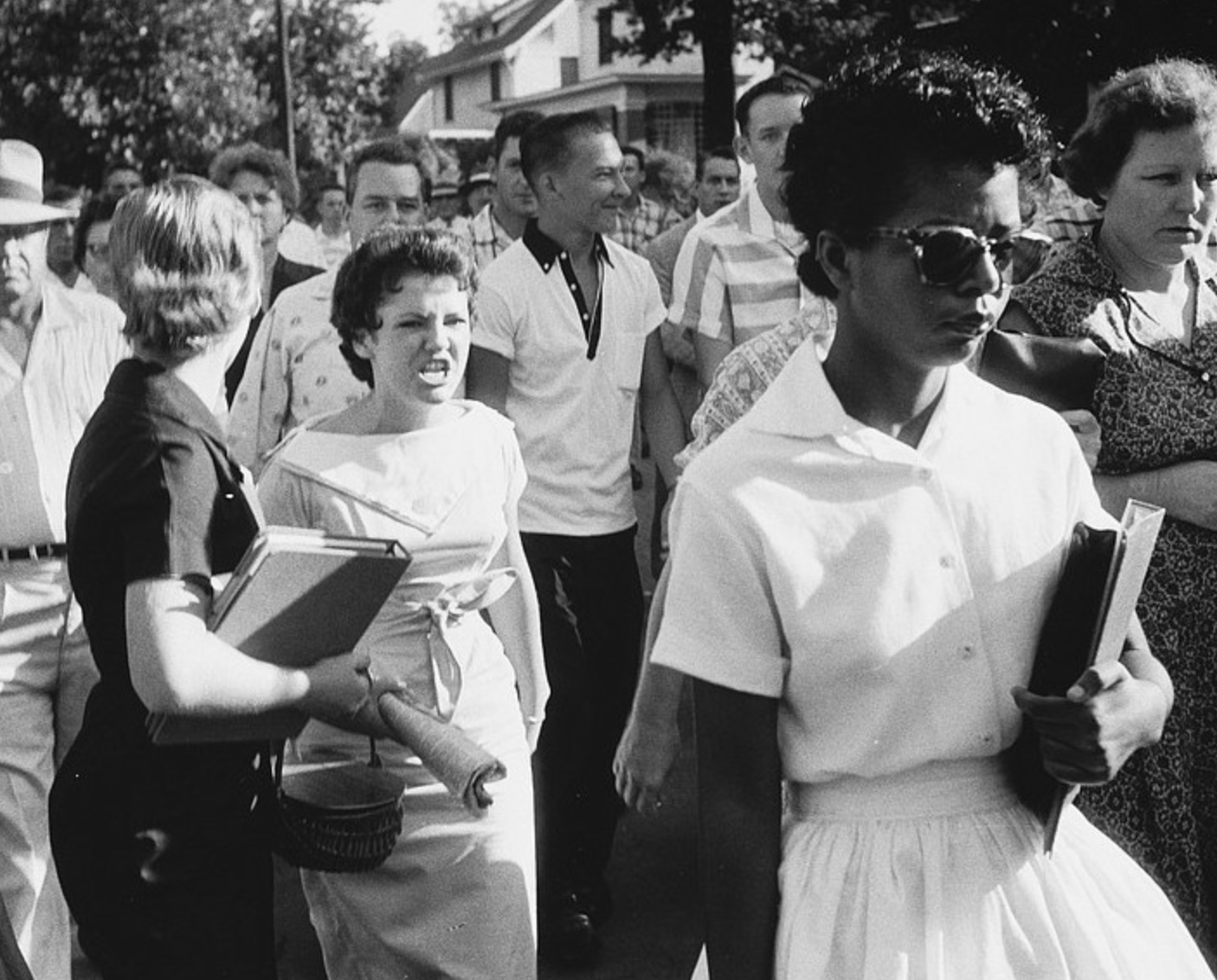
The same Post article described changes (“amendments”) to a website about the Little Rock Nine. According to the Post, the Trump administration “edited at least six pages to remove the word ‘equality.'” Elizabeth Eckford — who, along with her tormenter, Hazel Bryan, was immortalized in Will Counts’ iconic 1957 photograph — was direct. “They’re trying to rewrite history,” she told the Post.
Nine days before Trump issued his executive order, a Defense Department webpage documenting the military service of Jackie Robinson disappeared. The Pentagon quickly restored it, claiming the removal was an accident, but as ESPN noted, “the URL had redirected to one that added the letters ‘dei’ in front of ‘sports-heroes.'” In other words: Maybe Trump’s Pentagon didn’t mean to erase Jackie specifically, but it wasn’t an accident.
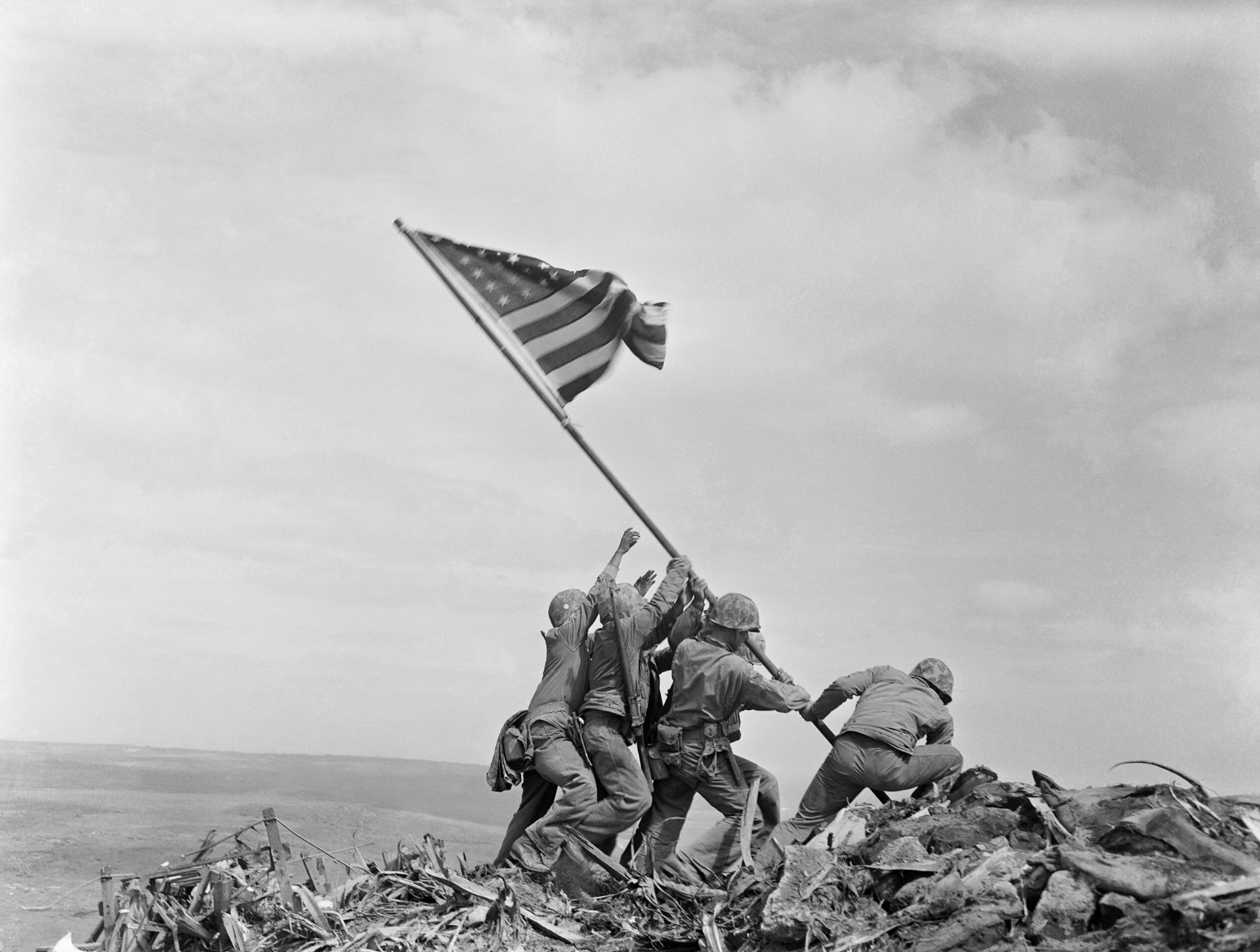
Also caught up in the Pentagon’s digital sweep: Pages dedicated to The Navajo Code Talkers, the Tuskegee Airmen and one of the six Marines who raised the flag on Mount Suribachi.
After initially celebrating the death of DEI at the Pentagon, a sheepish John Ullyot, Pete Hegseth’s press secretary at the time, said, “Everyone at the Defense Department loves Jackie Robinson, as well as the Navajo Code Talkers, the Tuskegee airmen, the Marines at Iwo Jima and so many others.” It’d be funny if it weren’t so blatantly scandalous. (Ullyot quit a month later and promptly wrote a scathing Op-Ed about Hegseth for Politico.)
“If you take away pictures of women, if you take away pictures of Black heroes, of Asians, of Native Americans, of Latinos, then who’s left?” wondered Don Moynihan, a professor of public policy at The University Of Michigan. He was speaking to NPR’s All Things Considered for an episode about the webpage removals. His question was rhetorical. The Trump administration, scholars who spoke to NPR said, “is trying to erase America’s non-white history.” A little over a month after that episode aired, Trump moved to cut NPR’s funding.
Perhaps the most brazen action undertaken in pursuit of the effort to scrub “improper ideology” from the national discourse was Trump’s February decision to fire the Kennedy Center’s board of trustees and install himself as chairman. Trump justified the move by reference to his personal vision “for a golden age in arts and culture,” which can apparently only be realized if he’s in charge of programming.
The new board’s comprised almost entirely of loyalists and sycophants including Pam Bondi, Susie Wiles, Fox’s Maria Bartiromo and Laura Ingraham and, naturally, Lee Greenwood. At a dinner for the new board this month, Trump said he had to commandeer America’s preeminent cultural institutional because its programming “was out of control with rampant political propaganda, DEI and inappropriate shows.”
‘Unparalleled legacy’
In his “Restoring Truth” order, Trump decried a revisionist conspiracy to substitute a “reconstructed” narrative of America “as inherently racist, sexist, oppressive [and] irredeemably flawed” for the country’s “unparalleled legacy of advancing liberty, individual rights and human happiness.” That legacy, he intimated, is the true story of America.
But what if the “reconstructed” narrative’s accurate, or at least more accurate than any tale of singular virtue and greatness? What if, in attempting to spin the sordid chapters as somehow glorious and contributive to the more perfect union the country is today — as opposed to recognizing them as the blight they are — America’s impeding its forward progress? And what if the story of America’s no more (or less) extraordinary than any other national story?
That latter question might sound absurd, and I suppose it is depending on your definition of “extraordinary.” But remember: America’s is a very, very short story. Indeed, the most extraordinary thing about America might well be how textured the nation’s history is given the compressed temporal window. On any other definition of extraordinary you’d have a difficult time making the case. Is America’s story more extraordinary than Britain’s? Or Russia’s? Or China’s? Or Germany’s? Or France’s? Or Egypt’s? Or Iraq’s? Or Syria’s? I doubt it.
Although I generally agree that the self-loathing inherent in some of the more extreme versions of the DEI push is counterproductive, the opposite extreme — glorifying Confederate generals, trafficking in euphemisms for slavery, ascribing de facto sainthood to the Founders, and all the rest — ignores the lived experience of African Americans, Native Americans, women and everyone else for whom the whitewashed version of the American story is indistinguishable from fiction.
Trump got it right when he said efforts to “rewrite history deepen societal divides.” Normally, irony’s lost on him, but I suspect he understands it all too well in this context. Like most demagogues, Trump’s political fortunes wax and wane with societal division. And, as The New Yorker’s Remnick put it, Trump’s determination to enforce “a mystical view of an imagined past is the reflexive obsession of autocrats everywhere.”


I was almost pleasantly surprised to see that ~90% of reptilicans found it at least somewhat important to publicly discuss the historical failures of the US.
But then I thought that would consist of a couple of tweets (Xcrements?) the last of which would pin the blame on Democrats and then back to business as usual.
The past 8 plus years have been terrible for the “American story”. Primarily, I blame Congress for passing on its duties to the American people, and therefore, putting both Trump and Biden in a position to function “autocratic”. Terrible for our country, our citizens, our currency and the world. Thankfully, as voters, we have another opportunity in 3.5 years to do the right thing. Ultimately, the voters are to blame. But that requires education of the voters and promoting the type of candidates that we actually want as leaders. Currently, there is a massive void in the type of leadership that we need for our country – both in the Democratic and the Republican parties. This creates a situation where people just get greedy and only think of themselves.
Well done, thank you.
Peter
American society’s march towards its aspirational ethos could be characterized as two steps forward and one step back with an occasional hiccup (Civil War, Vietnam). Trump 1.0 was more clownish than deconstructive. Trump 2.0 is a serious return to tribalism. For a nation built on immigration this is too ironic to bear. Some pigs are more equal than others.
The new National Story for MAGA is that “our” nation is under attack, and we must fight the “enemy” to preserve it, where “our” doesn’t include recent immigrants and “enemy” includes anyone arguing otherwise. It has nothing to do with rights, or with anything “for all”. This story is their “imaginary thing they can believe in”. And it has proven a powerful story.
Very nice. Beautifully developed. America’s hypocrisy has been part of its fabric since the nation was born. Reread Hawthorne, Cotton Mather, and his fellows. Note fellows. We wouldn’t even let white women vote nationally until 1920. Others such as Asian Americans, Native Americans, most Black Americans and others did not have full voting rights until 1975. Some citizens still don’t. The Equal Rights Amendment while passed by Congress and approved by a sufficient number of states, not all, however, has to pass one more hurdle, a final Congressional approval so it still fails to be included in the Constitution. This means that most of our citizens, especially including women, contrary to various political myths, do not all have equal rights as citizens in our fair land.
Initially only 6% qualified to vote which is what the famous Founding Fathers intended. It wasn’t until 1856 that all white men could vote without property or religious exclusion. Everybody else? Well, it took about another 100 plus years and access to voting is still a vexing problem.
Nice work, thank you! From personal introspection to who we are as a country, I enjoyed the journey and once again learned a lot!