

[Editor’s note: In light of the historic significance of the events which unfolded in Beirut on September 27, 2024, I’ve published an ad hoc Letter in lieu of September’s previously-planned Monthly]
Hassan Nasrallah’s dead.
Hezbollah dug his lifeless body from the rubble in Dahiya on Saturday. The group’s announcement came around 18 hours after the IDF dropped six-dozen bombs on a neighborhood in the Beirut suburb, where Nasrallah was gathered with the group’s senior officials in an underground bunker that doubled as Hezbollah’s headquarters, according to the Israeli military.
Nasrallah’s death marks the most significant escalation in tensions with Iran since Donald Trump ordered the assassination of Quds commander Qassem Soleimani in January of 2020. For decades, Soleimani, Nasrallah and Iran’s Supreme Leader, Ali Khamenei, presented themselves as a kind of triarchy comprising the highest echelon of Iran’s sprawling “Axis of Resistance,” a confederation dedicated to, among other things, the destruction of the Israeli state-building project.
Soleimani was the architect and the “executor” — as the US Department of Justice once put it — of the highly effective, well-integrated militia network that spanned the Shiite Crescent a term which, by the time of his death, was almost synonymous with the general. Nasrallah ran the most powerful of those militia for 32 years following the assassination of his predecessor, Abbas al-Musawi, who was gunned down with his wife and young child by Israeli attack helicopters in 1992.
In April, following an Israeli strike on Iran’s diplomatic compound in Damascus, I wrote that Soleimani’s network was being systematically dismantled by the US and Israel. That day, IDF warplanes eliminated Mohamad Reza Zahedi, a uniformed IRGC officer twice-appointed by Soleimani to run the Quds’ operations in Lebanon, a role which included heavy involvement in the joint Iran-Hezbollah-Russia effort to restore the Bashar al-Assad regime during Syria’s decade-long civil war. Zahedi’s assassination, you’ll recall, prompted Iran’s first-ever direct attack on Israel, a largely ineffectual missile and drone barrage designed more to appease a nervous domestic audience in Iran than to inflict any real damage.
By then, the IRGC, Hezbollah, the Iraqi IRI (a PMF fork comprised entirely of Quds-loyal militia, including Kataib Hezbollah, whose legendary founder Mahdi al-Muhandis was incinerated in the same Baghdad strike that killed Soleimani) and Hamas’s leadership outside of Gaza, had suffered at least half a dozen high-profile casualties in the space of just three months. Among the dead: Arms trafficker Seyed Razi Mousavi; Hamas’s de facto envoy to Hezbollah Saleh al-Arouri; Al-Nujaba commander Mushtaq Taleb al-Saidi; Quds operative Sadegh Omidzade and Abu Bakr Al-Saadi, a Kataib Hezbollah underboss with links to the attack on a remote American base in Jordan that killed three US service members in January.
At the time, I wrote that “Iran’s capacity to strike via its proxies is diminished with each assassination, and those assassinations apparently know no bounds.” I went further. “Esmail Qaani’s a dead man walking,” I said, on April 2, referring to Soleimani’s successor, who’s proven almost entirely useless even with allowances for the size of the shoes he was tasked with filling. I went on: “In my view, it’s just a matter of time before Israel goes after Hassan Nasrallah.” As it turns out, Mossad was already after him.
Time and again this year I assessed that Israel knew where Nasrallah was. Reporting in the hours after he was confirmed dead suggested that was indeed the case. Senior Israeli defense officials cited by The New York Times said Mossad was tracking Nasrallah “for months” before the IDF “decided to strike him this past week because they believed they had only a short window of opportunity before the Hezbollah leader would disappear to a different location.”
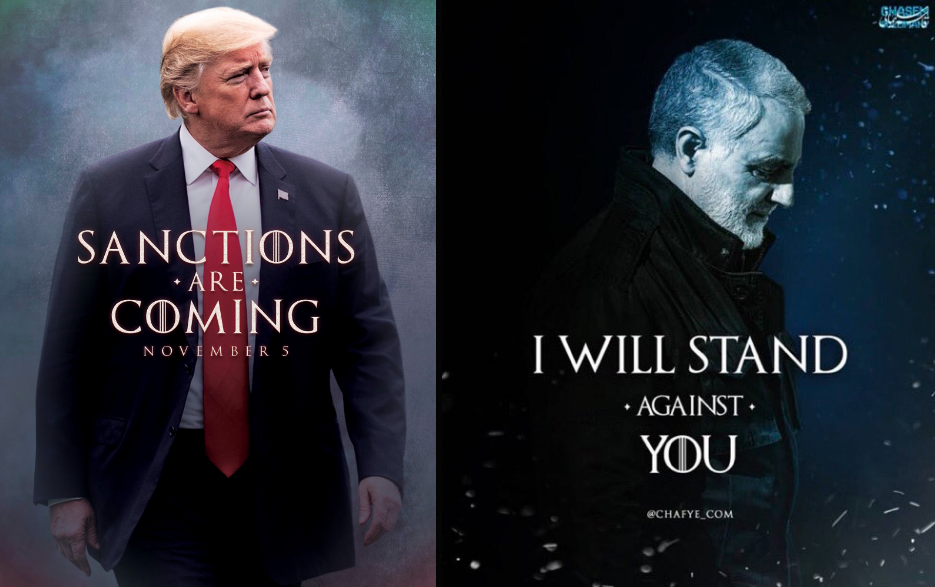
To reiterate: It isn’t surprising that Israel was tracking Nasrallah. Remember: The US and Israel tracked Soleimani for years. Mossad and Soleimani traded public taunts, some of them petulant, long before Soleimani found himself engaged in a surreal — and wholly ridiculous — meme war with Donald Trump. Soleimani delighted in being photographed and filmed on the front lines of various regional battles, including, famously, a series of selfies with Hezbollah, the above-mentioned Al-Nujaba and the Syrian government’s depleted forces just prior to the battle for Aleppo, which was then held by Sunni militants.
The aerial bombardment of Aleppo became the calling card of Russian general Sergei Surovikin. That fight — with Hezbollah and Soleimani to recapture Aleppo for Assad — is what earned Surovikin the nickname “General Armageddon.” As one expert told Radio Free Europe, “Though little acknowledged, [Surovikin’s] direct coordination with the Quds [and Hezbollah] unquestionably contributed to the strategic relationship the world now sees between Iran and Russia.” (In October of 2022, Vladimir Putin put Surovikin in charge of Russia’s war in Ukraine with a mandate to run the Aleppo playbook. He was relieved of his command just a few months later and eventually found himself implicated, rightly or wrongly, in Yevgeny Prigozhin’s failed coup.)
Western conceptions of terrorists are almost exclusively informed by dramatized accounts of the hunt for Osama Bin Laden, the fight against ISIS and the generalized struggle to rid the world of Sunni extremist ideology which, I’d be remiss not to briefly point out, is institutionalized in the Saudi monarchy. To Westerners, a “fugitive terrorist” is a lunatic with a cane and a slung rifle trekking around the mountains. Or sermonizing in a windswept tent. Or shooting propaganda videos in a cave with a homemade flag taped to the wall. Or donning a black balaclava while reading from a list of nonsensical grievances on camera before decapitating a hostage with a Crocodile Dundee knife. And so on.
As an intelligence agency, you might genuinely not know where those terrorists are. When you do find them, you just kill them. It’s not a discussion, and nobody cares because nobody really likes those terrorists. But those terrorists aren’t these “terrorists.” These “terrorists” — Soleimani, Nasrallah and so on — don’t measure success by how many wholly unrelated office workers they can kill if they fly a plane into a tall building half a world away. Nor by how many concertgoers they can slaughter if they take a bunch of amphetamines and go on a murder spree. There’s nothing to be gained strategically from that sort of thing, and there’s a lot to lose from it which, I should note, is why it was always risky for Hezbollah to overcommit vis-à-vis Hamas. The late Ismail Haniyeh‘s political ambitions and duplicitous “diplomacy” aside, Hamas is a Sunni extremist organization. Sooner or later, it was going to act like one, and not just in the ways it has before.
To be clear, I’m not suggesting — nor would I ever suggest — that there are “good” terrorists and bad ones, and that in modernity, differentiating between the two is as simple as asking “Well, is it a Shiite group or is it a Sunni group?” That’s not true, and it’s anyway so ridiculous as to get you laughed out of the room if you were to have this discussion in educated company. But what I am suggesting is that in life, you have to choose your allies carefully. Just because you have common cause with someone doesn’t mean you want to hitch your wagons such that their mistakes, miscalculations or, in this case, barbarous atrocities, become yours.
Whatever he said publicly after October 7, 2023 (and he said a lot), I can assure you that in private, Nasrallah didn’t want Hezbollah to own everything that happened that day for any number of reasons, some of which are strategic, some of which are existential. Hezbollah’s technically a non-state actor, but functionally, Dahiya — the Beirut suburb where Nasrallah was killed on Friday — is a fiefdom that serves as the de facto capital of a state within a state. Hezbollah’s military capabilities vastly outstrip those of the Lebanese regular army, such as it is. And Hezbollah’s foreign policy is infinitely more consequential around the world than whatever Lebanon’s official state foreign policy happens to be at any given time. Nasrallah ran a sprawling political machine, a functioning bureaucracy and a vast patronage network. Hezbollah’s an extension of the Iranian state and it has nation-state-like alliances with Russia, Syria and, in a limited way, China. In the simplest terms: Nasrallah had a lot to lose.
By contrast, Yahya Sinwar had nothing to lose. Or felt he didn’t. Sinwar’s gamble on October 7 was in part born of desperation and the perception that the Palestinian issue was fading not just into the usual disinterested obscurity, but disappearing altogether as a problem that needs solving, as the allure of economic prosperity and practicality pushed Israel and “friendly” Arab nations ever closer to something like peaceful coexistence. Sinwar wanted to light a fire. And he didn’t care who the subsequent conflagration ultimately subsumed.
On some accounts, Sinwar achieved much of what he set out to accomplish. The October 7 attack thrust the Palestinian issue back to the fore internationally, shattered Israel’s sense of national security, dealt a grievous blow to the IDF’s aura of invincibility, upended Washington’s designs on normalizing ties between Israel and Arab nations and pulled Hamas’s inter-sectarian allies, including and especially Hezbollah, into a full-on, armed confrontation with their common enemy.
But Sinwar’s victories, if you can call them that, came at a terrible cost. Most obviously, nearly 50,000 are dead in Gaza. Sinwar, by his own account, was willing to sacrifice at least that many Gazans for the “cause,” and he might’ve been willing to sacrifice Hamas’s capacity to exist as anything other than a remnant too. But it’s clear now that he jeopardized Iran’s entire regional project which, in Nasrallah’s death, faces an existential crisis.
By the time Iran pauses for the fifth anniversary of Soleimani’s assassination in January, the network he spent two decades building across the Shiite Crescent will be for all intents and purposes destroyed. Sinwar’s fever dream was a suicide mission, and if past is precedent, the plight of Palestine will fall by the wayside in the global consciousness sooner or later. And anyway long before any failure of the Israeli state.
In the meantime, the fallout from Sinwar’s gambit has cost Khamenei one of his closest living compatriots. On September 25, I wondered aloud in these pages about the future for Hezbollah. The next few days, I suggested, would be crucial to the extent Israel’s next targets would indicate whether the IDF was content to wipe out the Jihad Council — Hezbollah’s military panel — or if Benjamin Netanyahu was determined to eliminate the entire leadership.
At the top of Hezbollah’s military command sat Ibrahim Aqil, Fuad Shukr and Ali Karaki. Shukr and Aqil were most famous for their role in the 1983 bombing of Marine barracks in Beirut. Four decades later, Shukr was killed not far from the site and Aqil just weeks later. If it wasn’t obvious already (and it most assuredly was), Shukr’s assassination proved Hezbollah was fatally compromised. The Israelis had infiltrated the group, or at least the group’s communications networks.
Since Israel and the US began picking off operatives, facilitators, go-betweens and commanders late last year, I suggested, over and over again, that Iran’s proxies were operating under false assumptions about the integrity of their organization, from Beirut to Damascus all the way to Tehran. The precision with which the IDF operated and, just as tellingly, the names Israel targeted in succession, were a dead (no pun intended) giveaway: Mossad was inside the network.
Consider this: Every person, without exception, targeted since December was a somebody with name recognition in intelligence circles. That’s not luck. Nasrallah either didn’t see it or didn’t want to believe it. Apparently, this came as a surprise even to ostensible experts, who only accepted it this week. The Times quoted Michael Young, a senior editor at the Carnegie Middle East Center in Beirut. “[T]hey seem to have known everything,” Young said, of the Israelis. Indeed, Mr. Young. Indeed.
In “Endgame,” published less than 48 hours before Nasrallah was killed, I said, of the last surviving Jihad Council chair, “Next up’s Ali Karaki. I guarantee it.” He too was pulled out of the rubble in Borj al-Brajneh on Saturday during the same morbid excavation that unearthed Nasrallah.
Readers might also recall what I said in the minutes after Friday’s strike about the leadership in the event Nasrallah was confirmed dead. “I assume [Hashem Safieddine] would step in to lead, probably over Naim Qassem if my guess counts,” I wrote. Although Lebanese media suggested Qassem, officially Nasrallah’s No. 2, was “elected” to lead the group, the Times, citing three separate sources, said Safieddine was set to ascend the top spot. If Naim Qassem’s alive and is in fact named Secretary General, my assessment is that the group’s trying to keep a target off Safieddine, who’s Nasrallah’s cousin and whose son is married to Zainab Soleimani (“The Daughter,” proper noun, if you will).
Hezbollah will survive, of course, but in what form? There’s virtually nothing left of the leadership, and the military command structure’s decimated. Their arsenal is, by every account, severely diminished, even as it remains unfathomably impressive for a non-state actor. It sounds as though Safieddine’s absence from Friday’s ill-fated meeting wasn’t an accident. He was the designated survivor. But he won’t be alive for long, and it’s hard to know what a post-Hezbollah politico-security reality might look like for Lebanon. Suffice to say this is a turning point for the region, and a pivotal moment for Iran, where the regime’s staring into the abyss. I’d go so far as to say that if Nasrallah’s fair game, Khamenei is too.
When Shukr was killed in July, I wrote that, “Defiant rhetoric and obstreperous threats aside, Iran can’t go on like this.” If the writing on the wall wasn’t big enough by then, it was after that night in Beirut. As The Wall Street Journal put it, of Shukr, “despite being one of the most important figures in Hezbollah’s history, he lived an almost invisible life… so secretive that Lebanese media outlets reporting on his death published photos of the wrong man.” In the article, The Journal called him “a ghost.” And yet, Mossad knew where he was. Not only that, they had his phone number. Shukr was in his office on the second floor of the building where he was killed when he “received a call from someone telling him to go to his apartment five floors up.”
On Saturday, Khamenei called Nasrallah “the standard-bearer of resistance in the region” who, courtesy of the IDF, “achieved martyrdom and has ascended to the heavens.” The message pinned to the top of Khamenei’s social media account was unchanged. “In the Name of God, the Beneficent, the Merciful,” it reads. The timestamp: January 3, 2020, the day Soleimani was killed.


Would Israel kill Khamenei?
Seems that would commit it to then going on to kill a couple levels of Iranian commanders and clerics who could succeed Khamenei, and to destroying Iran’s nuclear weapons facilities to include its reactors and enrichment hardware. IDF aircraft would have to overfly a hostile country or two and a lot of air defense radars, harder than a quick sortie over the Lebanese border, and while IDF can certainly defeat Iran’s air defenses and destroy any target in Iran, alerted people can move and hide even if nuclear reactors cannot. Has Mossad penetrated Iran’s security apparatus as it has Hezbollah’s? I suppose more up close methods are possible, but how many times.
My guess is that Khamenei is right to be in hiding now but will probably not go from there directly to Heaven; he likely has a fork in the road, as in he and Iran can do some things and not do others that will stay Israel’s hand. Or he can choose Heaven, I guess.
But really, are these not all piffles next to the real question of the day? Oil and oil stocks – is there anything to which they will respond, fer chrissakes?
FWIW (and, apparently, my knowledge of the region is limited), if I was Israel, I would NOT go after Khamenei. Apart from the practical difficulties, countries really lose their shit when you go after heads of state. Not fair but these are the rules.
If not for, Donnie, the other wars and repeated nuclear retaliation threats coming from Russia, the Isreali actions would likely propel the conflict to front page news propelling fear trades. Now all we see is a relatively muted move in gold. I think people are numb from the horror shows. However I am not a sufficient student of history to see a parallel. I would read eagerly if someone were to pen a rhyming comparison.
Personally I have engaged in selling hope in these dark times. The primary narrative is about how both our regulatory structures are creating wealth and the coming boom in chemicals we will see over the decades due to our advances in electro chemistry. I also tell people about my 3 cents per mile operating costs in town with an EV and the 420 mile range it shows after charging.
There is much to be optimistic for. I attend classes at college and therefore am part of several first and second year student’s lives. I see the crop as eager to learn and excel at a level higher than we ever achieved. Yes they will make us proud. Even if some have traded cowboy boots (high heels for men) for hormone therapy.
Hats off to you, sir.
H, do you care to comment on the possible future direction of Lebanon as a state? What does the weakening of Hezbollah mean for the people of Lebanon, and the future of the country?
Nice to be reminded of how little I know, humbling as usual. In British media you don’t get a tiny fraction of this article so thank you very much for this.
Ali Khamenei’s days as Supreme Leader of Iran are numbered regardless of whether Israel decides to attempt to take him out or not- because even if the Israeli’s don’t get him, he won’t live forever (and be cognitively capable).
He is 85 years old and has been Supreme Leader for over 35 years. Transition of leadership in authoritarian, oppressive countries never seems to go smoothly.
The Shah’s son (Reza Pahlavi) is still alive and living in Virginia. Maybe he is available! I am guessing that all the descendants of those women who protested against The Shah are rethinking their support of The Supreme Leader- not that their voice counts.
This is a terrific article
Thank you for sharing this with the rabble!
It’s amazing to me that so many American right-wingers appear to support Putin and MBS. Both of whom are supporters of state terrorism. Just the other day I saw in passing Tucker Carlson praising MBS as the greatest of world leaders. It’s astonishing to me. Then again a lot Trump’s fans also praise Pinochet.
It’s a miracle of modern propaganda that the likes of Putin, Orban, Assad and ISIS have captured the hearts of the far-right all the while ignoring the conflict of interests with ‘freedom.’
Freedom from a liberal order these people all despise, for various reasons.
I think a fair few MAGA fans would be okay with a fascistic government if it allowed them to resuscitate a Jim Crow like environment targeting Blacks, Hispanics and LGBTQ+ people… What’s freedom worth when you’re given the right to beat the living crap out of minorities? And, for the better socialised, delicate MAGAs, legally discriminate and oppress them. Lynching are a bit like NASCAR, low class coded.
I do not think the rank and file MAGAT’s despise liberal ideas. I think they have been encultured to resist change and to romanticize about a mind’s eye past that never was. Also there is a bit of the bad boy mystique (maybe caused by lead poisoning) that propels the emotional roller coaster.
The leaded gasoline poisoned brains are aging out and dying off. I see a near universal rejection of MAGAT norms in younger college going types. Steve Bannon is not reaching the demographics he needs for sustaining the revolution he pines for. No I think the overweight 70 year old loudmouths are losing the battle before it even starts. A revolution cannot be made with has beens pining for a past that never was.
In the last 4 years we have done a lot of good by following our values. Much as been made of the war weapons sent to Ukraine, however much more money has been spent supporting these people with the necessities of life. We have given to the oppressed and in a very small way contributed to a redeeming of America in the eyes of our allies and enemies. A case can be made is that redeeming America is the one outcome of the Ukraine war that most threatens Valady and his cohorts. Netenyahu and Taiwan have played a masterful game of involving us in their conflicts. We need to be continuously aware that not all of our allies are our friends.
They killed Nabil Qaouk this morning. Right now, they’re bombing Hodeidah. If Abdul Malik al-Houthi’s not in a bunker, he should get to one.
Some day someone will write a book about Israeli infilitration of Hezbollah and Iran’s leadership ranks. It will be a best-seller.
Has Israel struck the Houthis before?
Never mind – I see. So many strikes, hard to remember who fired what.
Yeah, this is the second bombing run. I don’t think the Houthis understand what they’re dealing with here. They’re used to i) that Saudi-led coalition which, while brutal and certainly not opposed to causing civilian casualties, just wasn’t all that effective strategically in six years of trying, and ii) US / UK strikes designed to avoid killing people. This is real simple: If they keep lobbing missiles and drones towards Tel Aviv, Israel’s going to fly down there and kill everybody in Sanaa. I’m exaggerating, obviously, but you get the idea. They’re going to discover that the IDF’s a different animal altogether.
Did you see what the IDF said today? They said, to the Houthis: “This isn’t a message. This is action that sends a message.” These proxies need to wave the white flag, because it ain’t gonna workin’ out. That’s just the reality of it at this point. I didn’t think the IDF was going to go all-in, but they plainly have and the simple fact is that now, all of these glorified militia are facing a full-on war with an extremely aggravated, technologically-advanced modern military that by appearances has a green light from its government to kill anybody who even breathes wrong or frowns in Israel’s general direction.
I don’t want to get into too much of an argument with you being the host but, last week, you were saying I was dumb for suggesting such things as Iran ‘abandoning its proxies’ etc.
I mean, you write 100x better than I can but, one week later, aren’t we saying the same thing?
“I don’t want to get into too much of an argument with you being the host.”
Good idea.
Hahahaha.
Well, your house, your rules.
You’re a smart guy Fred, the issue (and you’re not alone in this, there are several other folks who fall into the same category) is that when there’s a debate worth having at length, the readership’s better served if I just write another whole article (like this one) than if I get into a lengthy exchange in the comment section. I don’t agree with your takeaway from this article vis-a-vis your comment from last week, but I see where your reasoning comes from. The issue, in my view, is that you’re not fully apprised of the extent to which Hezbollah’s an extension of the Iranian state. “Proxy” is a misnomer. Iran can’t defend Hezbollah here (how would that work?) but they can’t disavow it anymore than you can disavow your own knee or your own ear. They’re synonymous. The pickle is that historically, Hezbollah fights a low-level “war” with Israel on behalf of Iran, whereas now, Iran’s effectively in a position where if they want to preserve Hezbollah in anything like its current form, they’d have to fight an actual, state-on-state war with Israel, which they probably wouldn’t do even if they had the wherewithal, and they clearly don’t. In short: This wasn’t supposed to happen. Like Soleimani’s assassination, this wasn’t in the set of eventualities that the regime had planned for or even pondered. Sure, these people (Nasrallah, Soleimani and so on) were all going to be assassinated eventually, but the idea that the US and Israel would simply blow them up in full view of the international community and say, “Look. We did that.” wasn’t on the cards. Or at least Iran didn’t think it was. And that’s to say nothing of this full-on blitz in Lebanon which is different in character even than 2006. If the question is “Ok, well wtf are they going to do now?” The answer is “I have no idea.” And they don’t either. [Insert Bill Paxton “game over” rant from Aliens]
Thanks. Maybe it’s selfish but I really appreciate that answer as it clarifies where our differences of opinion might be. I understand I am but one commentator/subscriber but, if you have the time to comment at all, it’s really worthwhile to me.
And, FWIW, like many other readers have expressed, I really do appreciate these more in-depth articles. They add a lot.
It appears obvious that Israel had pre-planned all of these attacks – so that in the event that Israel determined that they wanted to execute the attacks, they would be ready to actually execute the mission.
It makes me wonder what other missions/attacks that they have pre-planned, but have not yet executed.
“No half-measures.” -Mike E.
Thanks for this excellent commentary.