

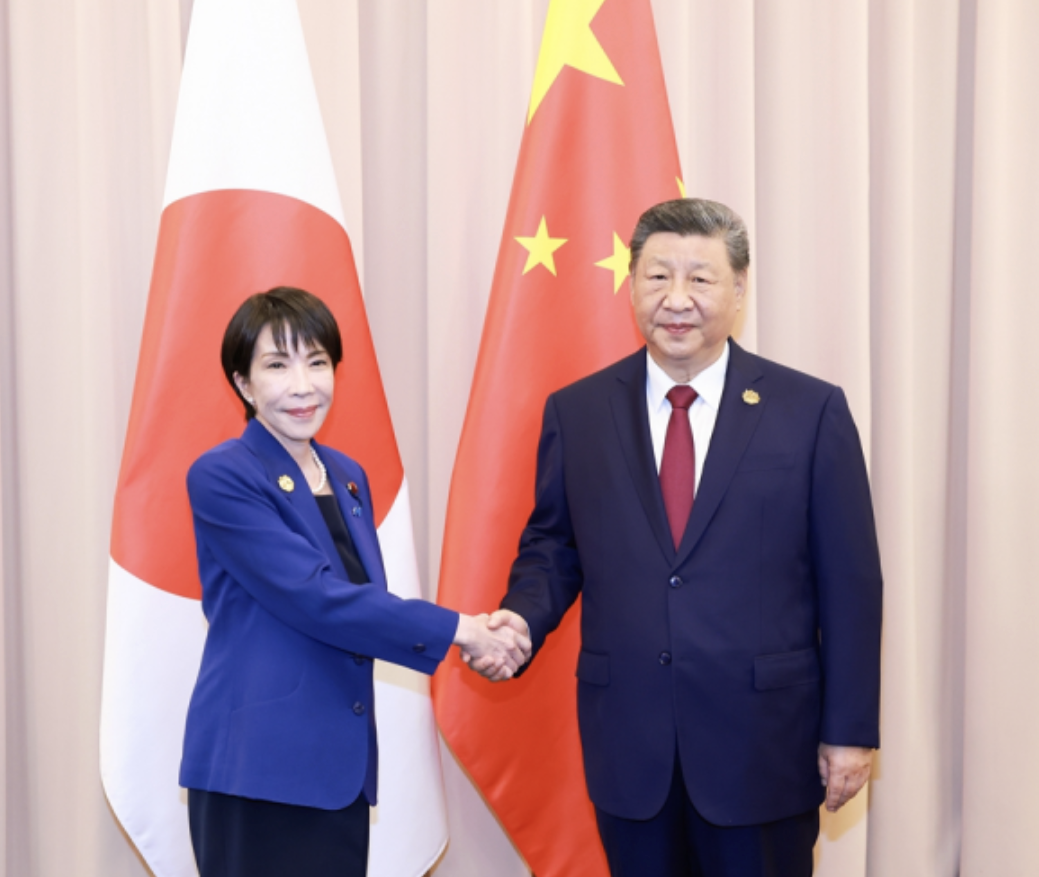
One thing was clear enough when Sanae Takaichi held “direct and candid talks” with Xi Jinping shortly after becoming Japan’s first female prime minister last month: The Sino-Japanese bilateral relationship will remain frosty on warm days.
Perfunctory pleasantries aside, official readouts from the meeting — which took place on the sidelines of the APEC summit in South Korea — were stilted and cautious, not unlike the two leaders’ body language while shaking hands.
In one particularly pointed passage from China’s version of the chat, Xi’s foreign ministry exhorted Japan to adhere “strictly” to the tenets of mutual cooperation as expounded in a series of preexisting documents setting out guidelines for the treatment of “major issues of principle.” Among those issues: “The Taiwan question” and, of course, “Japan’s history of aggression.” (As a younger woman, Takaichi suggested scrapping a national apology for World War II in the interest of protecting Japan’s honor.)
Takaichi’s a foreign policy hawk who’s made no secret of her sympathies for Taipei’s plight. She’s also a regular at Tokyo’s Yasukuni Shrine which honors Japan’s war dead including a handful of convicted class-A war criminals.
This year, Takaichi skipped a visit to the shrine both in recognition of her imminent ascendance to the premiership (no Japanese prime minister has visited the site in person since Takaichi’s late mentor, Shinzo Abe, in December of 2013) and as a show of good faith to Xi. In lieu of her presence, Takaichi sent an offering (a donation), a gesture that’s customary if still irksome to the victims of Japan’s military adventurism.
Suffice to say Beijing harbors deep reservations about Takaichi, and the feeling’s mutual for a laundry list of what I assume are obvious reasons, almost all of which can be summarized as follows: China’s a superpower now, and as Xi reminded Takaichi late last month, “China and Japan are separated by only a strip of water.” (On the off chance Takaichi needed a refresher on grade school geography.)
Fast forward to November 7 and, during a parliamentary hearing, an opposition lawmaker asked Takaichi to spell out what would qualify, in the context of Taiwan, as a “survival-threatening situation” for Japan. The question was a reference to an exception that allows Japan to break its own rules regarding military projection in the presence of an existential threat.
Takaichi responded about like you’d expect. “If there are battleships and the use of force, no matter how you think about it, it could constitute a survival-threatening situation,” she said, referring to a hypothetical PLA operation to seize Taiwan by force.
Beijing wasn’t amused and pretended to be aggrieved. I say “pretended” because exactly no one who knows anything about Takaichi would’ve expected a substantively different answer to the question, as posed.
It seems clear enough to this observer that China’s over-the-top reaction is an exercise in establishing guardrails early on in Takaichi’s premiership just in case she ends up replicating the political longevity of her legendary mentor.
Experts — some of them, anyway — were quick to suggest Takaichi’s remarks somehow represent a sea change. That Japan’s no longer a bystander. That Tokyo would put itself between the PLA and Taipei at the first sign of trouble. I think that’s overstated, perhaps wildly so, and I think it plays into Chinese propaganda.
Consider that the conditions under which Japan might feel compelled to undertake military maneuvers in self-defense would also be the conditions under which the US military would intervene. Japan wouldn’t be the PLA’s biggest concern in the event cross-Strait friction spirals into open war, and it’s not exactly as if Japan could somehow stay neutral in such a conflict: They host a major US air base.
Anyway, Party mouthpieces in Beijing are now threatening severe repercussions against Japan in connection with Takaichi’s November 7 comments, including the suspension of diplomatic and economic ties. Right on cue, a PLA propaganda broadsheet threatened to make Japan “a battlefield,” an absurdist remark which should be treated as such.
The fiery rhetoric comes on the heels of travel advisories which, if sustained, pose a serious threat to Japan’s tourism industry, and it goes without saying that any sort of trade ban, even if fleeting, would come at significant cost to the Japanese economy.
And, so, Takaichi has her first diplomatic crisis less than a month into her premiership. My guess: This’ll be resolved sooner rather than later because, again, it’s just an attempt by Beijing to reiterate red lines at the dawn of what could be a long tenure for a hawkish Japanese PM.
Earlier this month, Xue Jian, Xi’s consul general in Osaka, said of Takaichi, “the dirty neck that sticks itself out must be cut off.” In response, a Japanese official suggested something might’ve been lost in translation, but described Xue’s comment as “highly inappropriate” all the same.


Huh? There is nothing wrong with an educated, politically strong Japanese leader that happens to be a woman.
After all the years that Xi has been in leadership, I would think he would know how to handle this. But it sounds like President Xi may not know how to navigate the idea of working with a female partner that has leadership in Japan and an exposure to western culture.
I’m sure Xi will just smile, laugh it off, and try to get along. Don’t you think?