

The eurozone economy is in a recession. Or something that looks a lot like a recession.
Flash PMIs released on Tuesday painted a bleak picture ahead of this week’s ECB meeting, where Christine Lagarde will almost surely keep rates on hold, marking the unofficial end to a frantic tightening campaign that brought the policy rate from negative territory to 4% in the short space of 14 months.
S&P Global’s composite PMI for the bloc printed just 46.5 for October, a 35-month low.

If this month’s preliminary reading holds up, it’ll mark the fifth decline in six months. If you don’t count the pandemic months, private sector output dropped at the steepest rate in over a decade, the release noted.
The decline in new orders accelerated, indicative of waning demand on both the goods and services sides of the economy. Firms cut jobs for the first time since lockdowns in early 2021.
Both the manufacturing and services PMIs deteriorated further into contraction territory. The services gauge, at 47.8, sits at a 32-month nadir.

“In the Eurozone, things are moving from bad to worse,” Cyrus de la Rubia, Chief Economist at Hamburg Commercial Bank which partners with S&P Global on the releases, said. “Manufacturing has been in a slump for 16 months, services for three, and both PMI headline indices just took another hit. In addition, all subindices point very consistently downwards too, with only a few exceptions.”
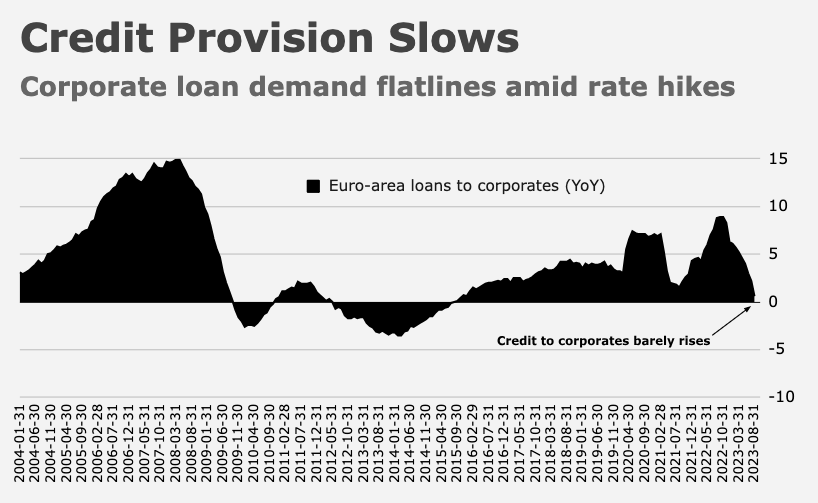
That’s pretty unequivocal: Q4 is off to a rough start in Europe. Recall that the latest ECB forecasts suggested rising stagflation risks. Corporate loan demand was the weakest since 2014 over the summer.
The country-level PMIs were (obviously) poor. Germany’s composite gauge printed 45.8 in the flash read for this month. The world’s fourth-largest economy is struggling mightily with a manufacturing malaise. In a testament to that, this month’s preliminary read on Germany’s manufacturing gauge, 40.7, counted as a five-month high. When 40.7 is a five-month high on a PMI were 50 is the demarcation line, you’ve got problems.
De la Rubia described “glimmers of hope” in German manufacturing where “some bottoming out” may be happening. “Manufacturing might return to growth territory in the early part of next year,” he ventured.
In France, all the PMIs were likewise in contraction territory and the manufacturing gauge hit a 41-month low. The French services sector “is hitting roadblocks,” Norman Liebke, another economist at Hamburg Commercial Bank, said. “Even though business activity signaled a softer decline, new orders both overall and from abroad reduced further, employment growth continued to slow [and] lower demand led to a faster reduction in backlogs of work.”
As for inflation, the releases were littered with the usual cautionary remarks. Wage pressures are evident and “sustained,” input prices are stubborn and higher oil is unwelcome. “There has been only a slight slowing down of inflation in both input prices and prices charged,” de la Rubia went on. “For the ECB, these figures reinforce the case of a pause in the interest rate cycle instead of thinking aloud about loosening monetary policy.”


How much consideration does the Fed give to the fact that Europe and China are both looking at considerable problems. It seems particularly important for large US corporations that have significant European sales.
Not much, I think. There isn’t much (anything?) the Fed can do about Europe and China’s problems. Neither Europe, nor China, nor large US corporations’ European sales, are the Fed’s mandate.
I was thinking in terms of US corporations ability to maintain growth and margins when the number 2 and 3 largest economies are slowing.