

Meanwhile, in US rates.
Lost in wall-to-wall coverage of the Jensen Huang drama Thursday was a continuation of Tuesday’s hawkish repricing at the front-end of the US Treasury curve.
As discussed at some length here, it does indeed appear that the midterm results emboldened Fed officials to lean into the inflation fight. And not a moment too soon, I might add.
The Fed board would dispute this, but I think it’s entirely fair to say Donald Trump succeeded this term in instilling a measure of fear on the FOMC, even as Jerome Powell and Lisa Cook refused to bend the proverbial knee.
The very fact that Powell won an award for courage in connection with his demonstrated willingness to risk criminal prosecution to protect Fed independence speaks to the credibility of the threat.
The blue tsunami might’ve constituted — here comes a bad joke — a kind of “Liberation Day” for the besieged Committee. Since Democrats routed the GOP earlier this month, Fed officials are speaking more freely, which in this case means more can candidly about inflation realities.
To the extent there were any doves left, this week’s core CPI overshoot very likely converted them to hawks, and that’s showing up in rates. Twos were cheaper Thursday by nearly 15bps on top of Tuesday’s 17bps increase. (Wednesday was a bond market holiday.)

Measuring from the Monday close to the intraday high on Thursday, two-year yields were nearly 32bps higher. That’s a roughly four-and-a-half-sigma move using rolling two-session changes since January of 2008.
Mary Daly joined the hawkish pile-on Thursday. “My bias is that further tightening will be needed,” she said, speaking at an event in California. “You just see this consistent pressure on inflation that isn’t simply in the sectors that are most directly affected by tariffs or oil.”
Indeed you do. “See this consistent pressure” in underlying inflation, I mean.
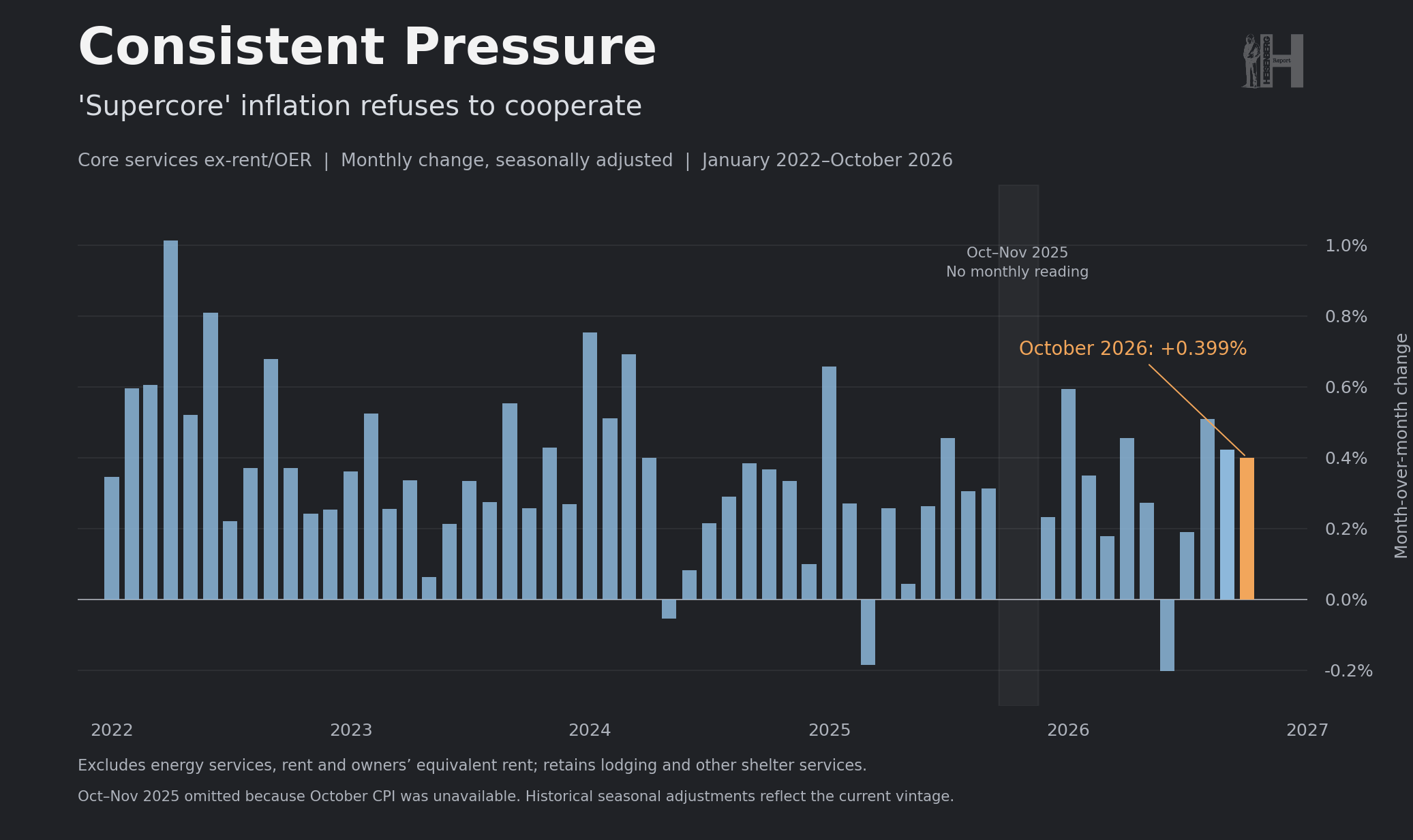
The figure above shows you the CPI-derived “supercore” measure the Fed watches for evidence of progress — or in this case, a lack thereof — on restoring price growth to tolerable levels.
Part of the problem Thursday was Trump. “We don’t need a deal with Iran,” he declared, in a totally unnecessary TruthSocial post. “We’ve got their money and we’ve got their Strait!”
(I’m not gonna pretend I didn’t laugh. And much as a lot of you folks despise him, don’t pretend you didn’t laugh too.)
Rate-hike odds escalated further, with nearly 29bps of tightening priced for the December FOMC. So, one hike fully priced and ~16% odds of a 50bps move.

The odds of a follow-up hike at the January FOMC rose all the way to 73%, up from ~24% earlier this week. That’s a helluva escalation. The twos-EFFR spread is now nearly 100bps.
Further out the curve, 10s aren’t just “back with a five-handle,” they’re 5.11%, the highest since October 21. And the long-end ETF’s on track to snap a five-week win streak with its third-worst week of 2026.
Now then: Who’s excited for PPI on Friday?!


I think if they offered Trump a late night tv slot, he’d happily quit his present job and let JD deal with the mess.
I heard a reference (on the radio) to an optimistic assertion that there is no need to worry about funding the continued datacenter buildout because “at the right price, there will be plentiful sources of capital.” Will those plentiful sources of funding be raised from corporate bond issuances? Just what Secretary Bessent needs.
Also, the 10-year minus 2-year has declined to just about 25 basis-points above inversion.