

On November 11, while editorializing around Jensen Huang’s dramatic personal and professional denouement, I suggested the ambiguity his Icarus moment introduces into the AI ecosystem is far more concerning than the (admittedly myriad) Nvidia-specific questions his ouster raises.
Huang’s forced exit, I wrote, “casts a measure of doubt on the web of deals at the center of the global AI buildout.”
“A measure” was me being polite. In the very next sentence, I dropped the pretense to civility, writing that “Nvidia’s inked so many vendor-finance-style arrangements around the world that keeping track of them long since became an exercise in futility.”
With Huang’s official exit, those arrangements are likely to get fresh scrutiny as market participants grapple with the daunting prospect of tighter underwriting standards at what some jokingly call “The Bank of Nvidia.”
“In addition to losing Jensen’s skill, drive, connections, celebrity and political influence with Trump, the AI industry has lost Nvidia as a source of liquidity,” one reader remarked on Thursday. “I don’t know what [share] of industry liquidity is represented by Nvidia’s deep pockets,” the same reader went on, “but [it] also provided access to chips and a stamp of approval to its deals, which no one else can/will.”
Getting one’s mind around this requires establishing a definition of “liquidity,” which isn’t straightforward in any context, let alone this one. But a quick-pass tally based on public filings reflects nearly $190 billion of equity commitments, customer backstops, third-party leases and guarantees.
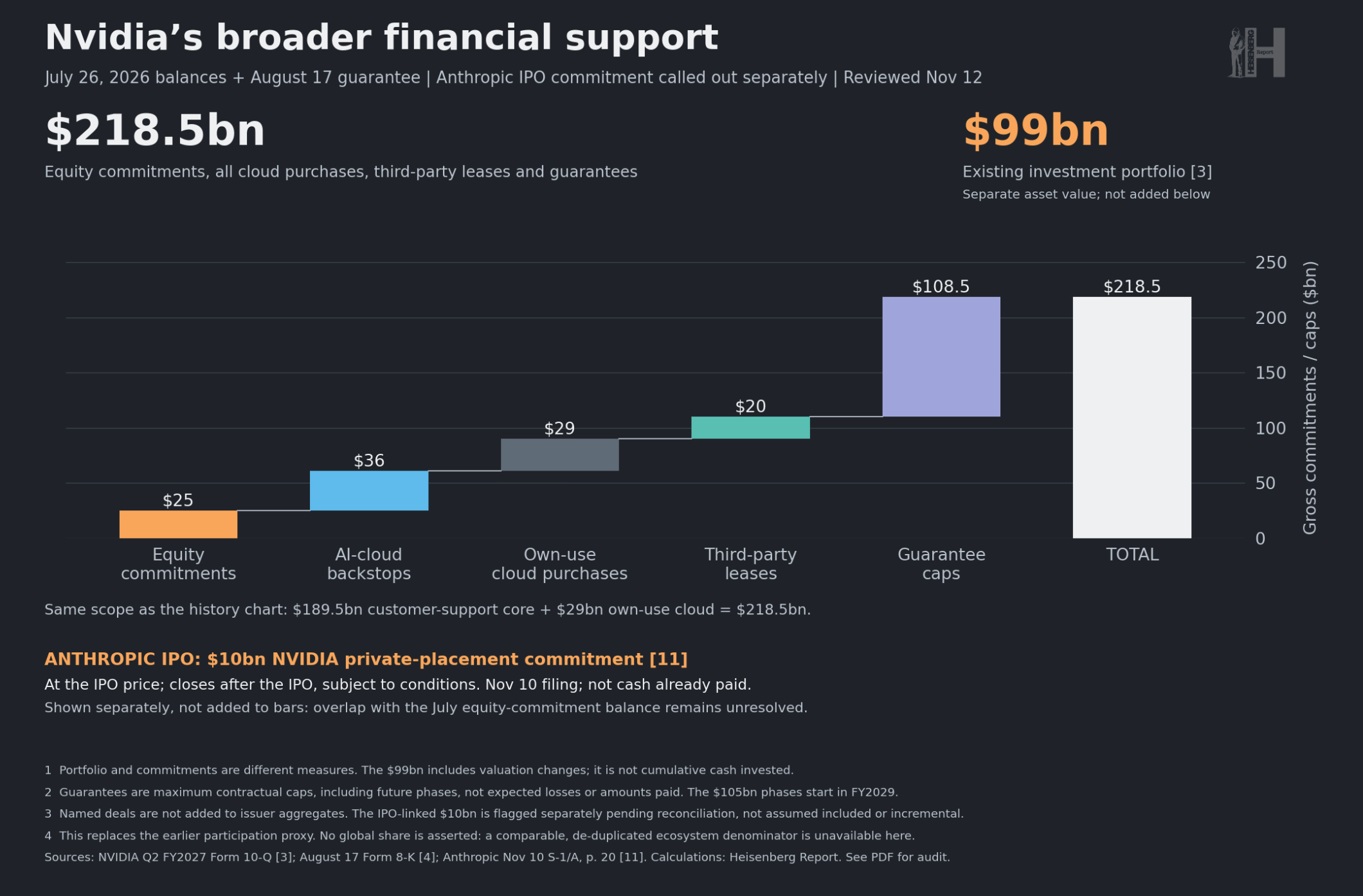
The figure above shows you the breakdown. When you add cloud purchases for the company’s own R&D, you’re up to nearly $220 billion.
Two things to note. First, Nvidia has a $99 billion investment portfolio too. Hold that thought. I’ll come back to it.
Second, and relatedly, Nvidia committed $10 billion to the private placement portion of Anthropic’s upcoming IPO. Other participants — e.g., AMD and Alphabet — could take up the slack should this week’s drama somehow impact Nvidia’s commitment, but that’s not the point. Rather, the fact that Nvidia’s planned $10 billion investment amounted to 38% of the total private placement speaks to the company’s Sasquatch-sized footprint in all things AI.

The figure above gives you a sense of how Nvidia’s “liquidity provision” — or whatever you want to call it — has evolved.
We’ve gone from a disclosed $42 billion or so in January to $218.5 billion including Nvidia’s guarantee of up to $105 billion for lease and power payments in connection with OpenAI’s planned data-center campus in Ohio.
Coming back to the investment portfolio mentioned above, the figure below shows you the breakdown of Nvidia-held stakes in other companies and infrastructure financiers.

The public company investments include SpaceX, Intel and CoreWeave.
Again, there’s no set definition of “liquidity” in this context. And, importantly, there’s no universally accepted methodology for what should and shouldn’t be counted when it comes to tallying Nvidia’s overall financial support for the ecosystem at the center of which the company sits, and over which Jensen Huang presided.
The goal here was merely to conjure a broad snapshot of Nvidia’s disclosed investments, outstanding commitments and contingent financial support, inclusive of investments already made, mere pledges and everything in-between. It’s fair, I reckon, to describe that as “liquidity” provision.
As someone at Bloomberg put it Thursday, understating the case in what was otherwise an especially splashy attempt to wring this drama for every page view it’s worth, Jensen’s fall from grace “creates uncertainty for the broader AI sector.”
In the same coverage, the network quoted Ryuta Makino, a semi analyst at Gabelli Funds, who suggested it’ll be a while before he can take full stock of the fallout. “I am still assessing the impact,” Makino said. “But there will definitely be a ripple effect given a lot of this was propped up by Jensen himself.”
Below, find the full “Heisenberg Report Analytics” Nvidia liquidity .pdf. If you haven’t emailed me yet about “Heisenberg Report Analytics,” you have until Sunday.


Love the format of your new report. The scope is bigger than I thought. Hopefully I’m allowed to subscribe as an impoverished short seller.
Yeah, it’s gonna be awesome. I mean, the daily .pdf will be just be a standardized thing — you’re not gonna get a specialized deep-dive into some specific topic each day, rather it’ll just be a collection of “dashboards” with explanatory notes, etc., and could be “boring” on days when not a lot happens in markets — but that Nvidia .pdf is indeed the format. And it’s indicative in that it gives you a sense of the rigor and professionalism of the overall presentation. I’ve spent two weeks building this and “coaching” Astra to “see the vision,” so to speak. It’s pretty cool. Just the whole process and seeing the finished product. It’s a testament to what you can build with this technology if you just lock in with it and give it a chance to help you out. You don’t have to give up any kind of control over your creative process. I know I didn’t. I just basically said “Hey, this is what I wanna create, how do we get there?” From there, it was just a daily dialogue to refine the models and be sure we were measuring what we intended to measure.
I think people need to understand, though, that this is like anything else: It has a “you get out of it what you put into it” dynamic. Maybe with coding and other “pure” number-crunching, you can just say, “Here’s what I want, go do it,” but with this, there was a ton of back-and-forth. Like, “No, no that can’t be right”, “What’s the date on that low point for CTA exposure? Oh! October 23, 2023?! Great! That’s validation! That’s when 10-year yields breached 5% for the first time this cycle!”, “No, no don’t put the logo there, it overlaps the chart!”, “Come on, dude, I know you can do this. The data’s public! Just go find it!” and so on. You really have to engage with these things and push them to get you what you want.
I assume you’re using the $200 a month plan and not the $20?
Maybe I lack imagination, but is there really a risk that Nvidia won’t be able to keep playing this role? Did we just go from Big Tom Callahan to Tommy Boy or what?
ahahhahah. No, it’s not like that at all. And I think that’s what people are overstating, including me. Not to diminish Jensen, but he’s not Steve Jobs. And he’s not Elon Musk. Hell, he’s not even Jamie Dimon. He’s just a guy who had the right technology at the right moment. I think he was more lucky than visionary. But even if he was Jobs or Musk, Nvidia will still be Nvidia. It’s not like they’re just going to give up now. Like, “We had a good run, but without The Fonz we can’t be expected to keep operating. Fire sale on Blackwells starts tomorrow. $300 each or best offer.”
Nvidia will still be Nvidia? In the Culbert report several ex employees were interviewed who said it was impossible that they didn’t know what was going on with diversions to China. So who in the company knew what and were complicit in the deception? Will heads roll? Shareholder fraud filings already happening. I would be more confident if/when the new interim hires outside auditors and forensic investigators, and remakes the board with hires outside the AI system including national security board members.
So you want to nationalize it, basically.
And of course a lot of people knew inside the company. Hell, a lot of people inside the government knew, including Donald Trump.
If you read any Bloomberg articles late last year, you knew it too. Where do you think that short seller (probably) got his idea?
Everybody knew. Democrats included. You don’t think they read those 2025 Bloomberg articles and countless other “Singapore connection” pieces published by all kinds of news outlets, including the Times?
Folks, you gotta get it outta your head that anybody in the corporate world or in government is honest. That’s just not how the world works.
You shouldn’t be surprised by anything, ever.
As you scolded me on Monday morning, there does seem to be a lot more to this story than my first read that it was just a “simple” dalliance. As I mentioned to a fellow cult member, it has the trappings of a LeCarre novel.
I do wonder how much the loss of these illegal chip deals will impact NVidia’s sales forecasts. If they can’t keep supplying Alibaba and Moonshot, does that significantly impact demand?
Nvidia’s next earnings announcement is scheduled for November 17. If I were the CFO, I’d use that opportunity to write down anything that I was even just a tiny bit concerned about.
That may, or may not happen, but I will be ready to purchase more NVDA on any sell off.
Apparently Musk just said it would be an ‘honor’ to hire Jensen. Run with that and it can take you to some places only a digital god could go.
All you AI and AI related companies, you’ve been warned. You are dealing with an organized crime syndicate. Cross them (don’t pay your tribute) and they will come looking for you. Especially you Anthropic. You wouldn’t let Pete and Don use your software to let machines make the kill decision. You don’t cross the Capo without paying a price.
I wonder if he will have his Nvidia symbol tattoo removed?