

Last weekend, I asked if US Treasurys were becoming “uninvestable.”
For my trouble, I was accused by one reader of trafficking in “clickbait.” Never mind that I’d merely posed a question. And that I explicitly said I’d be a buyer (a catcher of falling knives) should 10s trade with a five-handle again.
Maybe the bearish call implicit in my “uninvestable” Treasurys piece was clickbait, maybe it wasn’t, but it damn sure seemed prescient just seven days later.
Together, the four trading sessions post-Labor Day counted among the five worst “weeks” of 2026 for the beleaguered US long-end, where 30-year yields hit another “since 2007” high and 10s came within a basis point of 5%.
The figure below shows you the popular long-end ETF going back 16 or so years. It traded as low as $80.67 on September 10.

To find a lower intraday price for TLT, you have to travel all the way back to May of 2004, just two years after the product launched.
I won’t go so far as to declare September 10 the low. That’d be too unequivocal. Too declaratory. In short: It’d open me up to being wrong.
Instead, I’ll just say I wouldn’t be surprised if September 10 goes down as a “darkest before the dawn” moment for Treasurys. That day, the rates complex was thrown into turmoil amid,
- Surging crude (as the Houthis took the initiative in Yemen),
- An update on factory-gate prices that was warm in the wrong places (some categories economists use to forecast PCE inflation were elevated),
- Upward revisions to ECB staff inflation forecasts (ostensibly raising the odds of a third hike from the bank in December), and
- An underwhelming Treasury buyback operation, which found the department accepting less than the maximum par amount in 10- to 20-year notes for the first time since buybacks were restarted in early 2024 (insult to injury following the prior day’s disappointing announcement on the size of Scott Bessent’s upsized coupon repurchases)
Donald Trump didn’t help by floating a $1 trillion, unfunded fiscal expansion. That’d be reckless enough under any circumstances, and regardless of the details. In the context of the highest long-term borrowing costs in two decades and elevated inflation, it’s just a stone’s throw from madness, with the remaining distance easily covered by the initiative’s stated goal: Buying an election.
The situation at the long-end stabilized Friday, ironically in response to a warm core CPI print. The logic goes like this: Kevin Warsh has to hike in light of the September 11 inflation readout, and hiking will reaffirm the Fed’s inflation-fighting credibility and allay concerns about its independence, good news for the long-end.
I have my doubts. Not about the logic, but about Warsh’s willingness to hike ahead of the mid-terms, let alone follow up with more rate increases should they be necessary. But that’s another article.
Higher rate-hike odds meant sharply higher front-end yields. Indeed, twos were cheaper by one full “hike” on the week.
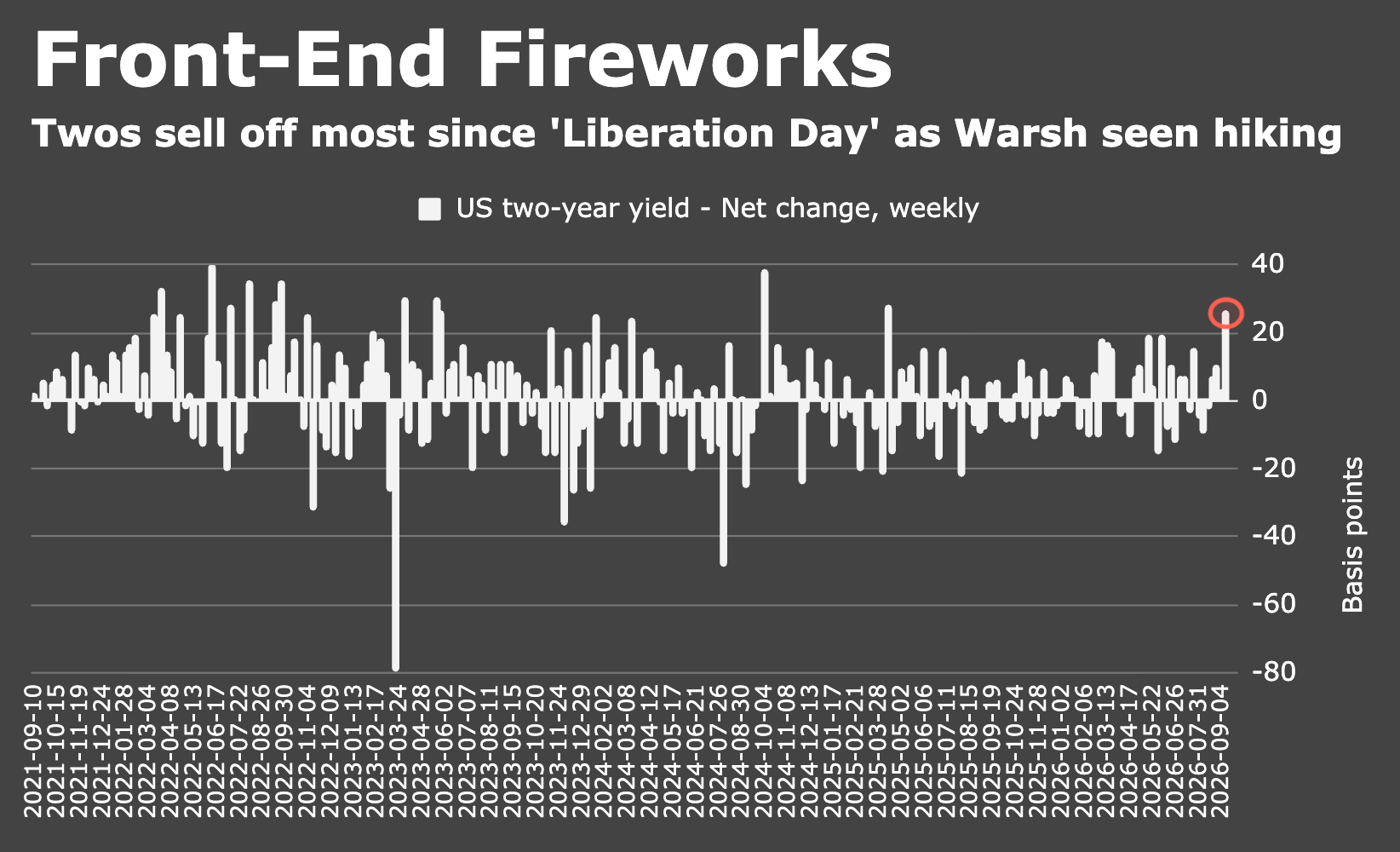
As the figure shows, we’ve just seen the largest one-week selloff at the US front-end since the volatility surrounding “Liberation Day.”
When the dust finally settled on an eventful week for bonds, yields were higher by anywhere between 26bps and 11bps across the curve, which bear flattened fairly dramatically. Overall, Treasurys as an asset class are down about 1.5% for 2026 versus a — checks notes — 80% gain for commodities.
The good news is that both of this week’s supply events — Wednesday’s 10-year sale and Thursday’s long-bond auction — evidenced very strong demand. Indeed, September 10’s $22 billion 30-year sale boasted a 2.7bps stop-through.

The figure above shows you the recent history of dealer allotments at 30-year auctions. At just 2.2%, September 10’s sale saw the lowest dealers ever.
So, even if dip buyers are absent from the tape, they’re at least showing up at auction. That’s not nothin,’ so to speak. And near-98% non-dealer bidding at the long bond sale is perhaps another reason to believe that September 10 will be remembered as a turning point for Treasurys.
Late this week, Bessent walked back his already infamous “I am the house, bet against me if you want” challenge, after Japanese Finance Minister Satsuki Katayama called it “scary.”
“I’m not saying ‘I am always right, don’t challenge me,'” Bessent lied said. “I’m trying to give the market good framing so that they don’t panic.”


“Your levity is good. It relieves tension and the fear of death.”
–classic American film
Bessent’s inability to read the room w/r/t communication never ceases to amaze. He may match Mnuchin on PR fiascoes before this administration is done or he’s dismissed.
Meanwhile we have Kevin “mum’s the word” Warsh in charge of co-writing the script with Mr Market.
Strange days. Maybe AI can fix the problem like it did in that classic film.
“The question isn’t ‘what are we going to do,’ the question is ‘what aren’t we going to do?’”
thanks for letting me know you’re worried about and trying to avoid market panics, Scott…I feel so much more reassured and confident now…carry on…
H is never clickbait because the content is worth reading.