

It’s a big week in macro-market land, where investors will parse policy decisions from three of the big four central banks as well as earnings reports from four of the Magnificent 7. A bevy of notable data releases will keep things interesting in-between.
The marquee event’s obviously the July FOMC meeting. You’re encouraged to read my full preview here. The CliffsNotes version says Kevin Warsh will almost surely keep rates on hold notwithstanding market pricing, which suggests the odds of a hike are nearly one in three.
“During [Jerome] Powell’s reign as Chair, investors became accustomed to expecting the Fed to sway the market away from pricing in >30% odds of a hike if one wasn’t on the table with a well-placed article in the financial media during the communications blackout window,” BMO’s US rates team remarked. “Warsh’s approach is unmistakably different, and no such clarity will be forthcoming.”
Needless to say, oil’s in the driver’s seat for rates, where the US front-end’s restless and bonds are a mess. So, it’s not Warsh’s aversion to forward guidance that has traders pricing relatively elevated odds of a surprise hike on Wednesday. Rather, it’s the collapse of the US-Iran ceasefire and the Houthi blockade of Saudi oil tankers in the Red Sea. (Blame the “goat herders.”) Donald Trump’s renewed tariff push doesn’t help to the extent it aggravates inflation angst.
The US and Iran largely refrained from attacking one another over the weekend, which may presage another “cooling off” period. Warsh could really (really) use a “TACO Tuesday” right now. A renewed commitment to diplomacy from Trump and the IRGC would take a lot of pressure off Wednesday’s press conference.
Last-minute deescalation or not, Warsh will have to work at it to avoid dissents. The very fact that the ceasefire proved so fleeting testifies to the notion that the Iran adventure was a geopolitical Pandora’s box. And that it’s not safe to assume the associated supply shocks are “one-offs.” The ECB certainly isn’t assuming the best.
At the same time, protectionism’s a fixture of the post-neoliberal world order. If globalization and free trade were disinflationary (and they unquestionably were), de-globalization and fractured trade are likely to be the opposite.
As for Warsh’s insistence on the idea that policy can incorporate tomorrow’s productivity renaissance today, I think that’s a politically-motivated talking point rather than a deeply-held belief of his. Whatever the long-term implications of AI, the buildout phase is inflationary, as price increases for key inputs (namely semis) are passed along to consumers (see Apple’s price hikes).
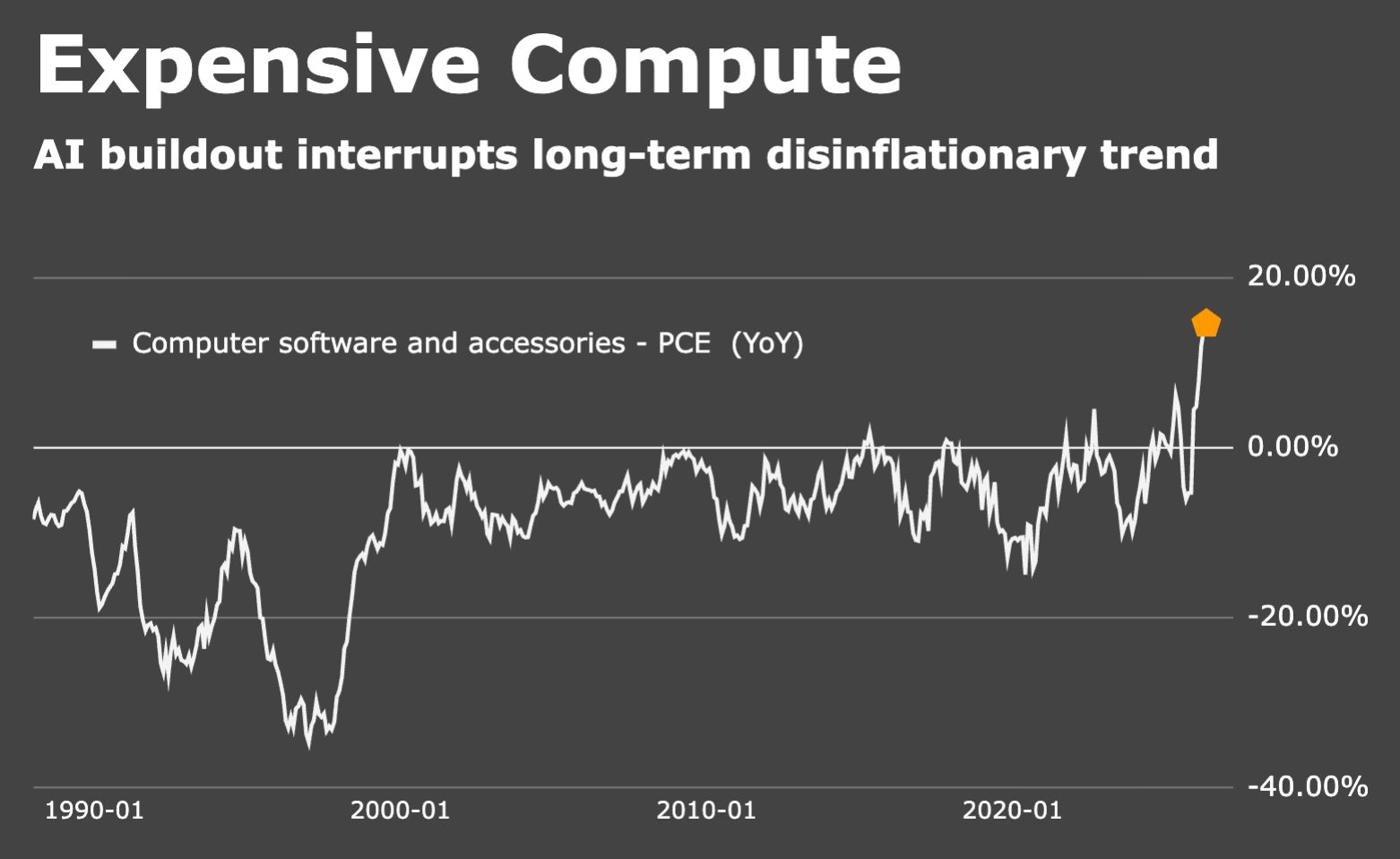
The figure above’s a reminder: A related aggregate in government price data is now accelerating rapidly, marking a dramatic break with decades of deflationary precedent.
The capex boom, meanwhile, is almost surely pushing up the neutral rate in the background. That adds an extra layer of uncertainty for central banks attempting to incorporate all of this into their reaction functions.
With that latter point in mind, investors may eye business spending just as closely as personal consumption in the advance read on Q2 US GDP, due Thursday from the BEA.

As the figure shows, private nonresidential fixed investment’s at multi-decade highs as a share of overall output, largely as a result of AI outlays.
Consensus expects 2.1% from the headline US GDP readout. That’d be consistent with Q1’s pace as reflected in the final revision.
The BEA will simultaneously release personal income and spending data for June, including an update on the Fed’s preferred inflation gauge for that month. Consensus expects a slight month-to-month decline on headline PCE prices and a 0.2% advance for the core measure.

Markets will surely discount the inflation figures. Both CPI and PPI were benign for June, but the subsequent renewal of open warfare in the Mideast made the releases less relevant for policymakers. The same’s true of the PCE price figures.
The same release will be eyed for any movement on the saving rate (which is near a record low) and for the real (i.e., inflation-adjusted) personal spending line.
Also on the US data docket: Conference Board consumer confidence, updates on the Case-Shiller home price gauges, the Employment Cost Index and the final read on Michigan sentiment for July.
Overseas, the BoE will likely keep rates on hold amid sundry cross-currents. The next day, the BoJ will do its best to address a distressing situation in Japan, where the flagging yen really could’ve done without another sharp rally in crude.
On the earnings front, investors will get results from Amazon, Apple, Meta and Microsoft.
Good luck out there. Keep a rabbit’s foot. And guard your Sky-Dweller.


Trump needs another MOU w/Iran. Hopefully, they can reel in the Saudis and Houthis too (kind of like the way they did w/Bibi and Hamas in Lebenon?).
The Fed (no task force reports, so we can’t raise rates) and the BOE will holds rates steady. The BOE needs to let the King of the North time to settle into his new digs on Downing Street. Kevee is going to have a few dissenters, maybe 5 (?)…..the new tariffs don’t help, anyone!
The BOJ needs to bump up their rates. They need to help the yen, but more is fiscal policies are needed too (Takaichi marching to Trump’s drum or is that Deep Purple beat).
Besides the big four horseman, lots of chip companies are reporting too. We’ll see, if Peter is still paying Paul…
This week a few of big oil companies are reporting.
Fasten your seatbelts, it’s going to be a bumpy week!
Enjoy
I think the girl took it. Can’t believe you threw a softball H and nobody hit it yet.
The major event of the week and maybe more will be PM Netanyahu’s Tuesday meeting with President Trump.