

The good news is, US job cut announcements plunged in April.
The bad news is, “plunged” is relative to the sky-high total from March when, thanks in no small part to Elon Musk, job cuts exceeded 275,000.
The 105,441 layoffs tallied for April by Challenger, Gray & Christmas on Thursday counted as a 63% YoY increase, and were the most for any April since 2020, when the initial pandemic lockdowns prompted US employers to announce more than 671,000 cuts, the most for any single month in at least four decades.

Last month’s total was the second-highest April tally since the financial crisis.
There’s no mystery as to what’s driving this. The government category has seen more than 282,000 cuts so far in 2025, up nearly 700% from the same period a year ago. Nearly all of those are attributable to Musk.
Let me emphasize, because I want you to be righteously aggrieved: The world’s richest person, acting in an unelected capacity and with no congressional oversight whatsoever, has unilaterally purged more than a quarter of a million government workers. That’s highly unfortunate, and it’s also very dangerous.
Unlike job cuts at, say, Tesla, it’ll take months or even years before it’s possible to assess the impact of those layoffs (or planned layoffs) on the delivery of services to the American people. The same’s true of indiscriminate cuts to R&D funding. These cuts are going to diminish the government’s capacity to provide for the public, and it’s very likely that scientific advances which would’ve been possible with government funding, will never see the light of day.

The figure above is just the YoY change in the Challenger series. I’m not sure I’ve ever seen a more derelict US Congress, and that’s really, really saying something given Congress’s reputation for being derilict.
But it’s not just the government cutting jobs. As Andrew Challenger noted on Thursday, there were job cuts “across sectors” in April. “Employers are slow to hire and limiting hiring plans as they wait and see what will happen with trade, supply chains and consumer spending,” he said.
So, in other words, the tariffs are a constraint on hiring and the associated uncertainty’s very likely behind some decisions to cut payrolls. Although just 1,413 job cuts have been directly attributed, by employers, to tariffs this year, it’s important to note that 1,350 of those cane in April, which is to say if Trump doesn’t relent, tariff-related job cuts should be expected to pick up.
As for DOGE, 283,172 cuts so far in 2025 are directly traceable to Musk, and another 7,000 or so cuts are attributable to the “downstream impact” of his actions, with the ripple effects hitting non-profits and education the hardest.
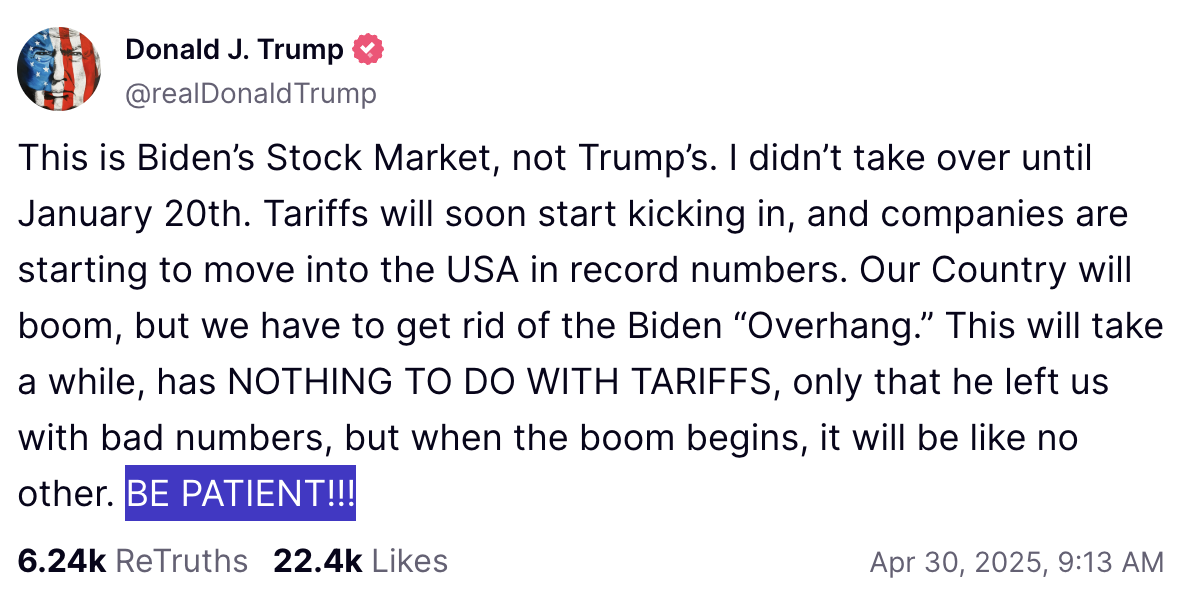
Companies cited “market and economic conditions” for another 95,348 job cuts in 2025. Trump will tell you that’s somehow Joe Biden’s fault. It’s not. As Challenger noted, employers generally cite uncertainty, concerns about consumer spending and “trade difficulties” when asked to elaborate. (But what do they know? About their own rationale for layoffs?)
All in all, Challenger went on, US employers have announced nearly 603,000 layoffs this year, the most for the January-April period since the pandemic, and nearly double the cuts announced during the first four months of 2024.
Meanwhile, initial jobless claims for the week ending April 26 were 241,000, up 18,000 from the prior week and the second-most since a weather-related spike in early October.

The four-week moving average is now 226,000, the highest since mid-March. Consensus was looking for 223,000 from Thursday’s initial filers print, so the actual update far exceeded estimates.
Continuing claims for the week to April 19 were 1.916 million, likewise ahead of consensus and yet another new “since November 2021” high. We’re perilously close to breaking out of a range that’s held on that tally since October.
I’m out of “golden age” jokes right now. But don’t worry: I’ll come up with some more. “BE PATIENT!”


I thought he served at Mr. Trump’s pleasure — and duly met the wood chipper when outlived his usefulness to employ the metaphor of that one memorable Marina Hyde column — and with congressional oversight (which apparently is a thing on paper only in your these days). Just to give credit where it is due.
Johan, I seriously doubt anyone other than Elon Musk could have indiscrimatley fired people like that. I think the credit is his.
And he hasn’t met the wood chipper, far from it. Tesla sales dropped so precipitously he had to step back so people would quit actively attacking the cars. The word is he could stretch the 30 days he has left into a day a week at DOGE and stick around the rest of the year. I read Musk said the President texts him in the middle of the night to make sure he gets some ice-cream when they are having one of their spend-the-nights at the White House or hanging around on AirForce One.
It’s hilarious how I can’t tell if you’re being facetious of not. Anyway, sure, but it was the elected officials’ choice to put an autistic person with a penchant for firings in charge. By the time Congress has a DOGE caucus and literally everyone knows what is going on but chooses not to interfere it seems to an outsider fair to say he has their approval too. So it’s not like he single-handedly orchestrated a hostile takeover of US gov’t.
I remember the Grace commission that Reagan formed and they had some good ideas on shrinking the government. I don’t get as upset as you about these firings, most government agencies are bloated, but I do wonder where these people could ever find a job working for some for profit company.
But it seems that most people, when reviewing ‘government bloat,’ never mention the similar inefficiencies of private corporations. Sure, companies periodically ‘purge the rolls’ to keep costs down, pivot into new territory or eliminate redundancies, but let’s not pretend that it’s the model of modern efficiency.
The marketplace can be far off the mark sometimes, and this is where the expectation of government involvement matters. Let’s take, for a prime example, the absolute failure of pure demand to keep us awash in enough ventilators that might be needed in, I don’t know, maybe a global respiratory virus pandemic. Some level of inefficiency might just be the price to pay for keeping the wheels turning, no matter what happens.
I was thinking the same thing Jeff, a lot of bloat in the private sector, probably much more
This comment is so painful to read.
Lordy, where do these so-called thoughts come from? One of my good friends was tossed by Musk. He was recruited from the corporate world mid-career specifically to help track groundwater pollution from a military installation that was headed toward civilian groundwater supply wells. He’d been there only 11 months, so still on “probation”, and was among the first wave to be let go. No worries for him finding employment. Good news for the Trump team though, because they’ll no longer have to bother reporting about that pesky groundwater pollution to anyone who might care. Another success of the first 100 days.
“because they’ll no longer have to bother reporting about that pesky groundwater pollution to anyone who might care. Another success of the first 100 days.”
Finally a real-life example of a beneficial effect from deregulation! Thanks!
OH, my nuclear science degreed niece and computer degreed brother-in-law will find jobs, they have been turning offers down for years, likely replacing lazy work at home corporate types!
Lee, sure there is bloat; there bloat in any large organization. There is no reason to believe these people were part of the bloat.
If the majority of them were “probationary” (less than 2 years) then the newest talent was being purged and that means there is not a refresh happening and a lack of new ideas and fresh blood. People who might be inclined to want to go into civil service and do good for others will not be so inclined anymore. The ramifications are going to be with us for decades.