

27 minutes. I was 27 minutes late, and I left 45 minutes early.
This city has a traffic problem. That’d be forgivable if there were places to go and people to see, but there aren’t. There’s just college football. Fleming’s counts as a “night out” if that tells you anything. That’s where I was going. Or trying to go. Fleming’s. The locals think it’s The French Laundry.
After inching through a bumper-to-bumper miasma on the main thoroughfare, my E350 meandered cautiously into a suburban dystopia, where it navigated a sea of nightmarish strip malls. Eventually, we — the car and I — found ourselves parked amongst cheap jewelry, cheaper clothes and a LensCrafters. “Hey Mercedes?” I queried the car’s built-in Siri substitute. “Why did I move back here?” A metallic rejoinder: “I’m sorry, can you say that again please?” “Never mind.”
I got out, went in and walked past the hostess: “I see them, thanks.”
He was always a good guy. Still is. I was always a bad influence. Still am. He flashed the kind of genuine, glad-to-see-you smile someone like me can’t even feign, let alone muster in earnest, and engaged me in an over-complicated handshake. I turned to his new wife for the obligatory one-armed half-hug.
We sat down and I ordered a cappuccino from a server who seemed relieved to see a white man. This is a town where waitstaff assume, not irrationally, that Black people “don’t tip.” That’s a stereotype, and it’s noxiously prejudiced. But like most stereotypes, it’s based at least a little bit on experience. At restaurants, it creates a chicken-egg problem: African Americans don’t get good service, so even if they were inclined to tip well, they don’t, which perpetuates the stereotype, leading to more bad service and so on.
“Sorry.” I always apologize for ordering cappuccinos at restaurants. Servers aren’t baristas. You shouldn’t treat them like they are. And generally speaking, you should order liquor. Or wine. “I can’t drink.” “Oh no worries!” she chirped. “What’s your name?” “Whitney.” I winced. His ex-wife’s name was Whitney. “Thanks, Whitney. Give us a few minutes.”
I reached into my D&G shoulder bag where his birthday gift was wedged between a Glock 43X subcompact and a blue Damier print Louis Vuitton pocket organizer. “I was going to stop and get a gift bag for it, but the traffic was bad,” I told him, producing a little red box and putting it on the table. He grinned and tried to read the embossed lettering: “Ferra — Ferragamo.” I pushed it towards them. “Open it up.” He lifted the lid and instinctually cast aside the miniature booklet on top of the tissue paper. “You want to keep that,” I urged. “That’s your authenticity documentation.”
Under the tissue was a black calfskin Gancini wallet with a contrasting red interior. “Awe man!” He noticed the cash. I’d put a couple of hundred in twenties in the bill compartment. “You ain’t have to do all this.” “I couldn’t give you a wallet with no money in it,” I joked.
The meal was fine. For a chain, it was actually better than fine. Whitney was, as it turns out, a plumber by day. “How does that work?” I wondered. “Well, I get up in the morning and put on my Mario outfit,” she explained, pantomiming. “Then I dress up like this at night.” “You ever switch them around? You know, wear the tie and vest to bust up the Koopa Troop and show up here with the overalls and newsboy hat?” She put her left index finger under her nose, mimicking Mario’s mustache, and made a striding motion with her right arm. I chuckled and took the check.
We walked out into the parking lot. It was still daylight and it was still hot. “This was really nice, man. I appreciate it.” Another over-complicated handshake, this time with an aggressive, pull-in back slap at the end. “Happy to do it,” I told him. He leaned against some kind of Cadillac and pulled out a vape. “What happened to the Black & Milds?” “You know I ain’t bought them in prolly five years, C,” he said. “Well that’s good.” He nodded. “They tryin’ to kill us off anyway. They don’t need no help.”
America is, was and almost surely always will be, a profoundly unequal society. The story we tell ourselves about the nation’s founding in principled virtue is embellished to the point of delusional fantasy, and where it does recognize genocidal conquest and forced labor, it exonerates nearly everyone involved by implicitly pretending the whole sordid episode happened far longer ago than it actually did. The idea being that men of that era couldn’t possibly have known better. Never mind that quite a bit of what they said and wrote suggested they not only knew better, but were in fact ready, willing and excited to die on the hill of universal equality.
A few Monthly Letters ago, I talked at some length about what I called “context-based grants of blanket immunity.” I’ll recycle some language from that discussion. When we grapple with the legacy of historical figures, we tend to contextualize otherwise unpardonable personal shortcomings by reference to the customs, conventions and social mores which prevailed “at the time.” In America, the most obvious example is the amnesty afforded the authors and signatories of the country’s founding documents many of whom declared all men equal and possessed of inalienable, God-given rights while holding other men (women and children) in bondage, as property, the gravest of all affronts to individual liberty.
But the immunity grant extends well beyond the relative handful of men credited with America’s inception nearly two and a half centuries ago. Unless you’re a whip-wielding plantation owner in a movie or a novel about the antebellum South, you generally get a pass for participating in a nation-building project that depended for economic development and territorial expansion on the maintenance of modern history’s most excruciating cognitive dissonance: The simultaneous belief in “self-evident,” universal equality which rendered monarchical rule illegitimate and prima facie ethno-superiority which legitimized slavery and underpinned the doctrine of Manifest Destiny.
Those notions of ethno-superiority — racism, for short — were, and remain, part and parcel of America’s national consciousness. By the late 19th century, nativism found its way into the mix, even among self-styled “reformers.” A nation of racist immigrants who by then had largely succeeded in exterminating and anyway permanently displacing the actual native population, had become a nation of xenophobes.
We’ve made some progress since then. A lot of it on some fronts. But… well, let’s just say there’s more work to be done. Racism’s still endemic, and xenophobia’s actually worse than ever. The party of Lincoln is now the party of a Pat Buchanan-Mussolini-P. T. Barnum composite sketch. And Republicans’ official motto is an explicit exhortation to roll back the clock, which is to say the GOP isn’t just anti-Progressive (proper noun with the suffix), they’re anti-progress (common noun, root word).
That’s exceedingly problematic, and particularly so given that the other party in America’s political duopoly — which, once upon a time, was the slavery party — has consistently failed to deliver for the non-white minorities whose votes Democrats take for granted. As documented extensively here, Democrats have lost share among Black and Hispanic voters, who’ve defected to a party (the modern Republican party) which on many vectors is openly antagonist towards non-whites.
Again, it’s important to note that it really wasn’t all that long ago when chattel slavery was the defining feature of the American south. While apologizing for ourselves to ourselves (we do that a lot more often than we apologize to the descendants of slaves), we very often act as though our forebears lived in the Dark Ages and the topic’s astronomy — as though they had no means by which to arrive at the conclusion that whether or not you believe everyone’s equal in the strictest sense of the word, it’s self-evidently true that to subject sentient beings to acute physical and mental suffering is to subject those beings to a suboptimal situation and, ultimately, a miserable existence. In case there were any questions as to whether America’s founders harbored misconceptions on that front, they spelled it out word for word in a fancy document. Then they all signed it.
Today’s Americans are thus eighth-generation descendants of, generously, ambitious hypocrites, the best of whom justified the tolerance of slavery by the (admittedly true) contention that trying to abolish it — or even endeavoring to dismantle the most heinous aspects of it — would make compromise impossible, thereby killing the whole republic-building project while it was still in its infancy.
The good news is that America’s still a very young nation. There’s still hope and, assuming humanity averts climatic oblivion, time. Although the pace of progress surely seems glacial to the historically oppressed, we haven’t yet reached the point beyond which the length of the journey towards a “more perfect union” calls into question the earnestness of the pursuit. But we should be cognizant that such a threshold does exist and, relatedly, that there’s a limit to how disproportionate outcomes can be before it beggars belief to insist that opportunities are equal.
According to the latest Fed data, the Black share of US household wealth in 2024 was just 3.4%, lower than it was in 1989. On that simple — albeit hugely important — metric, the country’s made less than no progress in three and a half decades.

Those shares are wildly out of proportion to the composition of US society. Black Americans comprise more than 14% of the US population but hold less than 4% of the wealth. White households make up 60% of the population but control more than eight in 10 dollars of total household wealth.
It’s hard to see on the chart, but the white share’s lower over the last 35 years. In 1989, whites owned more than nine out of every 10 dollars of household wealth in America. Today, their share’s “just” 84%. White Americans’ “loss” on that score is attributable to the growing financial heft of Asians, unless you think the readily apparent increase in the wealth share attributed to “Other” groups is a function of gains for American Indians, Alaska Natives and Hawaiians.
Late last year, Pew presented data from the Census Bureau’s Surveys of Income and Program Participation from 2022 and 2020 to show the racial breakdown of the nationwide surge in household wealth during the pandemic. The median Asian household had a net worth of nearly $321,000 in December of 2021, 28% more than the median white household.
The disparity between white households (to say nothing of Asian households) and the median Black household is nothing short of astounding. As the figure below shows, median Black household wealth was just $27,100 at the end of 2021, and that was after nearly doubling in two years. If you strip out home equity, the median Black household had virtually no wealth (just $8,300).

If you do the simple math, you’ll discover that home equity accounts for nearly two-thirds of Black households’ net worth compared to just 41% for white households. That makes discrimination in home lending even more pernicious than it is by its very nature.
According to the NAR, the denial rate for Black borrowers attempting to get a mortgage is 26%, 10ppt higher than the rate for whites. And that’s with all the myriad safeguards in place to prevent lenders from engaging in discriminatory practices.
As most readers are surely aware, the Black homeownership rate is the lowest among all races, and it’s not close. At just 44%, it’s nearly 30ppt lower than it is for white Americans. In the dozen years between the financial crisis and the pandemic, the homeownership gap widened materially, and still sits near 30ppt even after improving over the last two or so years.

As the figure shows, America made no progress at all since the late 1980s on closing the racial homeownership gap.
Even when Black Americans do realize the American dream, they face what many researchers suggest is systematic discrimination from both tax assessors and appraisers. A 2020 study by Indiana University’s Carlos Avenancio-Leon and UC Berkeley’s Troup Howard found “a nationwide ‘assessment gap'” in which racial minorities are subjected to “a disproportionate fiscal burden.” The study’s exhaustive, spanning more than 80 math-heavy pages. “Our baseline findings establish that minority residents in the US face a higher property tax burden than their non-minority neighbors,” Avenancio-Leon and Howard wrote, summarizing their findings. “Increased taxation clearly represents, in the most literal sense, an incremental cost faced by minority families and an additional impediment to minority wealth building.” Do note: 81% of tax assessors in America are white.
Now consider that, according to a Brookings analysis of granular FHFA home appraisal data, homes in Black neighborhoods are systematically undervalued by more than 20%. “[A]t least 10% of homes are at risk of under-appraisal in majority-Black neighborhoods, and this has a modest but meaningful effect on overall valuations and final sales prices, limiting wealth accumulation for homeowners in majority-Black neighborhoods,” the study said. Wouldn’t you know it: 95% of property appraisers are white, according to the BLS. (The rest are Hispanic and Asian. Less than 0.5% of property appraisers in America are Black.)
The figure below, based on FHFA data analyzed by University of Illinois Chicago visiting professor Junia Howell, a racial justice advocate who describes her raison d’être as “dismantl[ing] the specific policies, processes and practices that uphold white supremacy,” gives you a sense of the compound under-appraisal effect over time.

“The inequality between comparable homes in comparable neighborhoods increased by nearly $20,000 from 2021 to 2022” alone, Howell noted, in an annual report published by a non-profit housing and finance organization.
Since 2013, “properties in white neighborhoods have appreciated nearly $200,000 more than comparable homes in comparable communities of color, resulting in homeowners in white neighborhoods seeing their wealth increase $200,000 more than home owners in communities of color,” Howell went on. “Just because of the racial composition of their neighborhood.”
So, achieving homeownership is just the first hurdle if you’re Black. Once you own, you’ll face a “higher tax burden for the same bundle of public services,” as the Indiana study documented, as well as a never-ending effort to under-appraise your property and thereby undervalue the asset which, on average, comprises two-thirds of your total wealth.
As is clear from the fact that home equity makes up more than 60% of what little wealth Black families manage to accumulate, they own essentially no financial assets as a share of the total. The disparity there is so vast that the human eye can barely see the Black share of corporate equities on a stacked area chart.

To put some numbers on it, Black households owned all of $290 billion in stocks and mutual fund shares as of March 2024. That figure for white households was nearly $38 trillion.
According to Pew, one-in-10 Black households owned no assets at all other than their car or a checking account as of 2021. The same study showed more than a third of White households (and almost half of Asian households) owned bonds, stocks and mutual funds. That share for Black households was, at best, 20%.
To restate the obvious, it’s exceedingly difficult to make the case that these enduring inequities are a bug and not a feature. Indeed, when polled on the issue, Black voters recognize their opportunities for economic advancement haven’t materially improved and that a big part of the problem is the system, which they tend to believe is set up to set them back. A Pew study published in June found that more than two-thirds of Black Americans said the US economic system was designed to limit their advancement. The share was even larger among the college-educated.
There are myriad institutional factors which explain the vast disparities in household wealth. Pew was unsparing. “Evidence points to the role of slavery and post-slavery practices, such as segregation, that created disparate opportunities for wealth accumulation,” the think tank remarked.
That’s the 30,000-foot, socioeconomic view. At a more micro level, the racial earnings gap is arguably the biggest headwind to Black economic advancement. Simply put: If you earn at a fraction of the rate enjoyed by another group, it’ll be quite difficult, bordering on the impossible, to keep pace economically over time.
As William M. Rodgers III, vice president and director of the Institute for Economic Equity at the St. Louis Fed, noted earlier this year, the body of research dedicated to the study of the Black-white wage gap is “voluminous.” As much as it can be, that’s an understatement. This is one case where it’d be impossible to pen a comprehensive review of the extant literature, but really you don’t have to. Because the most important point is the simplest: The situation hasn’t improved since the Civil Rights movement.
A 2018 article published in the The Quarterly Journal of Economics found that the median Black-white earnings gap is as large in modernity as it was three-quarters of a century ago. “After narrowing from 1940 to the mid-1970s, the median Black–white level earnings gap has since grown as large as it was in 1950,” Patrick Bayer and Kerwin Kofi Charles observed. Notably, the gap gets worse over the employment lifecycle, and not because of differences in “accumulated experience.” As Christopher Rauh and Arnau Valladares-Esteban showed in a 2023 study published in the Review of Economic Dynamics, the “key determinant” in the Black-white earnings gap is “the unequal conditions with which men in the two groups enter the labor market.” As they put it, “effective policy to close the gaps… should primarily be concerned about how achievement gaps are generated before adulthood.” That, in turn, points to inequality of opportunity, unequal access to education and, relatedly, disproportionate incarceration rates attributable in many cases to discrimination in policing.
Writing in January, The St. Louis Fed’s Rodgers suggested that wage disparities don’t necessarily improve during periods of robust economic growth, contrary to popular belief (and to research which points to more equitable outcomes when the labor market’s tighter).

The figure above, derived from Rodgers’s work, shows the wage gap during years corresponding to business cycle peaks. “If the economy was to have its strongest ability to narrow the gap, it would occur during these years,” Rodgers wrote, in the course of lamenting that “even in the tight labor market period that started in March 2022, sustained low unemployment has had a limited effect on the Black-white wage gap.”
Notably, the residuals in Rodgers’s study are quite pronounced, which is to say the “unexplained” share of the gaps illustrated above (which in this case means the share not traceable to “racial differences in education and age”) is large. It’s tempting to suggest — and indeed, I would suggest — that there’s nothing inexplicable about the residuals. They can be readily explained by discrimination in hiring. Rodgers cautioned against jumping to conclusions, though. There’s a role for “cognitive skills, networks, health status, firm size, union membership and measures of general inequality,” he wrote.
I’m not sure that’s comforting, and indeed I doubt Rodgers meant for it to be. Differences in cognitive skills and networking can be traced to inequality of opportunity, and disparities in health outcomes in America are in some cases explainable by way of unequal access to health care. So, the institutional, structural factors which hold back Black Americans feed into the earnings gap, which in turn perpetuates the racial wealth divide, which reinforces structural disadvantages and around we go.
With that in mind, consider the disparity in intergenerational transfers. The wealthier you are, the more you’ll have to pass on to your children, and the more you start with in life, the better off you’ll tend to do. As you might imagine given the wealth divide, Black Americans are far less likely to receive an inheritance compared to whites. In 2019, nearly one-third of white households received an inheritance, with the average intergenerational transfer clocking in at almost $200,000, according to the Fed.

By contrast, just one in 10 black households received an inheritance, and the average gift was half that received by the average white household.
It’s not just formal inheritances. As the Fed noted in an editorial accompanying the presentation of the data illustrated above, “white families are considerably more likely to report being able to obtain $3,000 from a family member or friend in a financial emergency than Black or Hispanic families [and] they are also more likely to have a parent with a college degree.” Of course, educational attainment is correlated to wealth which means, in the Fed’s words, “white families are likely to have wealthier parents than Black or Hispanic families.”
Again, it’s important to understand that when taken together, all of this is a self-fulfilling, intergenerational prophecy. As Brookings put it, “the Black-white wealth gap can exacerbate the effects of the negative labor market outcomes that Black households are more likely to face.” If you start with less, as you will on average if you’re Black in America, you’re far less likely to obtain the skills and tools you need to thrive in the economy as an adult, which means you’re likely to earn less and thereby accumulate less wealth to pass along to your children, who’ll in turn start with less and so on, forever. That’s why so many charts illustrating various racial economic disparities evidence very little, if any, progress over decades.
A 2018 Minneapolis Fed working paper was blunt: “The historical data… reveal that no progress has been made in reducing income and wealth inequalities between Black and white households over the past 70 years.”
These structural disadvantages and the suboptimal outcomes they produce are compounded by predatory capitalism and other manifestations of economic opportunism targeted at the vulnerable. When asked this year whether they were aware of “narratives” which suggest corporations have ulterior motives when it comes to how they market products to Black Americans, 70% of Black adults said they’d heard that corporate marketing teams push luxury items on Black people in order “to keep them in debt.”
Pew’s use of the word “narrative” in the poll was misleading in my view, and indeed the think tank ended up apologizing later for “us[ing] the term ‘racial conspiracy theories’ as an editorial shorthand to describe a complex and mixed set of findings.”
To be sure, marketing executives don’t gather together in dark conference rooms to devise nefarious strategies for oppressing minorities. If that was the argument, “narrative” may be apt as a description. But I doubt seriously that a majority of Black consumers believe corporate executives spend their days holed up on the top floors of skyscrapers conspiring and consulting with white supremacist leaders on marketing strategy.
However, America’s failure to provide for equality of opportunity has created a paucity of plausible paths out of poverty for Black citizens, and thereby a relative dearth of financially successful Black people outside of entertainment and sports. In many cases, Black entertainers and athletes present an ostentatious picture of success, in part as a (wholly legitimate) middle finger to a system that stacked the deck against them in all the ways detailed above, and plenty more besides. As one of the world’s foremost Black billionaires once put it, “If you grew up with holes in your zapatos / You’d celebrate the minute you was havin’ dough.”
Black Americans, and particularly young Black men, thus come to believe that success looks everywhere and always like wearable or drivable luxury items — cars, clothes and jewelry, as opposed to wealth-building assets like equities, fixed income and real estate. The situation’s compounded by wide disparities in educational attainment. It’s hard to be financially literate when, because of the uneven initial playing field, even basic literacy isn’t a given.
Corporations are aware of that setup, and shareholder capitalism (i.e., the cult of the bottom line) virtually demands they exploit it by targeting Black consumers with aggressive marketing, knowing they’re susceptible to messaging which reinforces the idea that success is a $1,200 hoodie and a $10,000 watch instead of $11,200 worth of LVMH stock. That’s not, as Pew described it, a “narrative.” It’s a fact.
Ironically, Black people who end up trapped in “debt” as a result of such marketing practices might be the lucky ones. Because that at least suggests they built some kind of credit history in the course of pursuing valueless valuables, even if that history’s a bad one. In reality, too many Black Americans — and particularly young Black men — have no access to credit at all, no conception of why credit’s important and instead spend out of cash to acquire luxury items.
They don’t understand — because they were never told — that it’s actually important to have some kind of debt history if you ever hope to obtain a mortgage, a business loan or credit for a large purchase. You can repair a bad credit history. You can’t repair a non-existent one, and when it comes to credit histories, age (“seasoning,” if you like) is absolutely critical. If you’re 45 and you’ve never had a credit card, that’s not a good thing.
As Pew noted in 2023, white and Asian high-income households have far higher debt-to-income ratios than Black households. As the figure below shows, white households’ debt-to-income ratio was 91% in 2021. For Asian households, it was more than 100%. By comparison, Black households were barely leveraged at all, at just 60%.

That racial disparity, Pew was quick to point out, can be traced to “differences in access to credit.” Specifically, the study said, “Black and Hispanic households are more likely to be denied a home mortgage, have less access to other forms of credit or, generally, are more likely to be ‘unbanked.'” In a nutshell: Black households are under-leveraged because they’re underserved by the system.
We tend to conceptualize of debt as everywhere and always a bad thing. In a recent memo, Howard Marks cited Morgan Housel, an award-winning financial commentator who once said, of debt, the more you have, “the range of what you can endure shrinks.” In other words, more debt makes you more susceptible to the volatile vagaries of life.
That sounds smart enough — Marks thought it positively profound, at least from an “elegance in simplicity” perspective — but how much sense does it make in reality? It surely applies to portfolio management, but what about to a young woman who’s just spent seven years in prison and who, having been released and now trying to rebuild her life, needs a reliable vehicle to get to and from her new job? Does taking on debt (assuming she can get a loan) make her more susceptible to volatility? Quite the opposite. Not taking on a car loan in that scenario could be a recipe for volatility, which is to say a recipe for disaster. Being an ex-con, she’s probably already on thin ice with her new employer. Showing up even a few minutes late for even one shift — because she didn’t have reliable transportation — could lead to the loss of that job, and a quick spiral back into a life of crime. Regular readers will note: That’s not a hypothetical. I knew that young woman.
What does it mean really when you set out to acquire credit and someone extends it to you? It’s an expression, by both parties, of confidence in your prospects. You’re confident you can ultimately pay back the loan, and the lender shares that faith. If you never seek out credit, that means you’re not confident in your prospects, and absent a reason to believe otherwise — which is to say a documented history of paying back loans — lenders will share your lack of conviction.
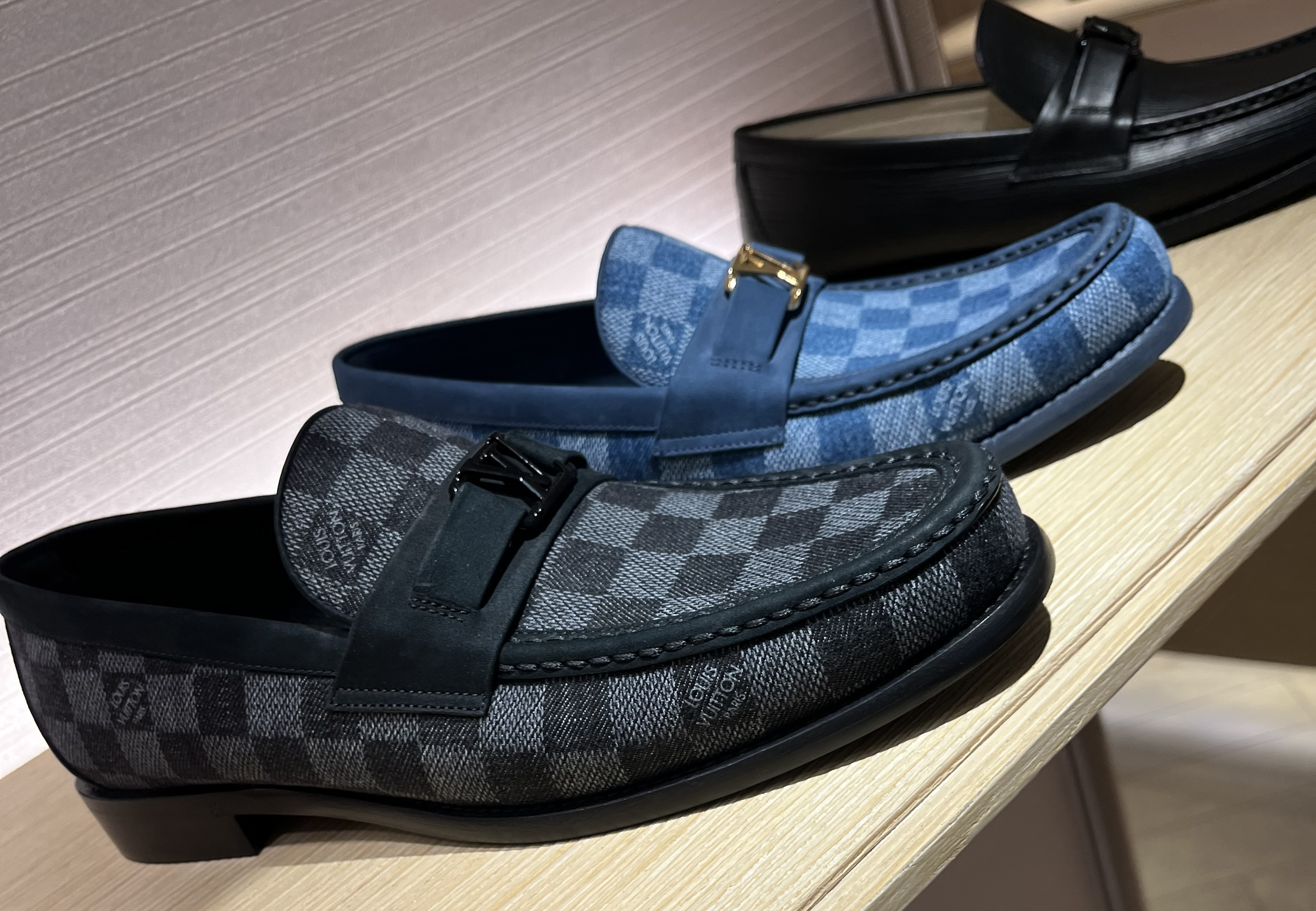
“Do they have any loafers? I gotta get me some loafers, C.”
I was on a pointless two-day lark to Nashville, Tennessee. He was at work, selling furniture, way back home.
I shouldn’t have answered the phone. He and his wife were trying to save for a house down payment, and they weren’t making much progress. The very last thing he needed was a tantalizing tale of impromptu tinsel live-streamed from the Green Hills Louis Vuitton. But he knew I was there. If I didn’t answer, he’d just keep calling.
“Why do you need loafers?” “To match the wallet! You got me wantin’ designer.” I shuddered. The wallet was a bad idea.
“Send me a picture!” “I don’t know how to do that while we’re on the phone.” It was a dodge, but it wasn’t a lie. I really don’t know how to multitask on a smartphone. I can make calls and I can do other things, but I never learned how to do both at once. If smartphone multitasking is the walking and chewing gum test for the 21st century, I’d fail it.
“Come on, C!” He wasn’t going to let it go. And I anyway wanted to get off the phone. My “client specialist” — a charmingly unassuming, polite young lady called Brooks — had four belts and a hoodie laid out on a table for me to try. “Let me jump off here,” I told him. “I’ll send you a picture.” I turned sheepishly to Brooks and gestured at the loafers. “I gotta take a picture of these for my friend.” “Oh, please do,” she effused, sensing more commissions. “He’s coming to join you?” “No.” I said it so flatly her shoulders fell. “Not today.”
I snapped a quick picture of Nashville’s sparse selection and sent it to him. He texted back immediately: “Damn! How much they hittin’ for?” That I didn’t answer. (The Major “hits” for about $1,100 before tax, and I didn’t want to get the next question which, almost invariably, would’ve been, “You think you can grab those for me and I’ll get you back in a few weeks?”)
I silenced my phone and turned back to Brooks. “Sorry about that.” “Oh, you’re fine!” She waved her hand over the belts. “I picked these out. Nothing too flashy.” “And they’re all 90s?” “Yes. We have an 85 in two of them, but…” “That’s fine. 90s are fine. These are all fine.”
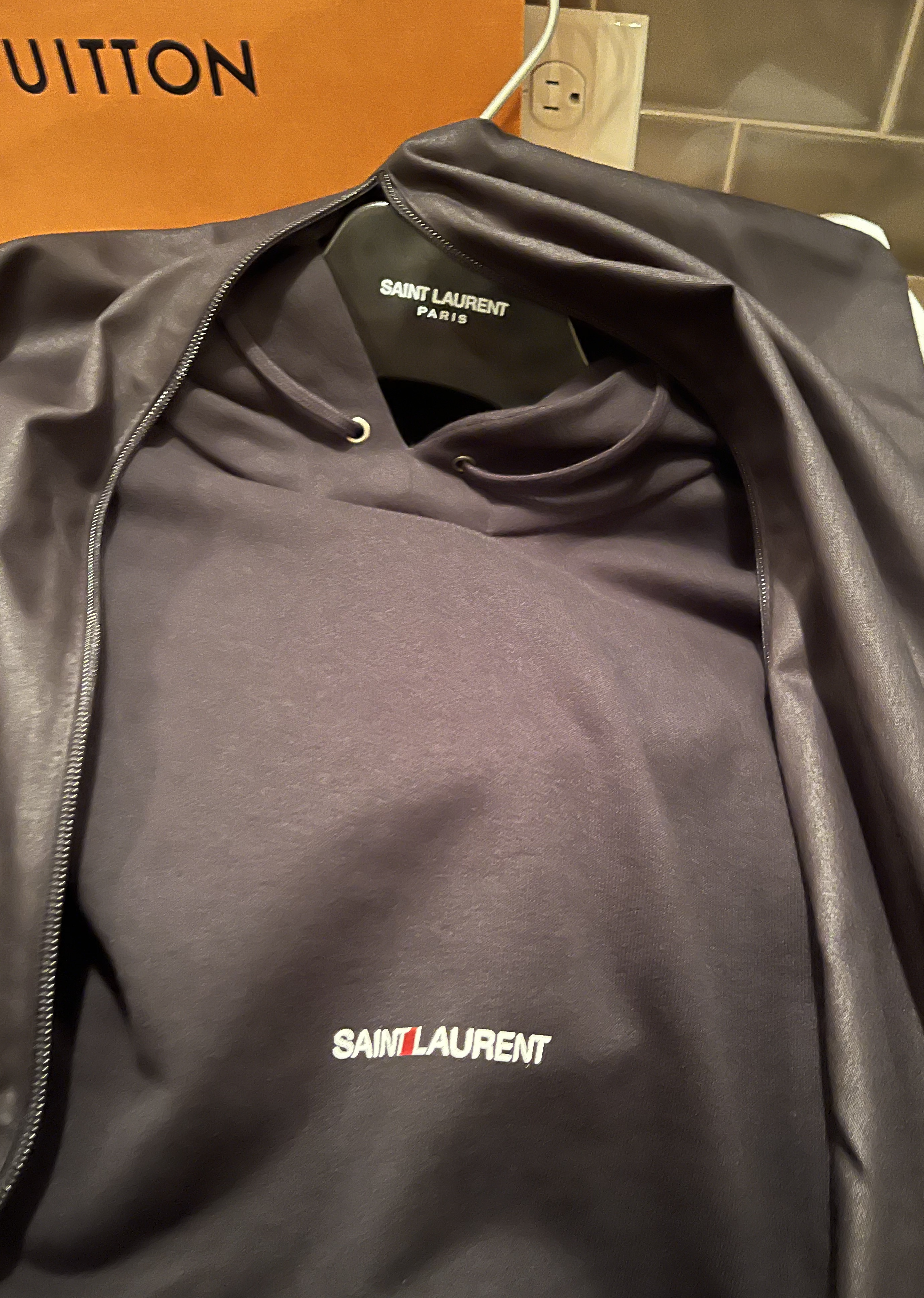
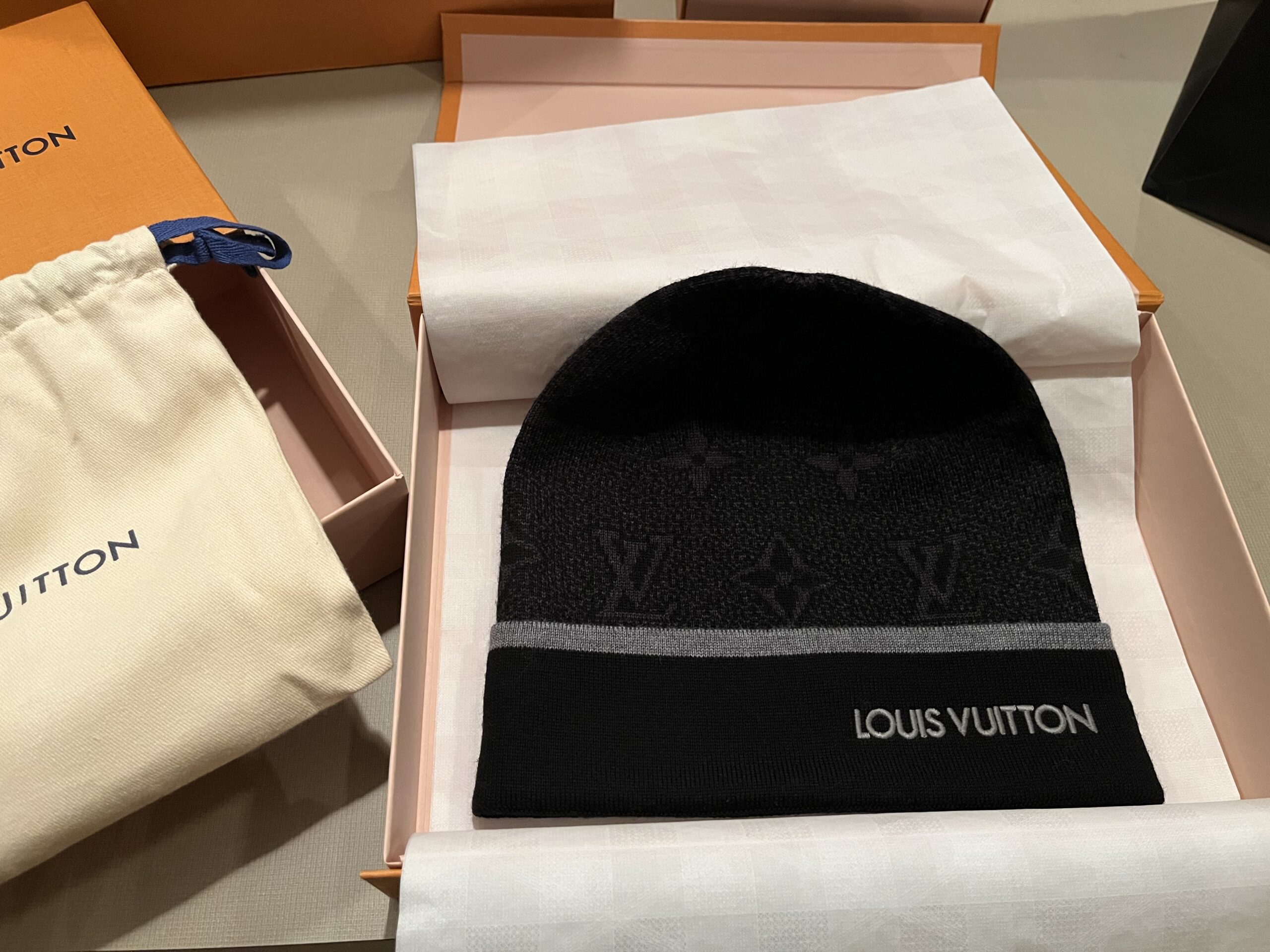
She tried to sell me a grey hoodie too. I wasn’t going for it. “I like it. I really do. But I’m going across the hall for the hoodie.” I had my heart set on an understated Saint Laurent piece. “To YSL?” “‘Fraid so.” She feigned exasperation. I felt bad. “I’ll tell you what. I saw a beanie online. Not the Néo Petit and not the Dual. I can pull it up on my phone if yo–” She cut me off. “I know which one you want.” She sashayed over to a small white counter, opened a draw and produced the Monogram Eclipse Hat. “That is indeed the one.” I was genuinely impressed. “How’d you know?” “It’s what I do,” she said. “Do you want to try it on?” “No, it’s fine. You’ve been great, Brooks, but we gotta wrap it up.” “Oh, are you late for your date with YSL?” she jibed, lightheartedly. I laughed. “That, and I gotta go back to the hotel to write an article.” She turned quizzical: “You’re a writer?” “Sort of. It’s a long story.”
The next time I heard from him was a week later, maybe two. It was just after five in the morning. He sent me a screenshot of a text exchange with his boss, a local mattress baron allegedly worth upwards of $50 million, a figure I judged to be dubious. “I’m not criticizing. I’m just trying to help a talented Black man build wealth,” this ostensibly well-meaning, white furniture mogul wrote, on the way to extolling the virtues of a starter home “even if it’s not going to impress anybody.” I chafed. The cadence was laughably paternalistic, and he stumbled into racist tropes every few words. This was a man who, half a century ago, would’ve referred to my old friend as “boy.”
“If he’s so damn concerned, maybe ask him to guarantee a 5% down payment mortgage for you,” I shot back, nauseated by the overtly condescending tenor of the exchange. “You right, you right,” he said. “Them’s facts.”
As the day went on, I thought about it. About who was really concerned with the best interests of my friend and his family. Yes, this boss of his was plainly racist, surely a Trump voter and, from what I could tell, probably wouldn’t be caught dead having dinner with a Black man in public. But he took a chance on providing a felon with gainful employment, thereby opening a door to basic economic opportunity and financial security. Then he took a special interest in coaxing my friend along the path towards homeownership, the only reliable wealth-building avenue open to Black Americans.
What, by comparison, had I done for my friend? Nothing good all those many years ago, that much is certain, but upon reflection, nothing good lately either. Flashing wealth in front of someone I know is impressionable and whetting his appetite for luxury goods with trivial gifts. Toting expensive firearms in Italian designer bags, thereby reinforcing the worst elements of a culture that’s poisoning (even killing) young Black men all across the country. And showing up with a trunk full of school shoes for his kids, when I should be opening college savings accounts in their names.
I called him later to say his boss was right. That he should pursue a starter home. That it’s not too late for that. “Let me call you right back, C.” He sounded busy. I assumed he was working. Half an hour or so later, he texted me another screenshot. It was a deal sheet from a car dealership. He was trying to buy a BMW and, to my great dismay, the dealership was prepared to let him do it. They were going to roll up the (substantial) negative equity on his Cadillac into an 84-month loan on a used 5 series.
I tried to call. No answer. I tried again. No answer. “Do NOT do that,” I texted back, frantically. “You’re already underwater. This will bury you. You’ll never get out from under that thing.” I paced around for a minute. Two. Three. I was about to send him another text when he called. He didn’t do it. I exhaled audibly. “Man, listen, I’m not trying to tell you what to do with your life, but you gotta be careful,” I exhorted, still a bit tense. “I know C,” he said, sounding deflated. “By I gotta get me a BMW. Or a Benz like yours.”


H-Man, a very good piece and when I say a good piece, it is one that makes you think rather than simply rolling with the discourse,
P.S. This adventure to the city should be over and it is time to return to the island for your own well being.
The article is thought provoking and supports it’s points with numbers. I got the impression that all your writing here could lead to a book or more. At first I was thinking a sermon, but later a book. Who knows, a great courses presentation maybe?
Some of the discussion of personal accessories made me think I have a picture in my mind of a different person than you are.
I think the more accurate way to think about my accessories and wardrobe is that you probably have the right picture in your mind about me, you just didn’t think someone like me would wear those clothes and accessories. Haha.
As mind reading goes not too bad. However I had more in my mind’s eye that will remain there.
Thank you for that, Engineer. This is a family-friendly forum ….
😉
My own mental image is firmly lodged in New Jersey mafia chic. Track suits for days.
There you go. I do the Palm Angels track suits these days, though. They weren’t around way back when. I try to keep up with the trends. I’ve got five colors in these: https://heisenbergreport.com/wp-content/uploads/2024/09/IMG-4441-scaled.jpg
That 4% is about to get a lot smaller as the existing housing market remains clogged up for years (maybe longer), due to what I believe, in hindsight, will be the biggest mistake that this Fed made: lowering interest rates too far.
For the foreseeable future, the only people who will be able to afford to buy a “first time” house will primarily be those (mostly not Black Americans), who get financial help from family. This situation will further separate the “haves” from the “have nots”.
Having said that, gifting cash always comes with uncontrollable and unintended consequences that may not be objectively “good” for the recipient. On one hand, I would love to make some major cash gifts to my 3 kids- but I am also afraid to do so because I don’t want to interfere in their lives; even though one lives in a big city near gangs, where one neighbor was recently arrested on murder charges and a drive by shooting occurred on a recent Saturday afternoon. Maybe I could match their savings, dollar for dollar? I am not sure and am taking my time to think this through.
I have not been to Nashville in decades- but am curious H, if you have ever tried this restaurant?
I recently sent a gift certificate for this restaurant to someone who lives outside of Nashville, who did me a very nice favor.
Great piece, as usual. 🙂
https://www.harpersnashville.com/our-story/
I haven’t tried that place. I ended up in a pinch for time when I was there, and I got overwhelmed with the restaurant choices. Like you, I hadn’t been there in a very (very) long time. It was all “new” to me and I ended up not eating out.
When reading this I was thinking about one of my favorite topics, the role that real estate tax shelters play in promoting the described economic distress.
Currently I believe tax policies favor investors over individual owners by way of 1031 exchanes, tax write-offs and accelerated depreciation. Our former policy of everyone can afford a home has been decimated by these policies requiring your young woman to compete with sophisticated investors who also can obtain cut rate mortgages. I believe we need to reform real estate tax shelters to give younger and minorities a chance to avoid serfdom. Othwerwise all but the top will be most accurately classified as economic serfs.
I’m caring for my elderly and dependent mother. I have a home care worker come 5 times a week for a few hours for some respite. I want to give this hard working young woman a gratuity and offered to start and fund a ROTH IRA for her to get started. She vehemently refused even after I told her a weeks salary is the customary tip. Planning for this I bought her a copy of “Random Walk Down Wall Street” which she accepted.
I told her that when I was 16 my father sat me down with the stocks and funds section of the Times and explained investing to me. Something no one has done for our young freelancer.
This article also reminded me that I started my wife’s credit history with a $500 cash secured credit card. When the flood of card applications started coming, we signed her up for a nice 2% cash back card and closed the secured card account. Perhaps that would be a better idea for our care aid.
I understand she may perceive our tip is charity and not appreciation.
Some will look at the story of the almost purchase of the BMW as evidence that the poor are responsible for their situation as a result of poor financial decisions. Now, I am fortunate enough to never, in my entire life, been close to being considered poor. But, I have noticed that whenever I have felt a little more financial stress than usual (which stress would be minuscule compared to that experienced by the bottom half of the population daily) I tend to buy lottery tickets. Just saying …
Finally found time to read this. Excellent article as always. Someone else mentioned writing a book, but I would suggest submitting to The New Yorker.
Your mention of tipping stereotypes reminded me of working with Randy. For several years, I bartended at a struggling tiki bar & grill. Because of its struggles, Randy & I were the only bartenders, and we did it all: bar, table service, opening, closing. Even dish. Randy helped out in the kitchen some times, which I managed to mostly avoid.
Randy, who is black, is one of the most generous tippers I’ve ever met. We had another black regular who was similarly generous. At the same time, plenty were ungenerous. When talking to Randy once about tipping stereotypes, I observed that black people were the least likely to tip between 15 – 20%. It was either >25 or <10. Randy explained that black people are aware of the stereotype, so they either play into it, or overtip to compensate for all the bad tippers.
We pooled our tips, so when people came in, we would ruthlessly divide up the work based on who was likely to get the best tip. Young women and minorities of any kind would get Randy, while I took older and whiter tables. No one wanted high schoolers or anyone from the after-church crowd. People who just went to church are notoriously bad tippers while also being exceptionally high maintenance. Ironic, eh?
In general, boomers were bad tippers. The men would round up from 15% while the women would round down. Middle aged women (of any race) also tend to be bad tippers. The best tips come from younger men–especially if they’re on a date, but even when not. The after work happy hour crowd was great–a bunch of young professionals with money to burn and a powerful need to drink away the week.
Anyone who asks for a favor and promises a good tip, and anyone who proclaims ahead of time that they’re great tippers, will tip badly, along with anyone who announces that they used to bar tend & then tries to tell you how to do your job. Finally, anyone who orders Patron will leave a bad tip. The Don Julio is sitting right there next to it, what is wrong with you?!
Never order Patron people. There are so many good top-shelf tequilas out there. Patron tastes like it smells: dirty feet.
Critical history is for luddites. Becoming is innocent
Well written article. The facts presented graphically demonstrate further those disparities.
Curious. Why the Glock 43x ?
Size. And design. That particular “shoulder” bag is technically a belt bag, I just carry it over my shoulder. The compartment’s small, so if you want to have room for anything else in there, you can’t really carry something much larger than that 43x or something similar. And Glocks are pretty sleek. There’s not a lot on them that might catch and tear the inside of a nice bag.
Thanks. Probably not going to work in the O’Neill board shorts that I wear then, as I’m short a D&G Shoulder bag.
H&K VP 9 Sk
I have a P30 which I love for the look (and for the H&K pedigree), but it’s got that LEM trigger, which I should’ve read up on before I bought it. To be totally honest, I’m still not entirely comfortable with that mechanism. I need to take it to the range and get some more practice with it.
Understood
Old school S&W 442 for me. Although I wouldn’t say no to a G26 or similar.
Years back, I traded a guitar for a 380 Walther, in homage to Travis Bickle. (Remember Easy Andy?)
But automatics are a PITA to clean and reload under stress, so I’m back to one of Mr. Andy’s other offerings. “They use these in Africa to kill elephants!” Plus they can put a FMD shell through the engine block of a MAGAlyes sacred Dodge Ram pickup.