If it’s more incremental, under-the-radar evidence to support the disinflation narrative you’re after, the latest vintage of the NFIB small business survey obliged.
No matter how hard I try, I can’t “pumpkin coach” (that’s a verb here) third-tier data into a top-tier release, which is a colorful way of gently noting that market participants simply don’t assign a lot of weight to the NFIB surveys. That’s unfortunate for a variety of reasons, not least of which is the fact that small businesses comprise nearly half of private sector employees in the US and accounted for 62% of net new job creation since 1995, according to the government. (And yes, I cite that factoid religiously.)
Sometimes, circumstances conspire to thrust the NFIB poll into the limelight. For example, the pandemic lockdowns posed an existential crisis for America’s small firms, and as such, seemingly every other headline from April of 2020 through, say, September of that fateful year, focused on the plight of small- and mid-sized firms. In March of 2023, investors were briefly interested in perceptions of credit availability as reported by NFIB respondents.
On Tuesday, the latest installment of the poll contained at least one notable: The net percent of owners raising average selling prices fell to 29% on a seasonally adjusted basis.

Although the survey was quick to call that “still a very inflationary level,” it was nevertheless the lowest reading since March of 2021.
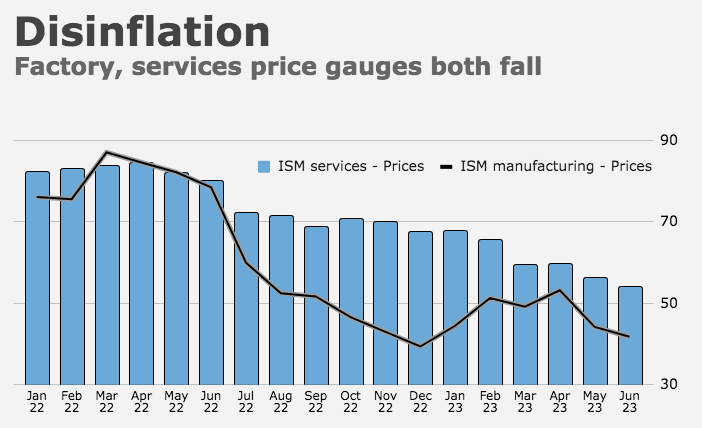
When taken with much softer readings on ISM’s price gauges, the largest monthly decline in used vehicle prices in more than three years and widespread expectations for moderating shelter price growth, those hoping to see a light at the end of the inflation tunnel that isn’t an oncoming train have reason to be cautiously optimistic.
And yet, small businesses aren’t — optimistic, I mean. “Halfway through the year, small business owners remain very pessimistic about future business conditions and their sales prospects,” NFIB Chief Economist Bill Dunkelberg said Tuesday. “Owners are still try[ing] to pass on higher inventory, labor and energy costs.”
Although the headline NFIB print rose to 91, matching the highest estimate from 20 economists, June still marked the 18th straight month during which the gauge loitered below its five-decade average. 59% of owners were either hiring or trying to hire last month. Of those, almost everyone said there were few or no qualified applicants.