
Is the pain trade still higher?
That’ll be a key question going forward for ebullient US equities, which are riding a hot streak, up five weeks running, the best stretch since Q4 2021.
Stocks are trading at pre-liftoff levels, prompting some observers (where “some” means I’m not alone in arguing there’s too much wealth floating around out there) to suggest Jerome Powell should lean into the market before the rally has a chance to seep into services inflation via the wealth effect-consumption nexus.
“It was April 6, 2022, when former NY Fed President Bill Dudley penned [a] Bloomberg Op-Ed titled ‘If Stocks Don’t Fall, the Fed Needs to Force Them,'” JonesTrading’s Mike O’Rourke recalled this week, while lamenting slow progress on core inflation. “Maybe Dudley was on to something — that financial conditions do matter.”

The text on the chart says it all. The Fed tried to send a message through the June dot plot. Investors aren’t buying it. Instead, they’re buying stocks. “Don’t fight the Fed,” the old saying goes. For now, FOMO > FOMC.
The irony is that part of the reason investors are comfortable buying equities despite implicit warnings from policymakers is that for the better part of three decades (and particularly during the post-GFC years) not fighting the Fed meant buying stocks, shorting vol and so on.
As discussed in the latest weekly, the Fed has a burgeoning bubble problem, and there’s still a mountain of cash parked in money market funds that could be deployed into equities. At the same time — and this speaks to the “pain trade” point — there’s evidence (anecdotal and otherwise) to suggest professional discretionary investors still aren’t fully engaged.
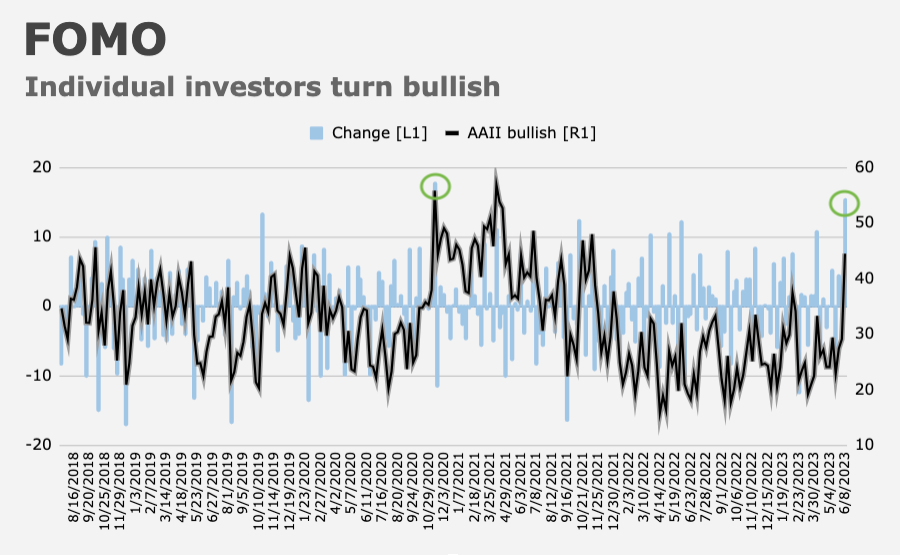
Recall that retail investor sentiment recently flipped bullish, and in rather dramatic fashion. As BofA’s Michael Hartnett pointed out, that makes for a rather stark juxtaposition with fund manager positioning, as communicated via the bank’s closely-watched monthly survey.

“Individual investor sentiment is at 19-month highs, melting up with frothy stocks as investors chase the bull,” Hartnett said, before calling the contrast with underweight asset allocators “eye-catching.” The charts make the point.
Although some indicators (e.g., Deutsche Bank’s gauge) show discretionary investors are now neutral as a group, I think it’s fair to say there are still pockets of under-positioning out there. If there weren’t, you wouldn’t see the kind of melt-up / “crash-up” behavior witnessed at various intervals over the course of this month.
For what it’s worth, a Goldman sentiment indicator which measures positioning across retail, institutional and foreign investors is now very stretched.

As is obvious from the simple figure shown above, this is the first time the bank’s indicator has breached the stretched threshold since the onset of Fed hikes.
But, again, it’s a question of whether (and how many) funds still feel compelled to chase the market from behind. If you didn’t “have it on,” so to speak, this latest leg higher, first on the Nvidia guide, then broadening out in June, was pretty vexing. The VIX seasonality is coming up, but that’s still six weeks away, and if rates vol dies and doubts about the Fed’s conviction keep the dollar at bay, it’s not terribly difficult to imagine equities extending gains in the near-term, even as it’s tempting to suggest they’ll surely take a break after a five-week run.
Although BofA’s Hartnett remains skeptical, he conceded that with cash levels in the bank’s fund manager poll holding above 5%, the “pain trade is still up.” Writing a few days ago, Nomura’s Charlie McElligott said that “following the end-of-quarter trade, there remains energy for a further melt-up on ‘Fear of Cash Underperforming Stocks”/ FOMO on the H2 start in July, then with less than six months to make your year.”


well…I feel very sorry for anyone worrying about “less than 6 months to make your year,” … hopefully people feeling that way have support for a more patient and positive perspective…
. . . which they can seek at their next employer.
That’s the reality for a lot of professional investors. Everyone has a leash, it can be days, a quarter, a year, but it’s seldom multiple years.