

Much has been made recently of the apparent disparity between layoffs in the tech sector and some of the most robust labor market data in US history.
Job cuts are piling up at a veritable who’s who of tech firms. At this point, I’ve personally lost count, but suffice to say at least 100,000 people have been impacted by the decisions, which, generally speaking, were the result of over-hiring during the pandemic.
It was tempting to extrapolate COVID-related trends, which is precisely what tech executives did. Some of those executives have lived through downturns in their careers, but others haven’t, and it’s safe to say nobody currently occupying a C-suite seat was in a position of corporate authority during the Spanish flu. So, even for executives with experience navigating choppy waters, the last few years presented a unique challenge.

Given all of that, it’s hardly surprising that many firms are angling to make 2023 a “year of efficiency,” as Mark Zuckerberg put it last week. On Monday, Dell cited “an uncertain future” for 6,650 planned cuts, becoming the latest tech firm to announce a meaningful headcount reduction.
So, what to make of “lean tech,” as it were, in an environment when seemingly every other employer in the country can’t find enough workers? In a new note on the subject, Goldman’s Ronnie Walker posed a few more specific questions. “Are [tech layoffs] an indication that while there is still plenty of demand for workers in a few industries, the labor market is much weaker in other industries, especially higher-paying ones?” he wondered. “Or an early warning sign about deteriorating demand at some companies that could soon spread to others too?”
Not to ruin the suspense, but Goldman isn’t particularly concerned about the broader labor market. Companies announcing layoffs have two additional things in common besides being associated, loosely or otherwise, with technology.
First, most of these companies hired at a torrid pace over the pandemic period. In fact, headcount is, on average, more than 40% higher compared to levels witnessed on the eve of the pandemic. That makes for a stark juxtaposition with the overall economy, where payrolls are a mere 2% higher.

As Walker put it, some of these companies simply “over-extrapolat[ed] pandemic-related trends that ultimately proved more fleeting than expected.”
In addition, it’s entirely likely that these layoffs are partly attributable to plunging stock prices and associated consternation among investors. As the chart shows, public companies announcing layoffs witnessed a -40% drop in their share price from the peak, on average, compared to just -14% for the S&P 500.
Of course, the gratuitous bloodletting in tech shares owes a lot to the impact of higher rates on growth stocks, which had the most to lose in a scenario where sharply higher real yields resulted in multiple compression.
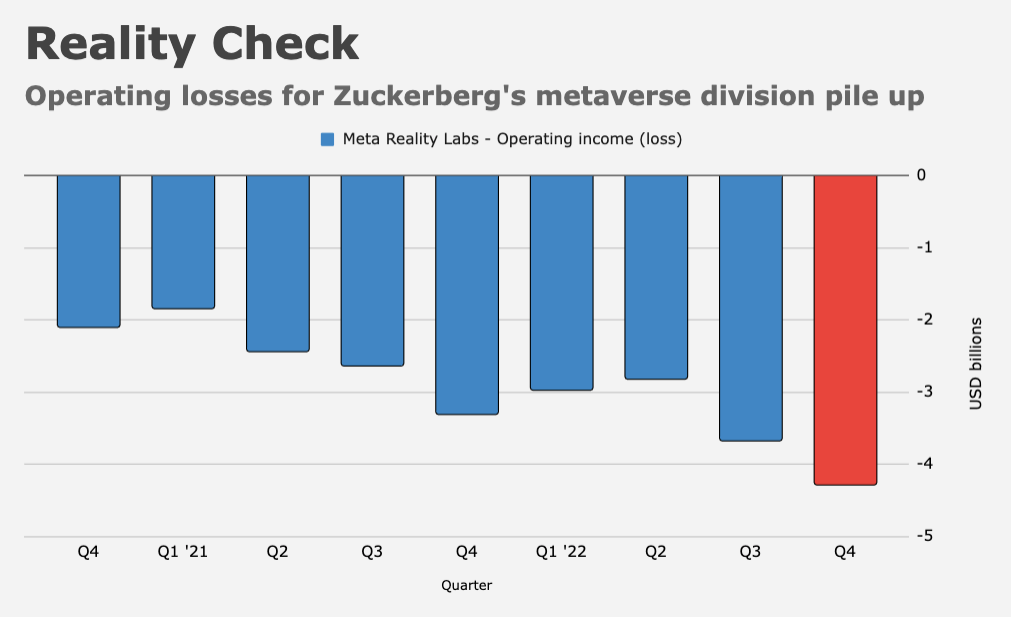
So, what do you do in that situation? You can blame the Fed, but that’s not necessarily going to placate shareholders. Cutting costs, on the other hand, can do wonders to allay investor concerns. Just ask Zuckerberg, who enjoyed a one-day $12.5 billion paper gain last week when Meta’s pretensions to cost discipline (never mind the sea of red in Reality Labs) triggered a mind-bending stock surge.
“This could mean that some of the announced layoffs were more an effort to improve company valuations by responding to investor demands to shrink workforces that were perceived to have grown too large and expensive, rather than a signal that the demand outlook had worsened,” Goldman went on to suggest.
Yes, I’d say that’s probably accurate. On Meta’s call last week, Zuckerberg and Susan Li reiterated that the 11,000 jobs Meta eliminated in November were “just the beginning” of the company’s “efficiency efforts.” That doesn’t have to mean more job cuts, of course. And hopefully it won’t. But when the stock’s down nearly 75%, as Meta’s was at one point, you do what you gotta do, I suppose.
The (sad) punchline is that once the AI learns to engineer itself, all tech workers may be rendered more or less redundant. Even, perhaps, the CEOs.
On Tuesday afternoon, Zoom said it’s laying off 1,300 workers, or around 15% of its workforce. “I know this is a difficult message to hear, and certainly not one I ever wanted to deliver,” CEO Eric Yuan told “Zoomies,” whose sacrifice, a letter promised, “will not [be] in vain.” Zoom’s shares fell nearly 90% from their pandemic highs to the lows in December.


So investors are to blame for layoffs? CEO’s know that laying people off will cause a rally that they can convert into income for the business so they are giving the market what it wants? As in, as much as we (the voters) complain about the government not making sure that there are enough good paying jobs for everyone, we (the investors) actually incentivize job cuts.
Seems like announced layoffs are becoming the new share buybacks. May be time to tax them too.
I would imagine that most of the tech layoffs will have no trouble finding jobs elsewhere. There may be some adjustments to the new income, but that’s to be expected.
My daughter has spent the last ten years working for the tech division of a digital ad agency, a division which develops, stores, and distributes data to the company’s agency clients. The firm was acquired a few months ago. The acquirer messed up the data services piece and so it is essentially eliminating it and laying off the staff. I’ve seen this with other tech companies as well. Layoffs are not just a matter of cutting a percent of employees in an area, it’s often knocking out whole areas and generally cleaning house and/or trimming the portfolio. My daughter has never had trouble getting a worthwhile job before but as one hits that age with a five in it and has held a higher level position (managing six teams), the market is much tighter. Right now she has severance and has said it’s time for a sabbatical. Her big decision coming up is that it is time to be a VP and she has said she is not sure about that idea. Me, I had tenure and an endowed chair to the end.
What were you a professor of?
This is all about placating the shareholders/investors and reducing the size of the employee resource high tech companies have been accumulating over the past 2-3 years. A real layoff would be 20-30% of the workforce and most of the announcements are 5-10%. I would watch for additional layoffs in the coming quarters in high tech.
I think you are close to right. Equity institutional investors like to see bodies falling out of windows. Bond investors like it considerably more…I haven’t done a study, but I imagine you would see a pretty strong correlation between stock price decline and layoffs going back to the seventies…I see institutions having a shorter horizon with each passing year since 1979..(when I started)
Check out #10 on this list: https://www.youngmoney.co/p/11-things-0-interest-rates-caused
When you hear tech exec’s talk about return to office and increasing productivity it makes you wonder how much of this was going on. Especially with a post-Covid “YOLO” workforce, it may explain why spending has been holding up as it has.
I think companies appreciate Wilson’s margin compression outlook more than investors do.