

It’s all about growth. The bond selloff, I mean.
That’s according to NY Fed chief John Williams, who on Wednesday told CNBC that in his view, a “large part” of what’s driving yields higher is “a strong US economy and a strong economic outlook fueled by big investments in AI and data centers.”
It’s easy enough to chuckle derisively at benign (rosy, even) explanations for a situation which, as The Wall Street Journal put it, “risk[s] making life more expensive for Americans.”
Wednesday’s MBA update showed the average 30-year fixed ticked higher for a second week, to 6.79%. More timely data from Mortgage News Daily reflects the full impact of the most recent leg higher for Treasury yields.

As the figure shows, the average rate for the best-qualified buyers was closer to 6.90% on Tuesday, the highest since June of last year.
Purchase apps actually managed to rise week over week, according to the MBA’s gauge, but I doubt the index will prove resilient in the face of a return to seven-handle mortgages, which is probably where we’re headed.
10-year US yields were the highest since November of 2023 mid-week, which is to say the highest since Janet Yellen heeded the warning from a rising term premium in the course of rescuing Treasurys from what might’ve otherwise been an unprecedented third consecutive annual decline.

There’s the chart. The optics are terrible in the context of the mid-terms, but Donald Trump doesn’t seem to care. On Wednesday, he suggested renaming the Strait of Hormuz the “Trump Strait,” not exactly the sort of gesture conducive to deescalation in a conflict that’s contributing to a five-years-and-counting inflation overshoot.
Trump’s late-2025 pivot to domestic policy and specifically to affordability is now like your commitment to eating better halfway into a jar of peanut butter at midnight (or your promise to cap a Phipps Plaza shopping trip at $5,000, $8,000 in): Lost irretrievably and thereby not worth pretending to care about.
Note that US diesel prices are back near their April highs, even as regular gas prices in America are still below their own war peaks. “US refineries primarily focus on producing gasoline,” BMO’s US rates team wrote Tuesday. “The resurgence of diesel prices has occurred, in large part, due to a slowdown in production [as] attacks on refineries in the Mideast, combined with the slowing in the flow of oil supply, have significantly reduced refining production capabilities.”
All of this is a bitter pill for voters who were promised price relief. Trump ran, lest we should forget, on a pledge to “fix” the country’s inflation problem. Instead, he’s rekindled price pressures with two wars of choice: A tariff war with everybody and a shooting war with Iran.

As the figure above, from BofA, shows, the MOU bounce in Trump’s overall and issue-specific approval ratings is gone.
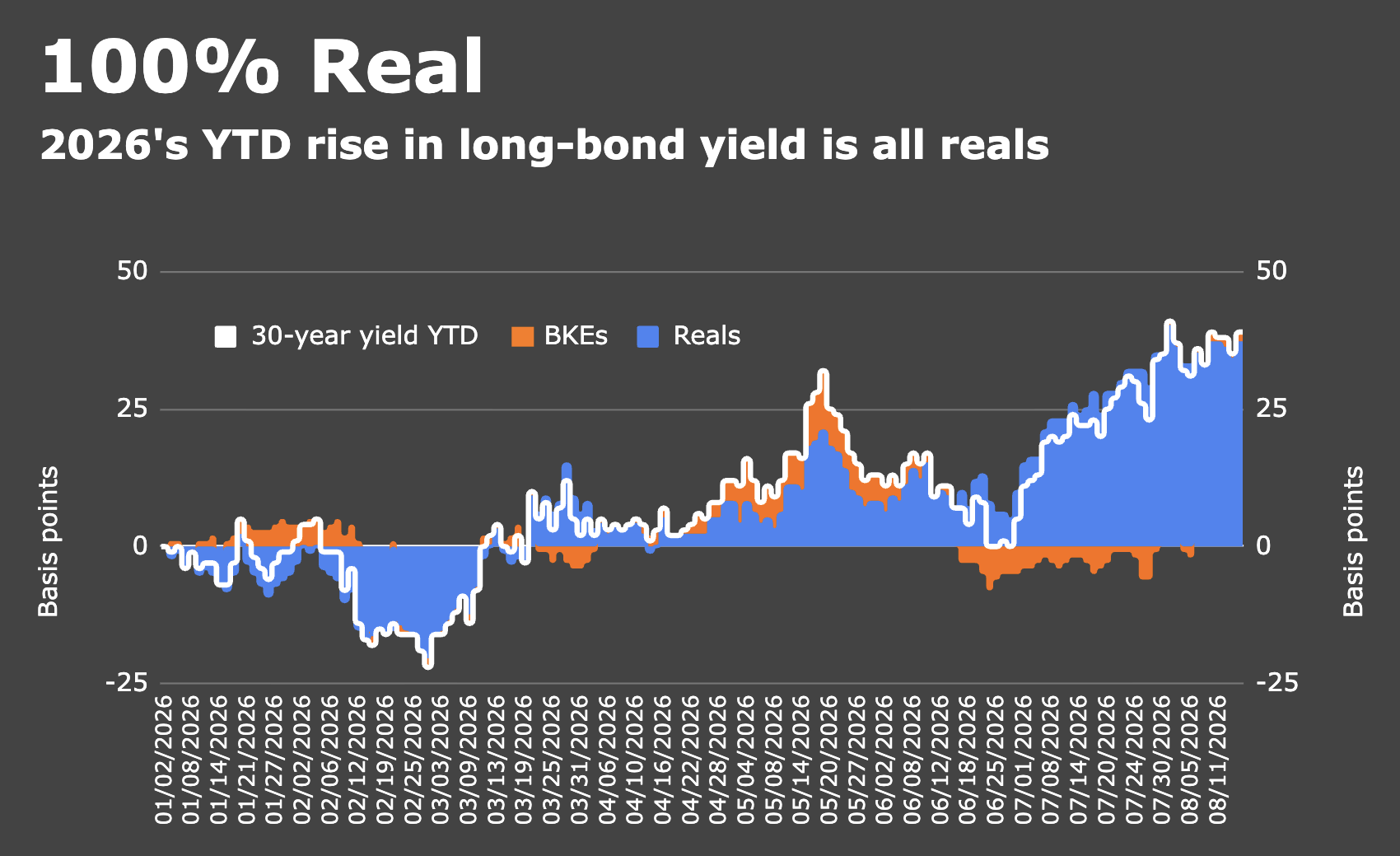
While Williams is right to suggest growth expectations are part of the story when it comes to higher yields (recall that the long bond selloff is all reals, not breakevens), unnecessarily high energy prices, trade taxes and a sticky term premium to reflect the absence of a credible plan for addressing America’s debt and deficit trajectories, all play a part.
And I anyway doubt voters bombarded with headlines about soaring US borrowing costs will be interested in the finer points of the long run neutral discussion. (“Your rate’s going to be 7.10%, but remember: R-star’s higher.”)
Although the bond bleed took a breather on Wednesday, Scott Bessent’s surely hearing it from Trump amid incessant jeers from the financial media, which is very keen to point out that long bond yields have retraced the entirety of the buyback rally.
“With 30-year yields back up near 5.30%, the market appears comfortable testing Bessent’s resolve to contain long-end rates moving forward,” BMO’s Ian Lyngen remarked, in a Wednesday note.
“Even if the Secretary chooses to more-than-double bond buybacks starting next week, the move wouldn’t address the prevailing fundamental drivers of the upward pressure on 10- and 30-year yields,” he added, whether inflation, rate-hike expectations, fiscal concerns or, as a chipper Williams suggested, “a strong economic outlook.”


I wonder if the sign proclaiming ‘Trump Strait’ will have gold plated letters? Or will these letters be solid gold?
That will never happen: Trump has never been “strait” with anyone.
Judging by the fact that Lord T’s “gold coins” have no gold at all in them, I would guess that all the reputed gold he’s circulating is all (not gold) plated stainless steel. Not only that but they will only be issued for a year or less.
I expect a fair number of those coins are going to be refused, defaced, and altered. I expect some fairly good memes and news stories will eventually come from it. There are actually artists who specialize in re-working images on coins. Bad idea to hand out pictures of yourself when you are unpopular and so controversial.