

Don’t worry everybody: Kevin Warsh has this under control.
“This” being inflation. He said as much on Tuesday during prepared remarks for two days of testimony on Capitol Hill.
The Fed, Warsh told lawmakers, will “get monetary policy right,” or near enough to right that “the inflation surge of the last five years will be a thing of the past.”
(Not much of a writer, that Kevin. Regardless of what happens going forward, the inflation surge “of the last five years” is, and will continue to be, “a thing of the past.” By definition.)
Warsh caught a break on Tuesday when the BLS delivered a very favorable inflation report just minutes before his congressional grilling began. The release showed consumer prices receded in June from May pretty much across the board.
Personally, I don’t think a so-called “adjustment hike” was ever on the cards for this month’s policy meeting, notwithstanding the fact that a majority of policymakers at the June FOMC expressed palpable concern about the outlook for price growth.
But if Warsh was entertaining the idea of a token hike to establish credibility he lacks by virtue of agreeing to be Donald Trump’s Fed chair, he almost surely isn’t in the wake of the June CPI readout.
During his prepared remarks to Congress, Warsh took the opportunity to talk up AI-assisted, structural disinflation. From a reputational perspective, Warsh has quite a bit invested in that narrative, even as his colleagues caution on “considerable uncertainty” around both the timeline and the magnitude of any potential AI-related productivity gains.
“Our task force on productivity and jobs will survey the pace, reach and impact of new general-purpose technologies,” Warsh told lawmakers. “We’ve experienced technological advances all our lives, [b]ut given the scale of investment — and potential changes in the method and speed of innovation — we might be seeing changes of a different order.”
Maybe. But in the meantime, AI’s actually putting upward pressure on consumer prices, a point driven home last month when Apple raised the cost of its products, even as it spared the iPhone.
With that in mind, it’s prudent to highlight the figure below, which shows you the surge in PCE price growth for the computer software and accessories category.
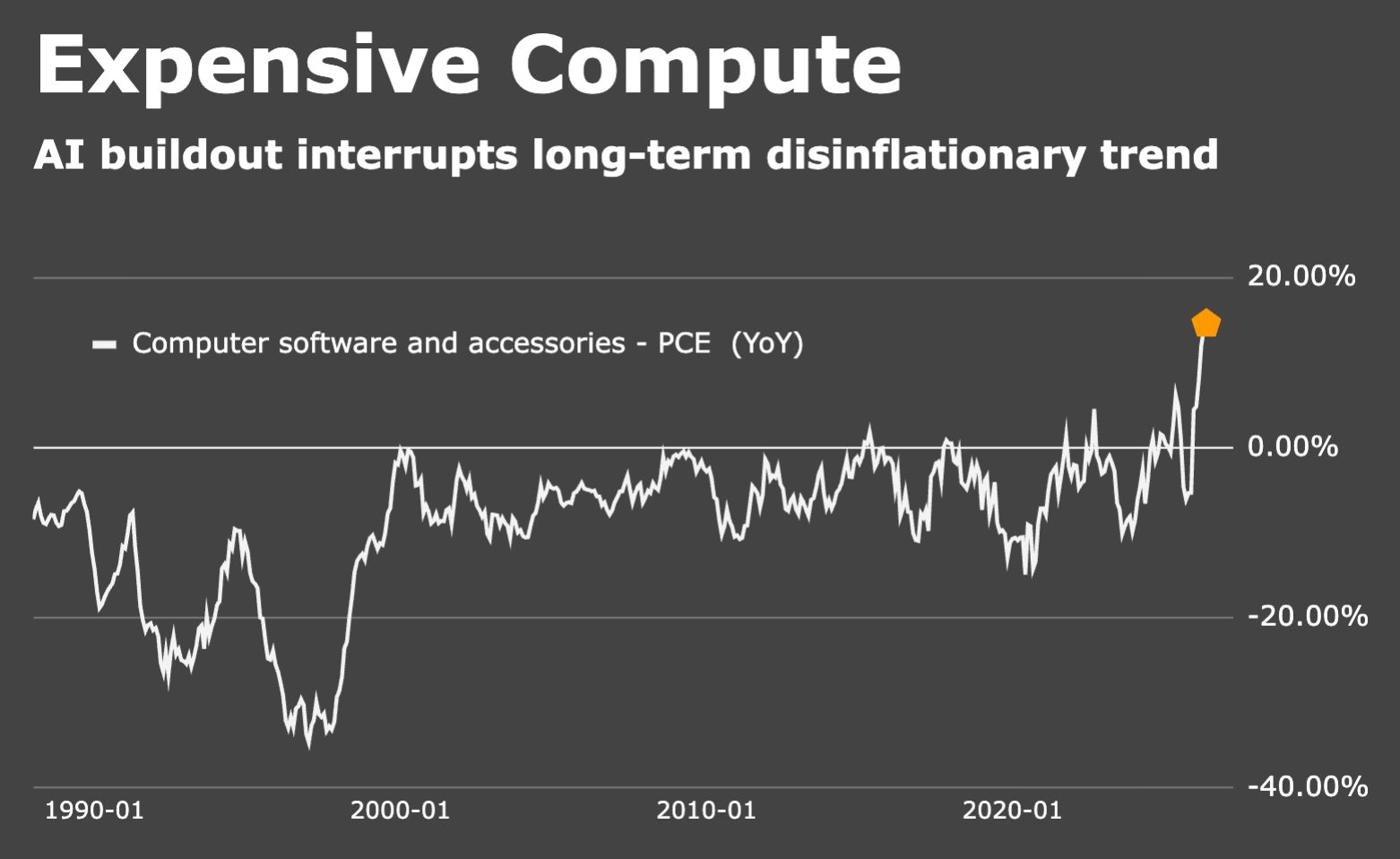
As you can see, the annual rate of inflation there was nearly 15% in May, the highest ever. The series goes back nearly half a century. The CPI gauge rose 17.4% in June, according to Tuesday’s BLS release.
This metric “was in negative territory as recently as November 2025,” BMO’s Ian Lyngen remarked, adding that in the two decades preceding the pandemic, “the average annual pace was -5.3%.”
In the same note, Lyngen flagged research that suggests the category’s subject to measurement error, but emphasized that “the AI boom is putting upward pressure on prices” regardless, and said “strong AI-related demand will remain a key source of inflationary concern even if the pass-through risks from tariffs and the oil shock are fading.”
Now that the war’s back on in the Gulf, pass-through risk from the oil shock may reenter the discussion depending on how far Warsh’s boss decides to push the issue.
Trump’s proposed 20% protection fee on shipping through the Strait of Hormuz would add significantly to costs. Even the Iranians thought it excessive.
“[Trump] is absolutely right. Whoever provides secure and safe passage of commercial vessels through the Strait of Hormuz should be compensated for this service,” Abbas Araghchi quipped. “20% is of course too much. We will be fair.”
Later, Trump dropped the plan. “Based on highly productive conversations with Middle East leadership, I have decided to replace the 20% United States Reimbursement Fee with Trade and Investment Deals that the various Gulf States will be making into the United States,” he said.


“Hawkish>Credible” is the single most important message Warsh must successfully portray. The media is nervously playing along. Were Warsh Hawkish>Cave to occur, we will have a lot of big problems fast.
A fully laden VLCC would pay around $33 million in protection money to Trump/USA to transit the strait of Hormuz …Iran $2 million. Who would you rather pay?
I heard someone trying to make him promise he would follow the data. Even if Trump is disappointed. Hats off to that guy for trying.
From what I can see, Warsh’s best out is to delay cutting if inflation subsides and/or the economy slows. Assuming oil prices somewhat behave he has until December . No midterms, committees should be functioning and have preliminary results and trump/bessent will be lame ducks. This suggests a sluggish reaction function to a slowdown. The question is what is the reaction function if inflation stickiness is to the upside? He will likely hike 2-3 times. A recession won’t be long once financial conditions tighten. Next would be a high one handle funds rate in 2028.
Kevin is not rasing rates:
Warsh today clarified that he thinks none of the existing, published measures of inflation that remove price outliers, such as the Dallas Fed trimmed mean, reliably capture underlying price pressures:
“None of those are very good measures of underlying inflation…. My view is that we need new measures to understand the underlying changes in inflation. Am I interested in what’s the mean or median price of a good and a big box retailer? You bet I am. And none of these measures capture that. I am super interested in finding new measures to do a better job to help us inform our decisions so that the inflation of the last five years don’t continue.”
At his confirmation hearing, he had referred to “trimmed averages” and “median type measures” as possibly more useful gauges of underlying inflation. This led to greater focus on median or trimmed mean gauges from Wall Street analysts who closely monitor inflation and map price data into their analysis of the Fed’s reaction function.
(In a WSJ story in May that was referenced at the hearing today, I wrote, “Warsh didn’t specify which trimmed mean he had in mind. The most widely cited is the Dallas Fed’s version…”)
Nick Timiraos included a great graph, for us dyslexic few…
https://x.com/NickTimiraos/status/2077125383489740825?ref_src=twsrc%5Egoogle%7Ctwcamp%5Eserp%7Ctwgr%5Etweet
On the other hand, total praise by the Doc.:
Fascinating to see how Federal Reserve Chair Warsh’s clarity and quality of communication elevate the Congressional hearing as a whole, especially as his reform orientation and intellectual curiosity prove contagious.
A real breath of fresh air after a period of operational slippages and intellectual inertia at the Fed.
https://x.com/elerianm/status/2077084741614932276?ref_src=twsrc%5Egoogle%7Ctwcamp%5Eserp%7Ctwgr%5Etweet
No interest rate raise this year because we need another task force (study group works too) for “trimmed averages and median type measures”! “His reform orientation and intellectual curiosity prove contagious” in the House of Representatives has to be the best laugh of the day. My head is still spinning.
Enjoy
Warsh’s strategy may be coming into focus: 1) establish that current inflation measures can’t be trusted, 2) setup task forces to come up with better metrics, and 3) thereby delaying rate decisions until after midterms while waiting for ‘better’ task force data. Wonder how that will sit with the king of crazy glue.