

The fundamentals are sound.
Said everyone in the days and weeks before every market crash in history.
I’m just joking. I mean, that is something people say when they’re trying to justify richly-valued assets, including and especially stocks. And you do hear that sort of rationalizing during periods defined by what always looks, in hindsight, like speculative excess.
But in our zeal to deride sundry Pollyannas, we shouldn’t neglect entirely evidence that suggests the fundamentals — however we define the term — actually are sound. Froth and sound fundamentals aren’t mutually exclusive, after all.
Just because the Reddit crowd’s bidding up — what is it today? — Kohl’s, isn’t conclusive proof that the broader market’s out of step with “reality,” it’s just a testament to the fact that “gamblers gonna gamble,” so to speak.
Earlier this week, I mentioned revisions breadth for the S&P. It’s gone vertical of late, exploding out of net negative territory to the reflect the most pervasive earnings optimism since 2022. With that in mind, it’s worth highlighting the charts below, from SocGen’s Manish Kabra, which give you some global context for that factoid.

“The S&P is in net EPS-upgrade territory and crucially it’s leading versus RoW for the past two months now,” Kabra remarked, referring to the bar chart on the left, which compares revisions ratios across locales.
The figure on the right gives you a sense of just how rapid the inflection really is. The black line’s the rolling three-month average. The red line (the current earnings revision ratio) is running way out ahead of the trailing mean.
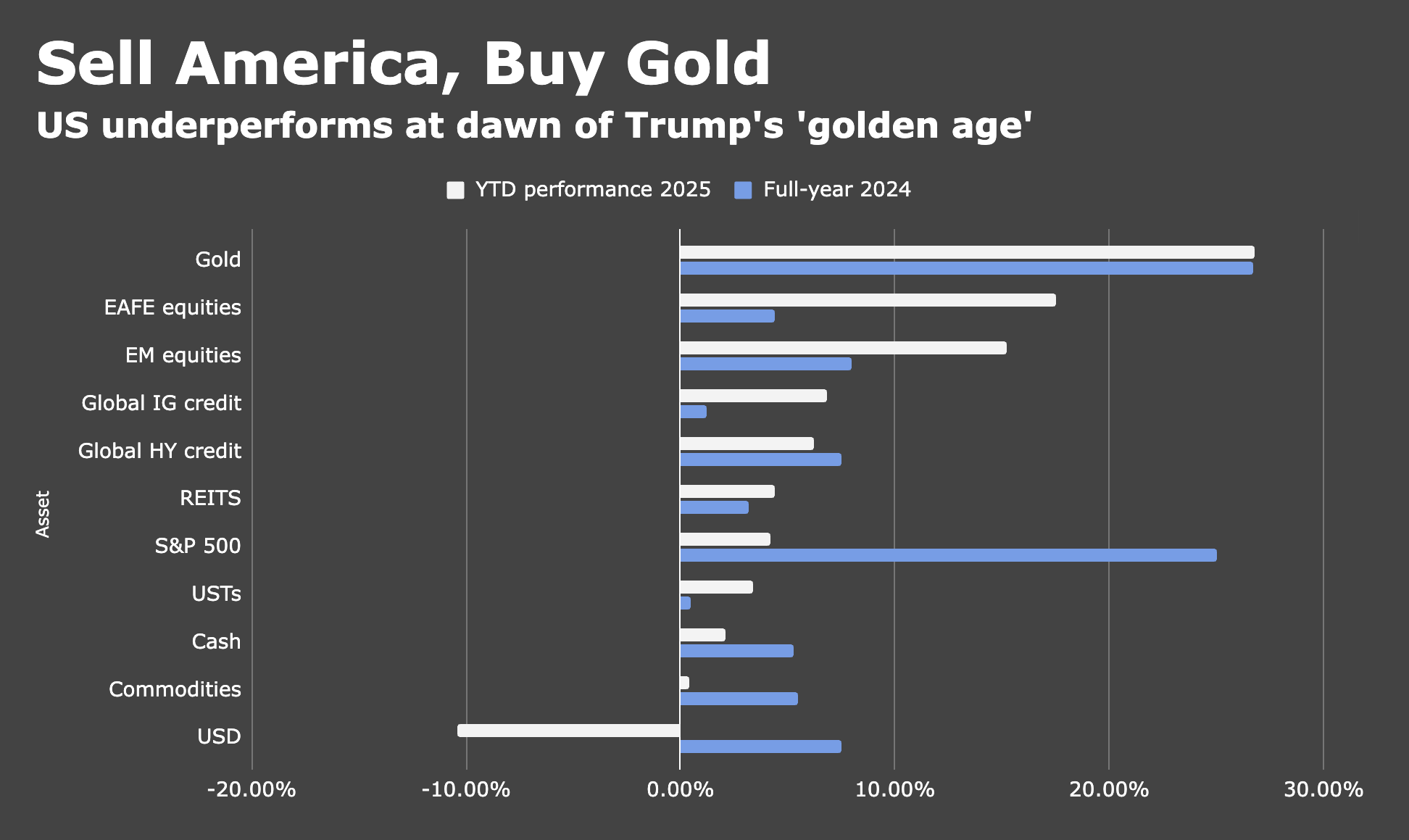
Of course, these are forecasts we’re talking about, so make allowances. Analysts could always be wrong. But given the historic underperformance of US shares (and US assets in general) during the first half of 2025, it’s fair to suggest the inflection in forward US EPS sentiment could presage the return of US equity market exceptionalism.
For all the talk of a global rotation away from US stocks, corporate America’s more dominant than ever when it comes to profitability. As the figure below shows, US profit share as a percentage of global equities remains near record highs.

The profit metric (the red line) is more important than market-cap dominance (the green line). The latter just reflects Mag7 valuations and the perpetual motion machine that funnels ever more money into the largest index weights.
Although he stopped short of endorsing this view himself, Kabra said it’s worth asking if we’re “on the cusp of new cyclical excitement for US assets.”
His view (SocGen’s house view) is that the S&P closes out the year somewhere near 6,400, a projection Kabra described as “hitherto bullish,” a nod to the fact that we’re nearly there already.
In the same note, he said a backdrop defined by a more dovish Fed, a dollar that’s probably biased lower, tariff costs that’ll ultimately get “split across the supply-chain” and favorable liquidity from the Trump administration’s de-regulation push all point to a risk rally that’s “supported fundamentally.”


APB for American Exceptionalism — it has apparently escaped from CECOT.