Did you hear the good news?
That “big, beautiful,” budget-busting regressive tax cut Republicans just rammed through Congress “provided a number of important wins for households.”
That’s according to NAHB Chairman and North Carolina homebuilder Buddy Hughes. Without casting aspersions, it’s fair to suggest the veracity of Buddy’s claim about Donald Trump’s signature legislation depends on your socioeconomic caste. If you’re rich, then yeah, the legislation did indeed “provide a number of important wins.” If you’re not rich… well, “the poor get poorer,” as the saying goes.
Buddy’s remarks on the bill came alongside the July vintage of the NAHB’s builder sentiment survey, released on Thursday. Spoiler alert: Builders are still feeling pretty glum. The headline print was 33 this month, up a tick from June, but God-awful all the same.

As the figure makes clear, “God-awful” isn’t an exaggeration. Since 2022, the NAHB headline has visited and revisited some of its worst levels since the financial crisis. And we’re still loitering near those levels today.
After suggesting the GOP’s bill will “provide economic momentum after a disappointing spring,” thereby bolstering homebuilders and would-be buyers alike, Hughes snapped back to reality. US housing, he said, remains bedeviled by “poor affordability conditions, particularly from elevated interest rates.”
What he didn’t mention is the fact that the deficit impact of the “big, beautiful” bill is part and parcel of the fiscal concerns putting a floor under benchmark US borrowing costs, which are of far greater relevance for mortgage rates than Fed funds. Further, Trump’s tariffs, if they ever manifest in higher inflation, will likewise push up longer-end yields.
Cue the MBA’s Joel Kan. “Treasury yields finished higher last week on average despite an intra-week drop, driven partly by renewed concerns of the impact of tariffs on the economy,” he said, while editorializing around the first rate increase in three weeks and just the second on the MBA’s 30-year fixed index since May.

Not surprisingly, application activity slowed over the week. Indeed, the MBA purchase index fell 12% on a seasonally-adjusted basis.
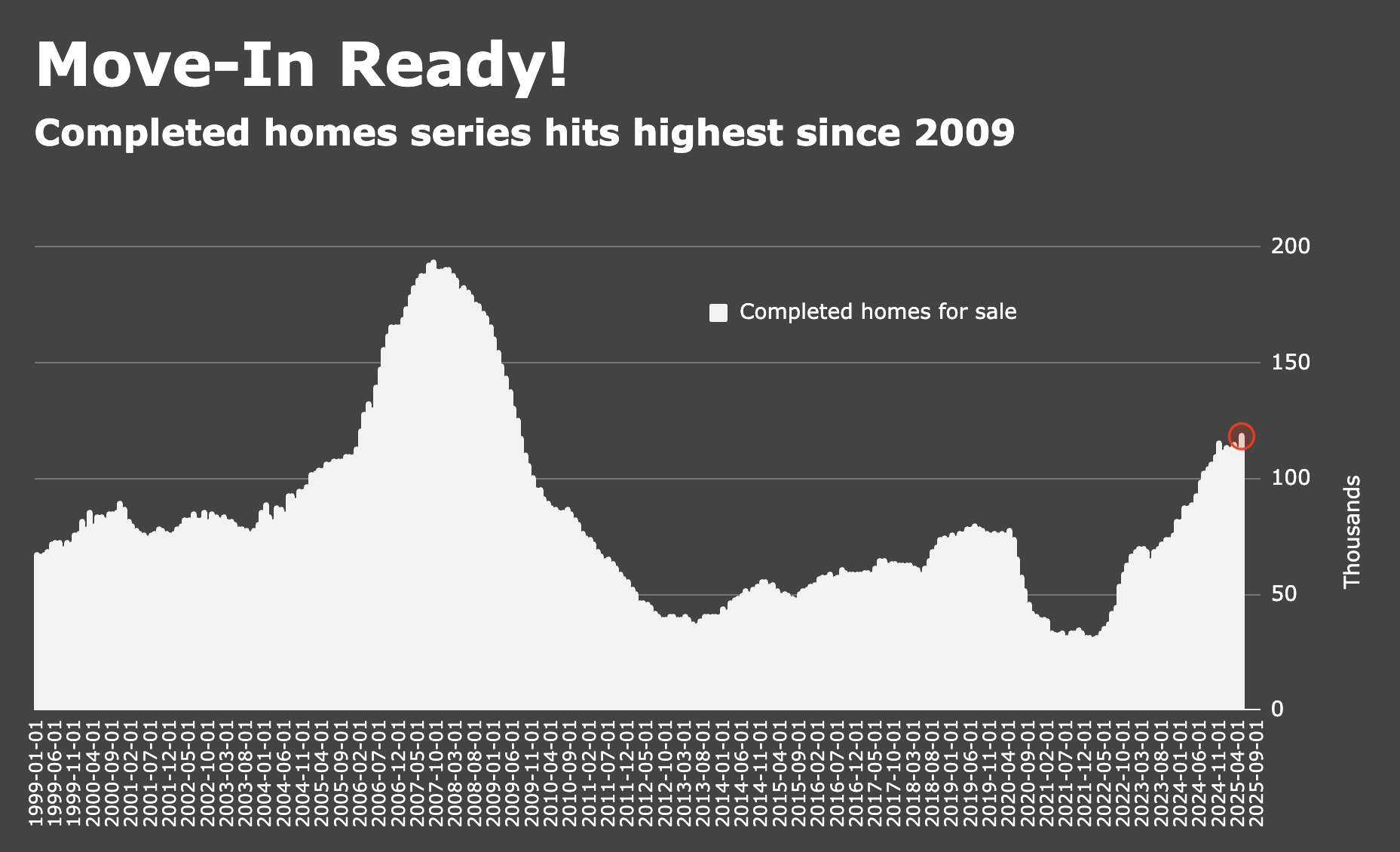
What does this mean for builders sitting on the most unsold homes since 2009? Simple: Incentives. Like rate buy-downs. And when those don’t work, outright price cuts.
Sure enough, Thursday’s NAHB release showed that nearly four in 10 builders cut prices in July, the most ever. Let me go ahead and admit to overdramatizing that data point: “Ever” just means since the NAHB started asking the question on a monthly basis in 2022. So, this series is all of three years old. Still, it’s worth a mention.
In the same report, NAHB chief economist Robert Dietz reiterated that single-family housing starts will probably decline in 2025 “due to ongoing housing affordability challenges.”
Meanwhile, in the resale market, Redfin data shows the gap between the median asking price and selling price has narrowed to just $5,880. “The small size of that gap is a sign that sellers are starting to price their homes lower as they realize it’s a buyer’s market,” Dana Anderson said, adding that annual wage growth in the US is now outpacing the YoY rate of sales price appreciation by more than two full percentage points.