

Small businesses in the US are feeling pretty glum these days. That’s bad news.
As I never tire of reminding readers, small businesses comprise nearly half of private sector jobs in America. On the eve of the pandemic, they accounted for almost two-thirds of net new job creation since 1995, according to official statistics.
That’s why it was so critical for the federal government to backstop small business payrolls during the COVID lockdowns — even at the risk of rampant fraud (which happened).
Small firms faced enough existential threats in the 21st century without having to grapple with public health measures which, while necessary in the early days of the pandemic to guard against existential threats to the species, nevertheless imperiled businesses without sufficient cash to cover operating expenses, including and especially payrolls, with no revenue coming in.
When the US economy re-opened, small firms faced a new challenge: Finding employees. Then another challenge: Intense competition for scarce workers, which translated directly into soaring labor costs. Then another challenge after that: Rampant input cost inflation. It was out of the frying pan and into the fire. Over and over and over again.
The mood among small businesses never really recovered. According to the latest vintage of the NFIB’s survey, released on Tuesday, sentiment was the worst in March since December of 2012.

Note from the visual that March marked the 27th consecutive month below the half-century average.
If you pan out on the index, current levels look even worse. These are, simply put, some of the worst NFIB headline prints in the history of the series which, I’d be remiss not to note, hit a record high during the Trump presidency.
These sorts of data points are maddening for the White House. The idea that Donald Trump cares more about small business owners than Joe Biden is plainly ridiculous, but just like everybody else, small business owners hate inflation with a holy passion.
“Inflation continues to frustrate owners as a significant share of them still report it as their biggest problem in operating their business,” the NFIB said Tuesday.
“Significant share” is an understatement. At 25%, inflation’s share of the “single most important problem” responses was a country mile above every other response with the exceptions of labor costs and quality of labor, both of which are related to inflation. (A lot of owners said “taxes” too.)
The NFIB weighed in the outlook for Fed policy, taking note specifically of Neel Kashkari’s suggestion that the Committee might not cut rates at all this year. “The data are certainly not supportive of cuts at the next two FOMC meetings. Cuts at those meetings are off the table,” the release declared. (I agree, but I’d gently note that Bill Dunkelberg isn’t an FOMC voter this year.)
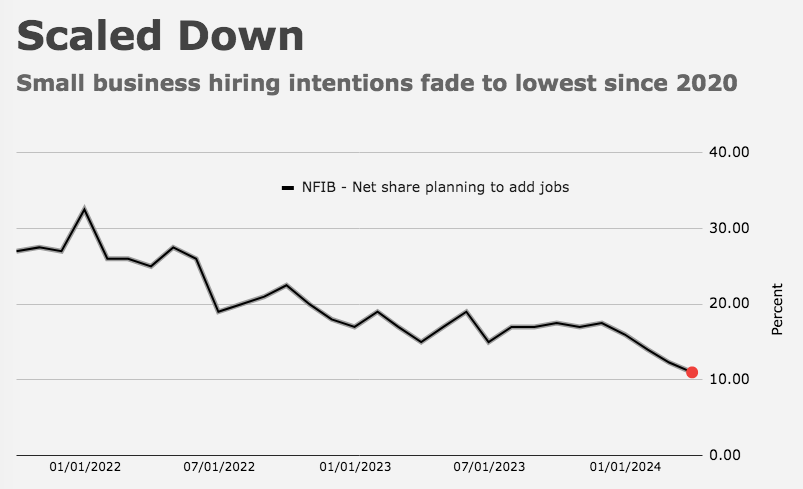
The color from the survey acknowledged robust jobs gains at the economy-wide level, at least as reflected in the NFP releases. But some bears have been keen lately to note that the hiring plans series in the NFIB’s labor survey suggests payroll gains are poised to moderate.
Of course, the longer the Fed holds terminal, the more challenging credit conditions will be for businesses which don’t enjoy ready access to capital markets and/or long-term fixed-rate financing.
“One half of the Fed’s mandate looks good, the other half is still frustrating Main Street,” the NFIB said, summarizing. “In the meantime, small businesses will have to manage higher financing costs a bit longer.”
On September 11, 2018, Donald Trump posted the text of a CNBC article to an official White House webpage. “Small business optimism surges to highest level ever, topping previous record under Reagan,” the headline read.


This article could have easily been an interview with me. Well, all but the ‘closed during the pandemic’ part, which looking back I wish I WAS closed and received payroll support, at least I would have had a break.
But yes, from the small business trenches, I can attest to the validity of these points. Ballooning debt payments, constantly worried about raising prices just to keep afloat versus alienating customers, generational demographic shifts in alcohol consumption, competition and commoditization by Uber & GoPuff et al, lack of corporate parties/events/gift giving….. I’m under constant stress and left wondering where it all went wrong.
I at least find escapism in reading superior market commentary and pretending that I have investable cashflow.
I’m a small independant IT consultant, who lost his last big contract a year ago just as the tech recession got underway. I haven’t had any customers to worry about in a year now. I’m fed up with not calling this a recession, whether or not the rigorous technical description applies. People are hurting. I talked to a recruiter today who got 1000 resumes for a single position. She’s been in the biz since before the dotcom crash and she said that didn’t compare to this year. I know I’ve seen, via a job site where they let you know how many people have applied, 270 people apply for a single senior position in my very narrow technical specialty.
At least misery loves company. Cheers.
I don’t know. Something doesn’t add up here. From the perspective of small business owners, I assume they want both lower rates and lower inflation. To suggest the Fed keeping rates high for longer doesn’t really help the owners, unless we’re willing to concede that doing so would translate into lower inflation. Sure, keeping rates high have bolstered the dollar to the best interest of the US, which is the largest importer of goods in the world. But commodities are rallying nevertheless against a fairly strong US dollar this year. It’s becoming increasingly clear that the US will eventually have to come around to the reality that inflation is higher now, say 3%, not the sacred 2% anymore. That means small businesses will have to come around to that reality too, irrespective of rates staying at 5% or 4%. So, in order to really help these small businesses, the Fed might as well cut rates as soon as possible, because the invert relationship between the US dollar and commodities has broken down. But if they still insist on a higher dollar, they might as well raise rates to 8%, like Jamie Dimon suggested. I don’t know if Dimon cares more about small businesses than Neel Kashkari. My guess is they both don’t care. Recall that the duo donned the hawkish hat in late September last year, when Dimon tossed around 7% on the same day Kashkari suggested in an essay that there was a 40% chance that the Fed has to hike rates meaningfully higher, say 6% maybe. At least Jerome Powell still cares.