
In the course of doubling and tripling down on what counts as the most bullish call on Wall Street, BofA’s Savita Subramanian talked up a “virtuous cycle” set in motion by the AI gold rush.
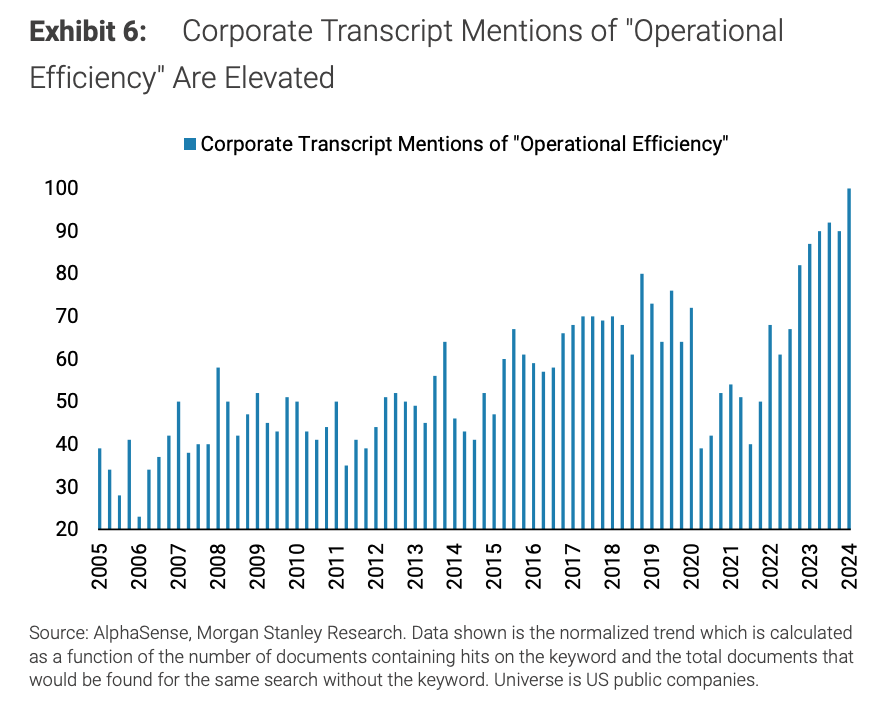
I should be as clear as possible: Although Subramanian’s especially bullish, you won’t find too many top-down strategists willing to brave a bearish view on AI. Even Morgan Stanley’s Mike Wilson likes the story, particularly as it relates to corporate efficiency, the hottest of hot topics on earnings calls last quarter.
If Subramanian’s right, we’re on the cusp of what could be a very long bull market. That being the case, it’d be foolish not to at least consider her arguments, which is why I’ve dedicated so much time to her notes over the past week and a half.
The “virtuous cycle” point is quite straightforward and, again, merits consideration even if (perhaps especially if) you’re a bear. She summed it up in just a few words and charts this week.
So-called “hyperscalers” including tech heavyweights Microsoft, Amazon, Google and Meta, plan to spend more than three quarters of this year’s earnings growth on capex.

As the figure shows, that equates to $180 billion between them, up nearly $40 billion YoY. Capex for the rest of the S&P is expected to barely grow at all.
The explosive spending from the hyperscalers might be considered bearish for those stocks. “They’re entering a reinvestment cycle [and] history suggests companies in reinvestment cycles underperform,” Subramanian wrote. But this is where her elegantly simple “virtuous cycle” comes in.
BofA suspects those investments (the $179 billion) will likely drive revenue and profits across sectors and the economy, starting with semis and networking (obviously), but rippling out through “electrification, utilities and commodities” amid surging power usage and “the physical build-out of data centers.”
And that’s to say nothing of the much-discussed productivity gains from AI, as well as other “domestic investments.” But Subramanian did say something about those aspects of the story. BofA, she wrote, “see[s] real evidence of an emerging productivity cycle, driven by domestic investment after 10+ years of underinvestment (plus AI).”

As the figure on the right gently notes, “stuff’s old.”
And then there’s the re-shoring trend, which BofA believes is “also a big tailwind to improving productivity” to the extent it means “building more efficient, new plants in the US.”
Finally, Subramanian noted that if past is precedent, productivity should begin rising sometime around… well, around right now, actually. Because history shows productivity increases “two years after wage inflation.”
That’s intuitive: If your pricing power starts to fade, your wage bills are sticky and you don’t want to fire people, you need to focus on efficiency. As long as the economy’s still doing ok, that’ll generally mean investing in the business.
Subramanian says that’s already happened and it’s paying off. “We are starting to see the fruition of investments made over the past two years,” she wrote. “The S&P 500’s revenue per worker jump[ed] to a record high after 15 years of no gains.”


Occurs to me that she has, almost surely, investigated planned efficiencies at BAC itself.
That’s all good but I’d argue Klarna using AI to ‘complement’ 700 customer services employees (and saving $40M per year) seems an even more direct way in which AI can improve productivity and profitability… and surely margin expansion is worth something to investors?
https://www.linkedin.com/pulse/from-hold-music-hero-how-klarnas-ai-chatbot-saved-40m-kamel-c6znc/
https://www.forbes.com/sites/quickerbettertech/2024/03/13/klarnas-new-ai-tool-does-the-work-of-700-customer-service-reps/?sh=246a155b5bdf
To convince me they need to use AI to permanently reduce staffing costs = FIRE people.
What do you think is the next step? Like, ‘complementing the workforce’ is stopgap to avoid scaring people/stakeholders…
Growth companies may choose to not hire more people as the business grows and existing employees attrit. Mature and over-staffed companies will do the RIFs.
Great article, have to figure how to use it to move cash to stocks/sectors.