Needless to say, and notwithstanding a little “friction” around Fitch’s decision to downgrade America, risk appetite is pretty buoyant.
So buoyant, in fact, that Goldman’s Risk Appetite Indicator sits near YTD highs, not surprising given re-risking across both systematic and discretionary investor cohorts, the late-May inflection in US equity flows and individual investor sentiment, and the generalized sense that record highs for the S&P are “inevitable.”
One question investors are grappling with amid the melt-up is whether stretched positioning is a contrarian indicator. Goldman’s answer is “not necessarily.” “While very negative RAI levels are a bullish, contrarian signal, outside of shocks, elevated risk appetite is less clearly bearish, at least initially,” the bank’s Christian Mueller-Glissmann said, in a new note.

As the figure above shows, the RAI is still totally disconnected from global manufacturing PMIs, and it’s moving in the opposite direction of services sector activity, which is fading.
What does history show? Well, after breaching 0.8, it generally took around six months for risk appetite to re-set below 0 on Goldman’s indicator.
Those six months were kind to risk assets. “These periods were generally risk-friendly with positive equity returns, flat bond yields and tighter credit spreads on average,” Mueller-Glissmann remarked, adding that cyclicals and emerging markets outperformed, albeit not by a huge margin, while commodity returns were mostly positive.

That said, valuations were unchanged on average during those same periods. So, if equities are supposed to post good returns from here, it’ll be up to earnings to drive gains. That could be problematic, even as Q2 reporting season in the US went “surprisingly” well (and the scare quotes are there for a reason).
Goldman’s equity strategists don’t see blockbuster earnings growth as especially likely, which Mueller-Glissmann gently warned “could be a speed limit for equity returns.”
At the same time, valuations are obviously quite stretched, with the S&P trading at 20x and IG credit near YTD tights.
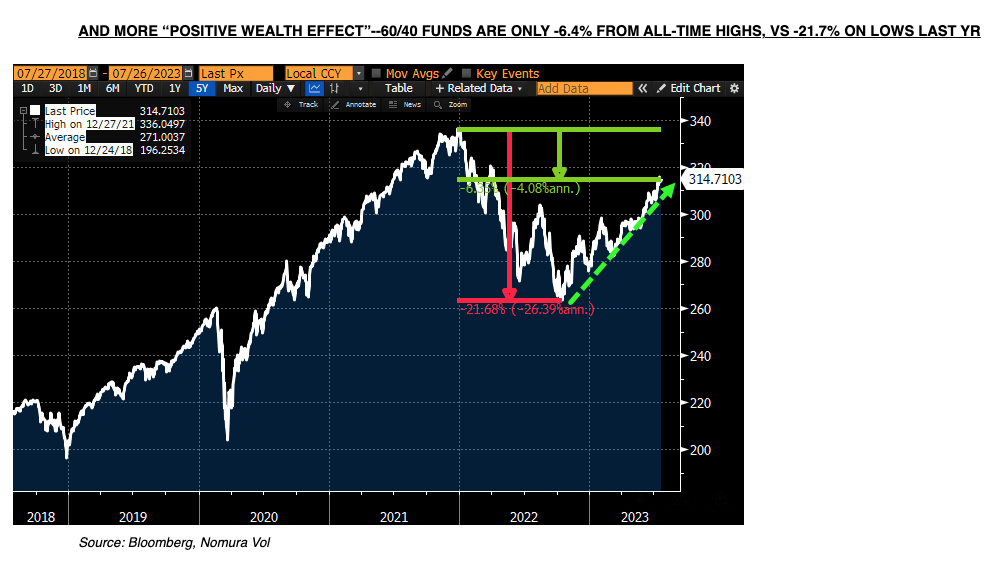
Going forward, Goldman expects markets to enjoy “more time” in the vaunted Goldilocks macro regime. That should be good news for 60/40 portfolios, which have stormed back in 2023 after last year’s egregious performance. This week’s long-end drama complicates that equation a bit.
Mueller-Glissmann offered a word (or two) of caution. “If China growth and global manufacturing activity accelerates in H2, there might be a return to a ‘Reflation’ regime, especially with still tight labor and commodity markets,” he said. “That could also increase the risk of a ‘Balanced Bear’ should inflation prove more sticky, central banks tighten policy more aggressively or bonds sell off further.”