Over the last several days, the US economy once again demonstrated a remarkable capacity to defy calls for an imminent recession.
The week began with renewed slowdown banter coming off a series of hawkish escalations+ (and re-escalations) from central banks, but no sooner had “hard landing” made it back into the headlines than a barrage of hot data out of the world’s largest economy put the slowdown narrative on ice yet again.
US home prices are rising month after month (even as the comparison with last year’s record highs produces the first YoY declines in over a decade), new houses are selling at the fastest pace since mortgage rates were 300bps lower and consumer confidence printed a six standard deviation beat+.
Taken together, it was “a perfect” run of US data, Nomura’s Charlie McElligott said. The magnitude and uniformity of the beats and was remarkable.

The Bloomberg US Economic Surprise Index is perched at a two-year high. “The US data keeps fighting the good fight,” Charlie wrote, alluding to the now pervasive notion that r-star is almost surely higher, which would explain why the economy isn’t “feeling much tightening transmission.”
Do note: There are now seven long run dots above 2.5%. This time last year, there were two. Officials are coming around, albeit slowly.
McElligott cited commentary from Delta’s analyst day, which was telling to say the least. There’s $300 billion in pent-up demand, and they “haven’t even made a dent” in it. It’s funny: I used similar language recently while noting that last year’s tightening did very little to deflate the household wealth bubble.

The familiar figure above reminds us that households — the ones with property and equities anyway — still have tens of trillions more in wealth than they had on the eve of the pandemic. Delta cited that figure. “Our consumer is in very good shape,” the company said. Apparently, Delta is a premium consumer brand now, not just an airline.
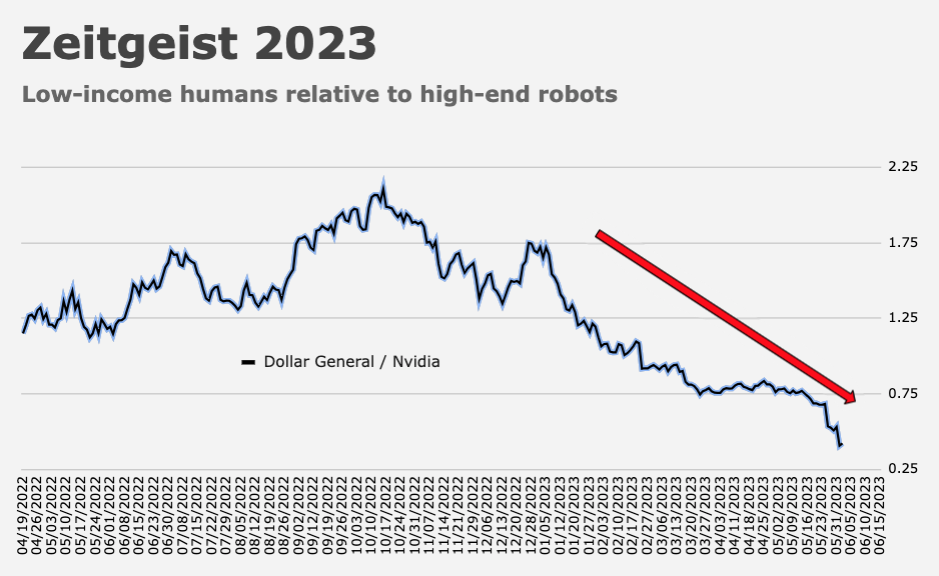
As McElligott went on to note, “the point about high-income consumers is important” because it speaks to the notion that the Fed is “back in the business of blowing the inequality bubble as holders of assets win and the low-end roasts.”
He juxtaposed Nvidia with Dollar General. The chart below speaks for itself, but just in case, Charlie added annotations.

That visual will also be familiar to regular readers. I used the ratio earlier this month to make a similar point.
“Individual securities portfolios [are] richening sharply and recovering chunks of last year’s losses, while the US house price data shows a re-acceleration in [property] values as well, now barely a blip lower from peak-to-trough,” Charlie went on.
The bottom line: The most predicted recession in US history is “the recession that refuses to realize.” So far.