

You didn’t need to be a political scientist or any sort of expert on Downing Street to know that Liz Truss’s fleeting tenure at No. 10 represented an existential crisis for the Tories.
I vividly recall a few pitiable attempts to excuse the fast-moving debacle that was Truss’s stint as prime minister. Contrarian types tried to paint Truss and her star-crossed, go-for-growth fiscal plan as victims of an establishment conspiracy, but it unraveled so quickly, and her response was so undeniably hapless, that even the most skilled purveyors of counter-narrative couldn’t salvage the situation.
By the third week of October, following the gilt crisis, Labour had opened up a 37pp lead, according to YouGov.

It was, without exaggeration, a singular feat of political and fiscal ineptitude. When taken together, the rapidity and depth of the crisis has very little, if any, modern precedent in the developed world. In just six weeks, the Truss government blew up the entire UK government bond market and triggered one of the worst sterling crises in all history.
Given what he inherited, it’s probably not fair to suggest Rishi Sunak is “failing.” Rather, he was set up to fail, and it doesn’t help that he was part of Boris Johnson’s cabinet. Controversial as he was, Johnson benefited initially from an easy comp on the other side of the “special relationship.” Boris was a lot of things, but Trump wasn’t one of them. In a testament to the acute nature of the developed world’s leadership crisis, you get points for that.
Ultimately, Boris ended up mired in scandal, though, and Sunak was late getting off the Titanic. Johnson resigned from Parliament this month blaming an inquiry (a “Kangaroo court,” as he called it) into his handling of the COVID “Partygate” scandal. The US should be so lucky. America’s last president has been indicted twice in three months and many legal experts suspect that’s just the beginning.
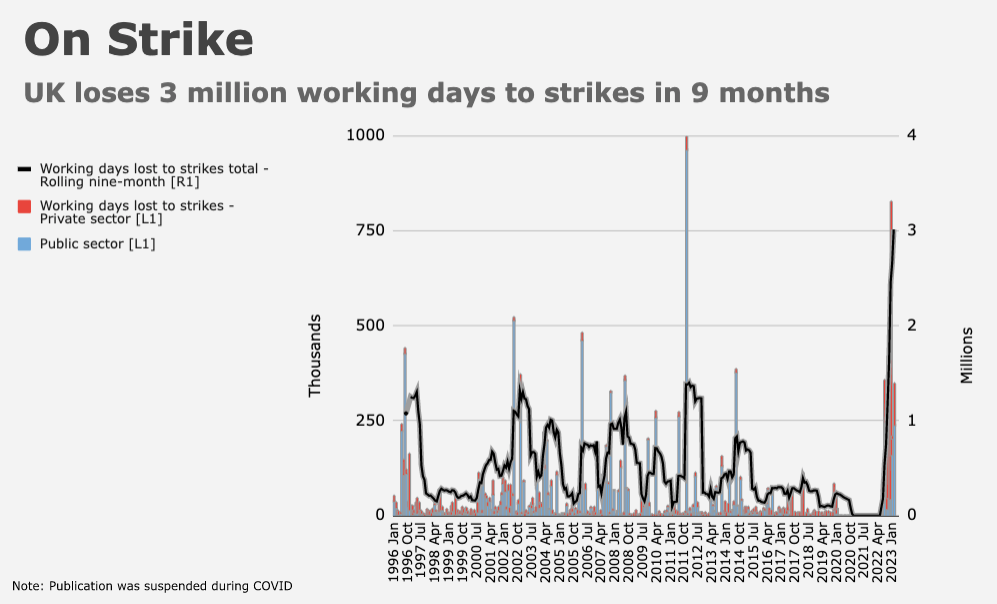
In addition to the latest Boris sideshow, Sunak is grappling with a host of other political headaches and, of course, a multi-faceted economic crisis defined by strikes, rampant inflation and a dozen consecutive rate hikes from the Bank of England, which is all but certain to hike again this week. Terminal is nowhere in sight, or at least not according to markets, which are pricing another half-dozen rate hikes.

Effectively, terminal expectations are back where they were when traders feared the BoE might have to resort to draconian measures in the wake of the Truss budget boondoggle.
The data isn’t cooperating, to put it mildly. The last inflation report was a veritable disaster and there’s another one coming this week, prior to Thursday’s MPC decision. “The BoE has arguably the weakest case for contemplating pauses anytime soon,” Goldman’s Kamakshya Trivedi remarked.
It’s possible the BoE will explicitly comment on market pricing for rates. They can’t guide for another four or five hikes after Thursday’s, and they have on occasion cautioned traders when policymakers believe their own intentions are far enough out of step with market pricing to warrant verbal intervention. As ever, the irony is that the longer inflation stays elevated, and the more times the BoE is proven wrong and forced to persist in tightening, the more justified the market is in doubting the official line.

Call it bad luck, ineptitude or a combination of the two, but the BoE’s inflation forecasting record this cycle (shown in the figure above) is a cartoon.
Labor market figures for the period ending in April, released last week, only added to the BoE’s consternation. Nominal regular pay may as well be back to COVID-era records, which is risky from a wage-price spiral perspective. And because price-adjusted pay is still negative, there’s every reason for workers to push for more, which paradoxically chances keeping inflation elevated, suppressing real wages in perpetuity. It’s an intractable quagmire.
“We think the downtrend in wage growth is going to be slow [given that] labor market shortages look at least partly structural,” ING’s James Smith said, suggesting wage growth could end 2023 near 5% in the UK. “While that doesn’t necessarily require the BoE to take rates much higher, it does suggest rate cuts are unlikely for at least a year.”

The unemployment rate was just 3.8% over the same three-month stretch denoted by the red annotation. There’s no sense in which 7% wage growth is consistent with 2% consumer price growth. That math won’t work, a fact which isn’t lost on the BoE.
Of course, the rate hikes are causing problems for mortgages. HSBC just raised rates twice in a single week, and approvals are plunging.
“If we look at the mortgage market — the main transmission mechanism for interest rates — 6% rates would mean a homeowner with a 75% loan-to-value ratio would, on average, be paying close to 40% of their disposable income on repayments,” ING noted. The comparable figure was 30% on the eve of the GFC. That consideration alone could ultimately prevent (or at least dissuade) the BoE from meeting lofty market expectations for the terminal rate.

Public opinion of the central bank has never been worse, according to the BoE’s own polling, conducted with Ipsos. Recall that the bank’s net satisfaction rating went negative for the first time ever in May of 2022. It’s been underwater since.
If the question is what all this means for Sunak, the answer is “Nothing good.” On the political front, Truss’s lamentable Thatcher impression and the havoc it brought upon the country is seared into the national political consciousness, and although Boris resigned as an MP, he isn’t the sort of person who’s going away. The Tories are a circus, which makes Sunak troupe leader.
As for the BoE, they have virtually no latitude to do anything other than hike rates until inflation comes down or the UK enters a recession, whichever comes first.


I’m a Brit and have been watching this shxt storm going on for many years. The Tory party is an embarrassment, far too many knighted and titled idiots in positions of authority. I’m a fan of Rishi but the rest of them are just embarrassing. We desperately need a government of competence but can’t see it. So glad, as a family, we have no mortgage, no loans and all our excess assets are in US assets. At some point in the next 6 months sterling is going to collapse.
We, too, I fear are headed in the same direction, just a year or two behind. Our Tories have similar goals and there are no available adults here to turn to. Maybe the British tradition of a faithful Nanny is real a great idea still. Most of us never had one.
I am also a Brit and whilst I think Sunak is competent, he is also tainted and that’s reflected in the polls. The labour leader Keir Starmer is competent, so a labour win in the next election will be good for the UK. In the meantime sterling continues to strengthen on the back of higher UK rates, which is a car crash in waiting. Most of my assets are also in USD and it certainly has been painful with sterling up +6% this year versus the dollar. Sterling has now gained almost 20% since the LDI crisis last year!
The UK is exhibit A when talking about the failure of post-capitalist laissez faire economics (supply-side Thatcher-nomics): offshore anything that can be offshored, privatize the safety net, promote and protect rent-seeking behavior, and exploit every loophole in campaign finance laws (such as they were and are) to shovel the gains to the top 1 percent. At this point in that slow-motion disaster, the only thing likely to save the country is an existential crisis on the order of the Great Depression (a US analogy but applicable).
I neglected to add the insidious, not-to-be discounted role in all of the above played by the Murdoch empire.
+1 on that.
It’s obviously a feedback loop between idiotic voters and the Murdoch empire but, well, there’s not much that can be done about the voters.
And, sure, the elite takes a share of the blame too. They make their disdain too obvious. Unless they’re truly desperate, people will spit on your free healthcare and safety net strengthening if you’re offering it with a sneer of superiority plastered on your face.
But, still, Murdoch weaponised that natural hatred of the elites (and did much to expose the disdain and then reinforce it by making his viewers/readers act more and more appallingly).