To some market participants, it probably feels like the earnings recession call (the “profit reckoning”) has been pushed into the future so many times that it’s no longer viable.
Similar to economic recession forecasting, there’s an expiration date on such calls. There has to be. Otherwise there’s no point. Downturns do happen, so in a strict sense, the next recession is always “right around the corner.” It’s just a matter of how long the street is. If there’s no sell-by date on calls for recession, then we’re not really saying anything when we predict one.
The same goes for profit downturns, with an important caveat: Companies are adept at managing down expectations, and that effort finds expression in bottom-up consensus. That means there’s a tendency for results to be “better-than-feared” until the bottom falls out in earnest. The “it could’ve been worse” interpretation of results that meet or beat a lowered bar persists right up until it’s no longer possible to pretend. We’ve seen some version of that for three straight quarters now in the US, even as YoY EPS growth has finally turned negative.
When you think about the above, do note that there’s actually nothing unusual about the seemingly long wait — nothing out of the ordinary about a “delayed” profit reckoning. In fact, the current decline in forward EPS is “right on track” from a historical perspective, Morgan Stanley’s Mike Wilson wrote. The figure below gives you the context.

“Investors often need to be told by companies directly just how bad things are likely to get before they throw in the towel, and companies will fight it until they no longer can,” Wilson said, explaining why this process can be drawn-out to the point of feeling interminable.
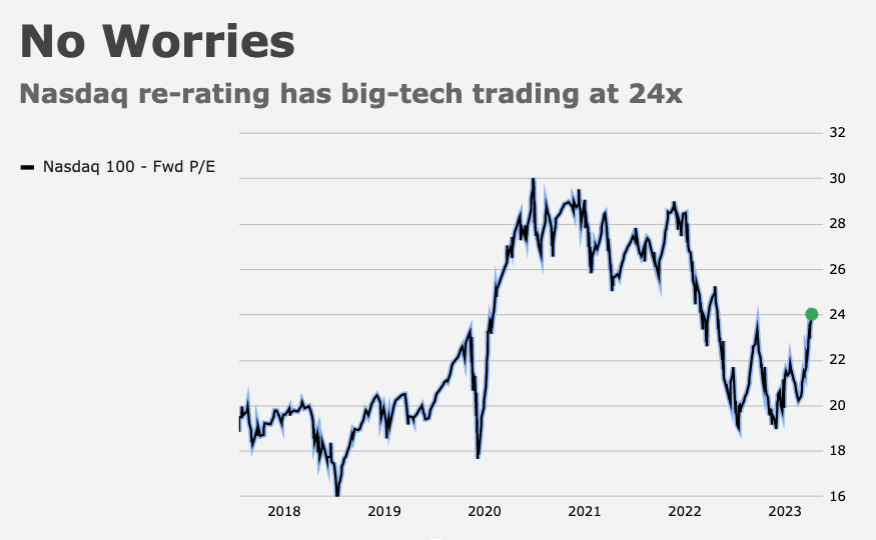
Of course, multiples trough before earnings, so you might ask if the re-rating witnessed during the first several weeks of 2023 (to 24x on the Nasdaq 100 and 18.5x on the S&P) represents the market simply getting ahead of a forthcoming bottom in EPS.
Wilson doubts it. “A P/E of 18.5x might make sense if one thought earnings estimates were bottoming and likely to reaccelerate,” he wrote, in the course of reminding investors that Morgan Stanley’s earnings models point to a sharp deceleration. Wilson’s base case is for index-level EPS of $195. That’s well below the buy-side (~$215), a country mile below bottom-up consensus ($224) and $15 below the average of his top-down counterparts around the Street. His bear case is $180.
He blamed the maddeningly slow (if historically consistent) bleed in profits for “keeping many institutional clients more invested than perhaps they want to be.” That crowd recognizes the earnings downside and doesn’t necessarily like the price but, as mentioned here last week, career risk is a thing — and it matters.
To be sure, the profit reckoning is unfolding. In addition to the first YoY decline in earnings since COVID, estimates for Q1 2023 are dropping quickly, forward EPS growth is negative and, as Wilson went on to say, “the decline in S&P 500 margin estimates since the start of the year is the worst since the GFC.”

The margin picture is almost guaranteed to darken going forward. COGS are outpacing top-line growth now, and although wage pressures may be abating, the US is still experiencing an acute dearth of labor, which means the price of scarce workers is likely to remain high in what’ll feel like perpetuity to companies for whom labor is the biggest cost.
None of that’s lost on institutional investors, nor are they oblivious to myriad other risks, which now run the gamut from Fed over-tightening to a global military conflict to alien invasions. For most, the frustration comes down to one simple question, Wilson said: “What will be the catalyst for stocks to fall if they haven’t yet?”
Others, though, tell Morgan Stanley that “the pain trade is higher because investors are bearish, and without an obvious catalyst, they will continue to stay long and even chase.” That’s certainly been the case in 2023.
To that latter contention, Wilson offered a simple rejoinder. “We would caution against that kind of thinking as we believe price will ultimately be the catalyst on the downside just like it was on the upside.”