

If you take House Republicans’ budget bombast literally, a key GOP demand for agreeing to a debt ceiling increase will be mathematically challenging to meet.
That’s a polite way of suggesting that some GOP lawmakers may be insisting on the impossible. During his fraught campaign to secure the House gavel, Kevin McCarthy reportedly promised holdouts he wouldn’t acquiesce to a debt ceiling increase “absent a discretionary budgetary agreement in line with the House-passed budget resolution or other commensurate fiscal reforms to reduce and cap the growth of spending.”
Part of that pledge entailed balancing the budget over a decade. Although Republicans have yet to explain precisely what spending they want to cut in exchange for an agreement that would avert a US default, McCarthy over the weekend said Social Security and Medicare are “off the table.”
As Goldman wrote, in a Monday note, that excludes almost half of non-interest spending from any prospective cuts. Focusing instead on discretionary spending significantly narrows the opportunity set. Half of discretionary spending goes to defense, and it seems highly unlikely that McCarthy can marshal anything like broad-based support among Republicans for deep cuts to the military.

So, what does that leave? Well, just $800 billion in non-defense discretionary spending, as shown in the figure above. That’s problematic for Republicans looking to eliminate the deficit.
“Over the next ten years, the Congressional Budget Office projects a primary deficit of 2.4% of GDP; our own projection is slightly greater at 2.7%,” Goldman’s Alec Phillips said, before noting that “in current dollars, this would mean a cut in annual spending of slightly more than $700 billion.”
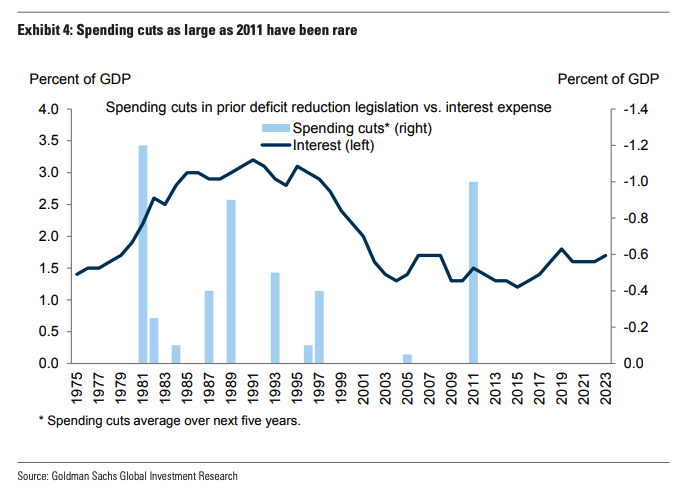
There’s never been a single deficit reduction package as large as that which some Republicans are ostensibly demanding, but more to the point, if cuts to mandatory spending and discretionary military outlays are off the table, then the GOP would need to cut virtually all non-defense discretionary spending to eliminate the primary deficit. Plainly, that’s not realistic.
Goldman’s Phillips did say that the GOP’s other goal (cutting fiscal year 2024 spending to fiscal year 2022 levels), is “more plausible.” Even there, though, it’s an upHill battle. Such a plan would have to make it through the Democrat-held Senate, and then get past Joe Biden.
Read more: Default Plan


These are the worst hostage takers since The Lone Rangers took over KPPX.
I think that the US military is one of the best social upward mobility opportunities that the United States offers to our citizens. (Education is also right up there)
The men and women who enlist are given an opportunity to learn responsibility, how to work with a team, leadership, personal financial management and many other life skills which can change the course of those individuals’ lives. The skills they learn while enlisted can then be utilized within the military organization or in other private/governmental organizations to be financially independent.
One other thing it offers is a chance to understand how you measure up against your peers from across the county under the innate conditions of military service where kissing ass or good looks are not as viable as they are in the real world.
Furthermore there is a real adjustment back to civilian life that is most likely to challenge, disabled veterans, combat veterans, deployed veterans, and to a lessor degree those vets who serve overseas for long periods. It is not always easy to completely take advantage of all of that other good stuff in short order, post service. It is not comparable to traditional education in that regard, and in fact some soldiers who are in field heavy / or conflict ready occupations are damn sure falling behind their college peers in some in some very important educational conduits along the timeline. Believe it or not there is also a strong anti veteran sentiment in some corners of the employment universe.
Nothing is perfect.
We have high school graduates today who are incapable of reading, writing and doing math at what high school graduates could do when I graduated from (public) high school.
I am “old”, but not THAT old!