

What’s next for Nvidia? What now?
Those questions (it’s really just one question) burn bright and hot amid what I described last week as one of the most consequential corporate scandals in the modern history of capitalism.
At the considerable risk of overstating the case, Jensen Huang’s affair with Alice Huang (no relation, thank God), a purported Chinese spy, has the potential to topple not just a CEO, but an administration.
It’s not inconceivable, in my view, that Democrats will attempt to build an impeachment case against Donald Trump early next year based on his alleged failure to act on intelligence suggesting Huang was romantically involved with the ringleader of a smuggling operation that purportedly funneled billions of Nvidia chips to Chinese firms in violation of US export restrictions.
We’ll probably never know the whole story, but new details continue to emerge. On November 13, Bloomberg reported that a Singapore-based cloud services firm called Aperia purchased nearly two dozen Dell servers equipped with geopolitically-sensitive Nvidia chips. Those servers ended up installed at a data center in Shanghai with links to Megaspeed, the company Alice founded three years ago.
The related documents constitute “the most explicit evidence yet,” as Bloomberg put it, “that an expansive network of Chinese companies with Alice at the center managed to get its hands on smuggled Nvidia hardware.”
On Sunday, The Wall Street Journal cited “shipment records” in alleging that Megaspeed “arranged” the transfer of almost $12 billion in cutting-edge Nvidia hardware to Chinese entities between March 2024 and June 2025.
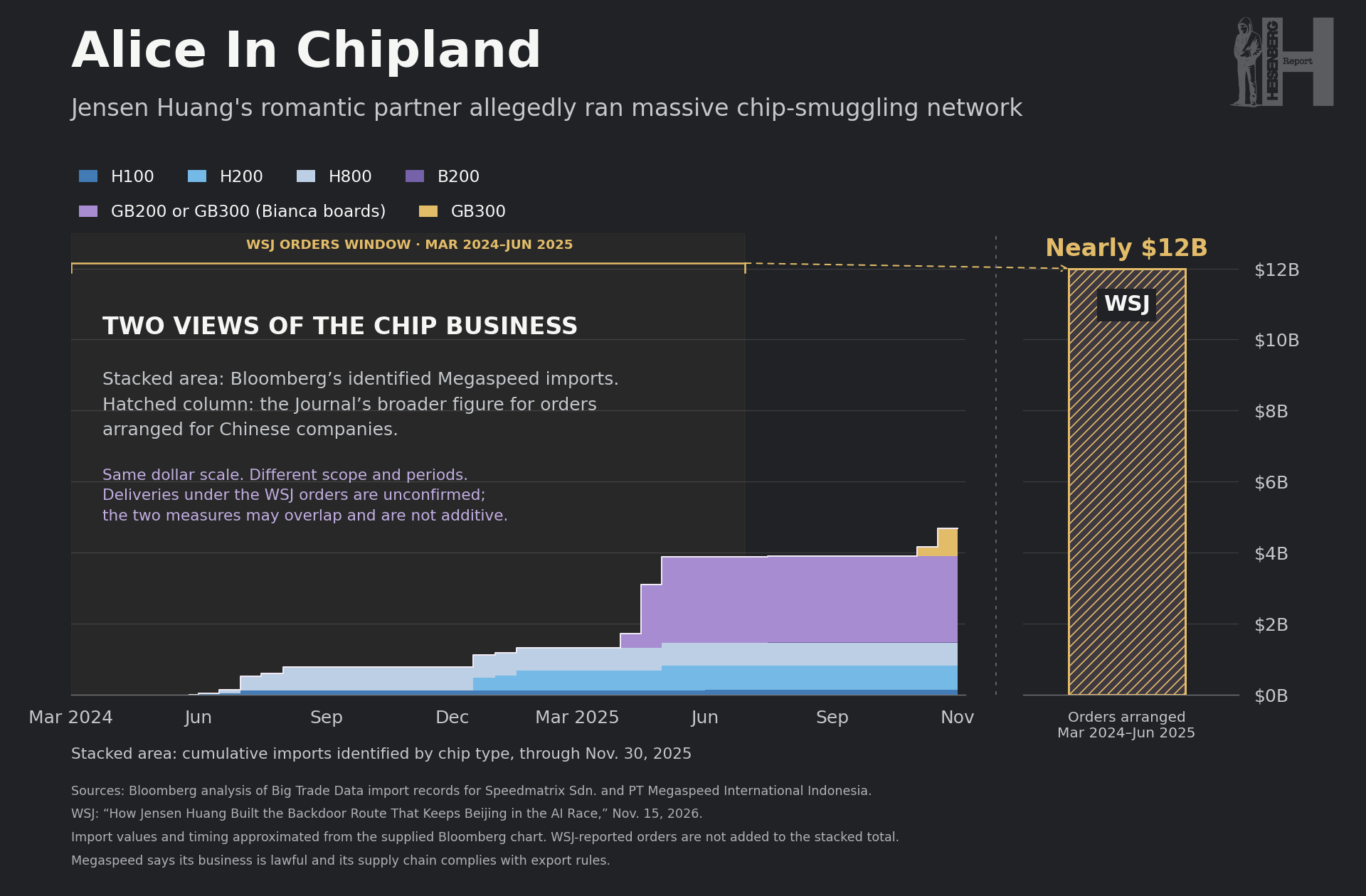
The figure above gives you a sense of how the totals associated with Alice’s network are growing as more information comes to light, even as it remains very difficult to determine what’s what, where the overlap exists and so on.
Separately, The Information reported Alice Huang’s smuggling network “turn[ed] up in a funding round” for China’s national AI champion DeepSeek. Entities linked to Alice “invested through vehicles that keep them off DeepSeek’s shareholder list,” the article said, adding that “the aim was a steady supply of Nvidia’s newest chips.”
And on and on. Every news outlet on planet Earth is chasing the next revelation in this saga, and there’ll be a new one every, single day.
The White House seems keen to scapegoat Howard Lutnick for this debacle, but I doubt that’s gonna work. Democrats will grill him, of course, but they want Trump, not Howard.
As for the stock, Nvidia’s probably a screaming bargain but “probably” is doing a metric ton of work there. It’s down six weeks in a row, with last week’s 12.75% drop counting as the largest since “Liberation Day.”


Oct 2 – Nov 13
Since the Oct 6 peak
Since the Oct 6 peak
The animated figure above shows you the scope of the rolling six-week decline: It’s around 30%. From the peak in early October, Nvidia’s shed more than $1.8 trillion in market cap.
For what it’s worth, I bought a little more late last week ahead of earnings (set for November 17 after the close), although I didn’t really want to. My average cost on Nvidia’s $131.08 following what I bought Friday. Suffice to say I’d done well enough on it already to feel comfortable buying more, even as the new shares were considerably more expensive than the ones I bought previously.
Not investment advice. (Remember the unofficial Heisenberg Report tagline: “Don’t try this at home. Any of it.”)


Oooh. Animation in the analytic charts. Cool. Personally, and especially now, I wouldn’t touch NVDA with a sterilized tent pole. I’m an old-fashioned Buffett follower. One of his main rules was, if you don’t fully understand any investment, consider it toxic and stay away.
When did you first purchase NVDA?
Well, too late, just like everybody else. Haha. January 27, 2025, is when I bought most of what I have.
Great animated chart! Don’t you worry Nvidia will tank after earnings on Tuesday? (I guess not or you wouldn’t have bought it.)
I have no idea what it’s going to do after earnings. We’re in weird territory with this name.
True that!
H-man this is another impressive article (unreal chart)…
I have a cheap bid on NVDA. Their chips are reportedly sold out until 2028 (8 quarters)….that’s also impressive.
I read it takes 12-18 to make NVDA’s chips.
So, the profit machine is still cranking it out.
I’ll be very interested in how Kress will handle the pressure filling in for Jensen Huang, circular financing and the risky investments in costumes guarantees.
No matter what Kress does some of the analysts will assume the worst w/o Huang (not Alice in Shanghai). I think we’re going down captain.
Did Bessent throw his hat into the CEO ring?
Pause animation checkmark. I like your product instincts.
Yeah, see the (brief and hopefully ended) chart discussion on “Abnormal Times.” I’m in “compliments only” mode on the animated charts, which is to say if you have something nice to say about them, great. I’d love to hear it. If you have something even marginally not nice to say, keep it to yourself. (I realize your comment was a compliment. So thank you.)
To expand on this a little more (i.e., in addition to what I said in the comments on “Abnormal Times”) the animated charts are quite good and they represent an objective improvement. That said, only a select few charts will be animated. Most will be static, as they’ve always been.
But for a small subset of readers, any animated charts is too many animated charts, just like for a small subset of readers, my site redesigns (“all” three of them over 10 years) were a source of severe consternation. Those readers will have to get over it. Because the animated charts are here to stay. Again: Most charts will be static. But some will be animated. Learn to love ’em, ’cause they ain’t goin’ nowhere.
So I had this memory of Mr. Lutnick saying the following, but after a little research, I found that it was David Sacks, also known as the crowned AI and Crypto Czar, on a panel in Saudi Arabia in 2025, and it’s still funny:
Transcript David Sachs May 13, 2025 in Saudi Arabia
[22:00–23:19]
Let me speak to that risk of diversion for a second. So you’re absolutely right. It’s not an issue with
a friend like Saudi Arabia at all. But I think that, in general, there’s a great deal of misunderstanding
about the diversion of GPUs.
People tend to think that these things are like diamonds that can fit in a briefcase or something like
that. That’s an antiquated understanding of the type of technology we’re talking about now. What
we’re really talking about here are servers that incorporate GPUs. And, in fact, we’re talking about
server racks.
The latest Nvidia product, called NVL72, is a server cabinet that contains 72 superchips. It’s stacked
eight feet high and weighs 3,600 pounds. Okay, this is not something that can be smuggled in a
briefcase.
And the truth is that you need thousands of these things to create a supercluster that could be a
national security threat to the United States.
So the policy objective of preventing diversion to countries of concern is an absolutely important
objective of the United States, but it is not a difficult one to achieve.
The truth of the matter is that all one would have to do is send someone to a data center and count
the server racks to make sure that the chips are still there. We can manage this problem of diversion
without stopping the diffusion of American technology.
[End: 23:19]