

When the dust settled following Democrats’ historic midterm election sweep (and I’m by no means convinced the dust has, in fact, completely settled), US stocks were down a whole 2.7% for the week.
That counted as the worst weekly showing since “Liberation Day,” but hardly constituted a disaster. Even when you include shallower declines logged in the three weeks leading up to the vote, the benchmark’s a mere 5.5% from its last all-time high, not exactly a catastrophe considering the seismic political ramifications of the election.
Meanwhile, the Treasury portion of your portfolio logged a fourth consecutive weekly advance and your gold allocation rose nearly 5%. So, all in all, nothing to see here. End of article.
I’m just kidding, but the joke serves a purpose: That’s how you should think about markets, isn’t it? It’s how I think about them when I’m not pretending to care about the mercurial particulars for the purposes of penning melodramatic macro-market color.
Now, without further ado, to the melodrama.
Despite a half-hearted rebound on Friday, semis were bludgeoned, as investors pondered the “terrifying” prospect of slower data center buildouts and what that might mean for chip stocks, which capped a five-week run of losses with a 12% decline.
I’d encourage you to peruse “Um, Excuse Me, But Your Chips Are Bleeding” for the full details, but as a brief addendum to that article, it’s worth noting that the Taiex had its worst week since 2001.

There’s the chart. As one of the longest-tenured members of our cult was keen to point out, Taiwanese regulators stepped in on Friday with a “package of medicine” (to quote Kevin Warsh) aimed at stanching the bleed.
Specifically, Taipei raised margin requirements and said that starting Monday, short sales are limited to 3% of a given stock’s ADTV. In case that’s not enough to put a floor under the market, the finance ministry said it’ll dip into its plunge protection fund to buy some local equities. If you’re curious, that vehicle has about $15 billion in fire power.
The situation in South Korea was predictably dire given that Samsung and SK Hynix basically are the market. Just three weeks on from its worst week since the financial crisis, the Kospi suffered another egregious wipeout, falling nearly 12%.

Samsung plunged 16%, SK Hynix 20%. At the lows on Friday, the local benchmark was down almost 48% from the June highs.
Note that the Kospi was below 5,000 at the November 6 lows. The last time the index traded sub-5,000, Ali Khamenei was still alive.
Back at the Ponderosa, and looking beyond the tame “headline” weekly decline on the S&P, the roller coaster-style, close-to-close moves on Wednesday and Thursday drove one-month realized vol up to ~20.

As the figure shows, that’s basically 100%ile on a one-year lookback. When realized vol spikes, it creates a latent equity supply impulse across a universe of target vol strats with roughly a quarter trillion in AUM between them.
Those strats aren’t a monolith, so you have to make some assumptions when you go to model their reaction function — and when you extrapolate from that reaction function to estimate exposure changes for a given vol reset.
But if you assume, for example, that equity exposure’s set based on the higher of one- and three-month trailing realized, what we saw this week (i.e., what you see in the cart above), very likely meant a significant “sell” impulse from that cohort.
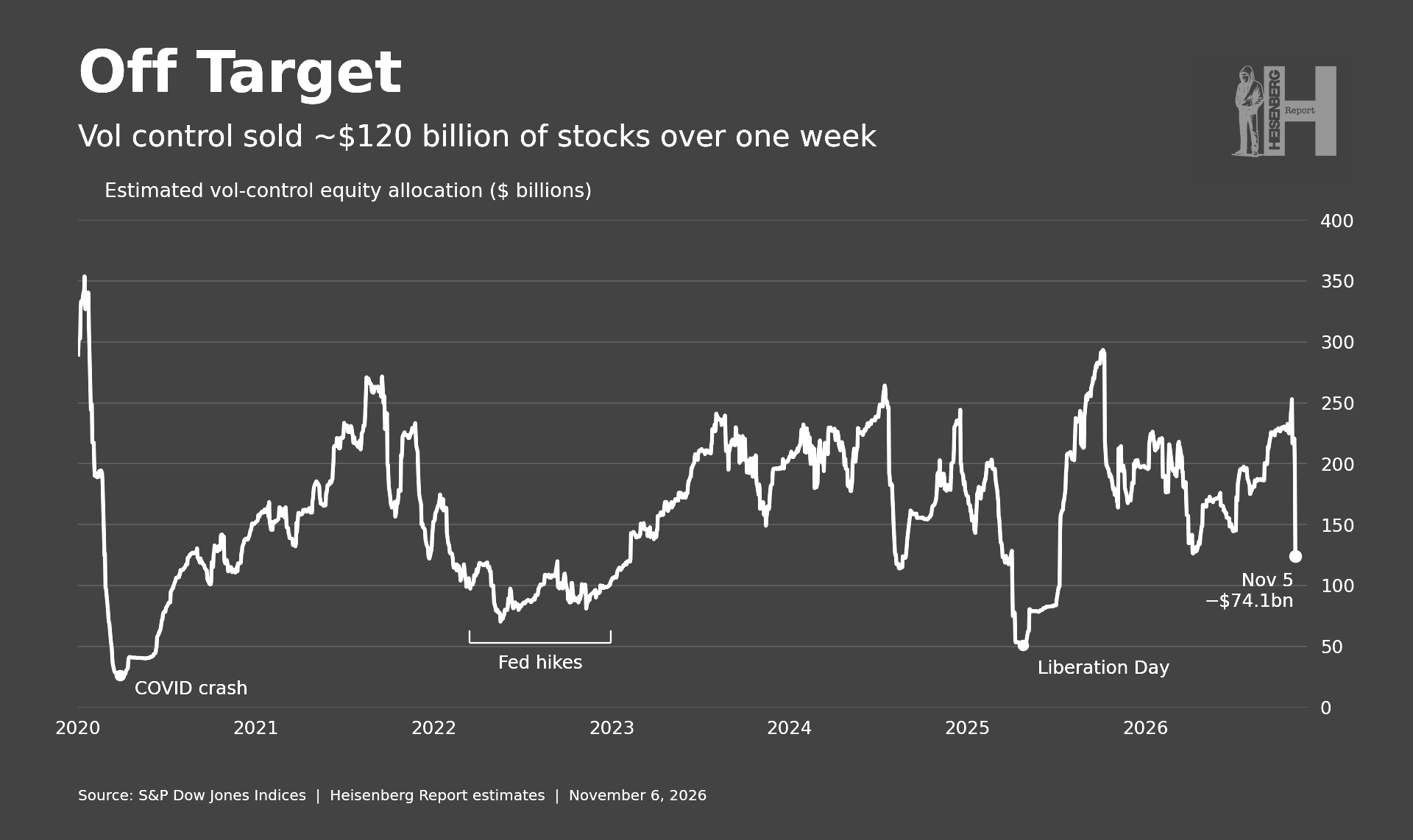
The figure above gives you some historical context. Target vol exposure tends to be “escalator up, elevator down.” The “down” on November 5, 2026, was about $74 billion.
Because I know some of you are going to ask: Yes, I have my own models now. I spent my Friday evening working with OpenAI’s Astra configuration, which allocates more computational resources to difficult tasks compared to Sol, a more general-purpose setup that aims to strike a balance between capability and efficiency for everyday use cases.
The upshot is that I now have models for target vol exposure, multi-asset CTA triggers, risk parity allocations and leveraged equity ETF EOD rebalancing projections. They all update automatically each day. I also have estimates for the forwards on vol control buying/selling under different daily SPX change assumptions, and so on. I’d describe these models as “in beta testing” right now. We’ll see how it goes.
I realize a handful of you will probably want to inquire about accessing those models. You can email me about it, just as long as we’re all on the same page in terms of, you know, me not being in any way, shape or form culpable if they “fail” somehow. These models are no more a crystal ball than anybody else’s models.
Anyway, coming back to the market narrative, there’s a big question mark hanging over the hyper-scalers.
On one hand, Democrats’ avowed determination to slow the data center buildout could give the big-spenders the plausible deniability they “need” to be less aggressive on the capex front, which in turn could mean less debt and equity issuance. At the same time, fewer data centers means hyper-scalers’ existing AI infrastructure is now more valuable.
On the other hand, “Slow down so you don’t accidentally kill us all” is the polar opposite of Zuck’s famous “Move fast and break things” mantra. And let’s not pretend Democrats aren’t vindictive creatures just like Republicans. They remember the blue-to-red betrayal and they also remember Donald Trump’s second inaugural, which was an indoor, VIP-only event featuring a who’s who of big-tech titans assembled in a billionaires row.
Not knowing what’s next, investors looked to hedge. Mag7 skew steepened on what might as well be a 90-degree angle, to 90%ile on a one-year lookback. The figure below shows you Mag7 put skew. It was 92%ile on Friday.

That’s a proxy for crash protection demand on the cohort — i.e., relative demand for OTM downside versus closer-to-spot puts. Suffice to say the left-tail’s in play again.
On Friday, Bloomberg reported that Microsoft’s “winding down” an AI cloud rental agreement with Oracle as part of a company-wide strategic “re-think.”
The C-suite at Microsoft, the linked article suggests, is increasingly circumspect about such deals, particularly those involving a neocloud space Microsoft itself helped birth.
Meanwhile, some potential investors in Anthropic’s (imminent) IPO have reportedly cut their valuation estimates to as low as $1.1 trillion, down from $1.5 trillion late last month and as high as $2 trillion earlier in October.
Damn, Claude. What can I say that hasn’t already been said about Josh Brown’s hair?


My, my, you have been busy earning your cheese on our behalf. Thank you, sir.
FYI on those models mentioned in the article, I’m pretty confident in them, not in terms of their ability to “predict” anything, per se, and certainly not as any sort of day-trading “guide,” but just in terms of their being as good a proxy as any Wall Street model for what they’re trying to guesstimate. At least now, it’s not a black box on my end. I know what the inputs are and therefore I understand where the output comes from.
The way I have them (the models) set up, they’re going to produce a daily “report,” which’ll just be a snapshot of where it all stands with some (very) brief explanatory notes. There won’t be a lot of editorial color if there’s any at all. I haven’t decided what I’m going to do with that daily report yet, but… well, it’s gonna be available eventually as an add-on.
It’ll be a while before that’s part of any public-facing subscription option on the site, but if you’re interested in getting it, reach out and we can talk about early access.
For early adopters, I’m thinking of charging some token amount — maybe $5/month or $7/month or something. Just to cover the cost of the upgrade I had to do to get the frontier AI model. You’d get the snapshot every evening of every day the US equity market’s open. The models refresh at 6 PM ET. I’ll probably turn it into a .pdf and then just send the .pdf as an attachment to whoever’s subscribed.
Once I roll this out as an à la carte add-on via the official, public-facing subscribe page, it’ll be significantly more expensive than whatever that token initial amount is (although not prohibitively expensive).
For anyone who adopts it early, I’ll freeze (i.e., guarantee) the price at that token early-adopter rate for 18 months. For now, I’m only going to offer a monthly version — i.e., no annual subscription to this yet. I want this to be a slow, controlled, low-stakes offering for me and also for you.
It’ll come with a very strict set of disclaimers which’ll boil down to this: For illustration purposes only.