

Ken Griffin, who didn’t love his Nick Offerman character in Dumb Money, sees a bubble.
While chatting this week with Dani Burger (as a quick aside, Dani’s on my long list of “I remember when she wasn’t too famous to talk to me” people), Griffin said tech epochs and economic revolutions more generally are almost synonymous with bubbles. This time’s probably no different, he intimated.
In the same fireside-style chat, Griffin cautioned that so far, there’s not much in the way of concrete evidence to support the idea that AI adoption’s accruing to corporate bottom lines in an across-the-board way.
The figure on the left, below, from Goldman’s Ben Snider, gives you a sense of what ol’ Ken meant when he told Dani that “corporate America has been very uneven in its ability to extract value from its AI models.”

Just 2% of S&P 500 firms which discussed AI’s impact on productivity during last quarter’s earnings calls were able to quantify the impact on their bottom lines. 2%.
That figure better rise. Because plainly, it isn’t sufficient to support huge corporate outlays on the new technology. Shareholders want to know not just where “their” money’s going, but what the return on it is.
The figure on the right (Exhibit 20 from Goldman above) gives you some idea of how the Street’s thinking about this. Goldman’s assuming a 1ppt fillip to overall S&P EPS growth from AI productivity next year assuming 60% adoption and 10% “capture” (if you will) and better than 2ppt in 2027, when nearly three quarters of firms will have adopted AI and improved their ability to realize the allegedly myriad productivity benefits.
“Economy-wide surveys and corporate commentary signal enterprise adoption that is increasing but remains in early stages, and the impact of AI adoption on corporate earnings still appears narrow,” Snider wrote. “However, the recent acceleration in enterprise AI spending suggests the earnings impact of AI adoption should become clearer in coming quarters.”
It better. Better become clearer, I mean. Because as Griffin so eloquently put it this week, “I think all of corporate America is looking at their bills from Anthropic and OpenAI and going, ‘Okay, we need to think about how to make sure we’re getting productivity out of this.'”
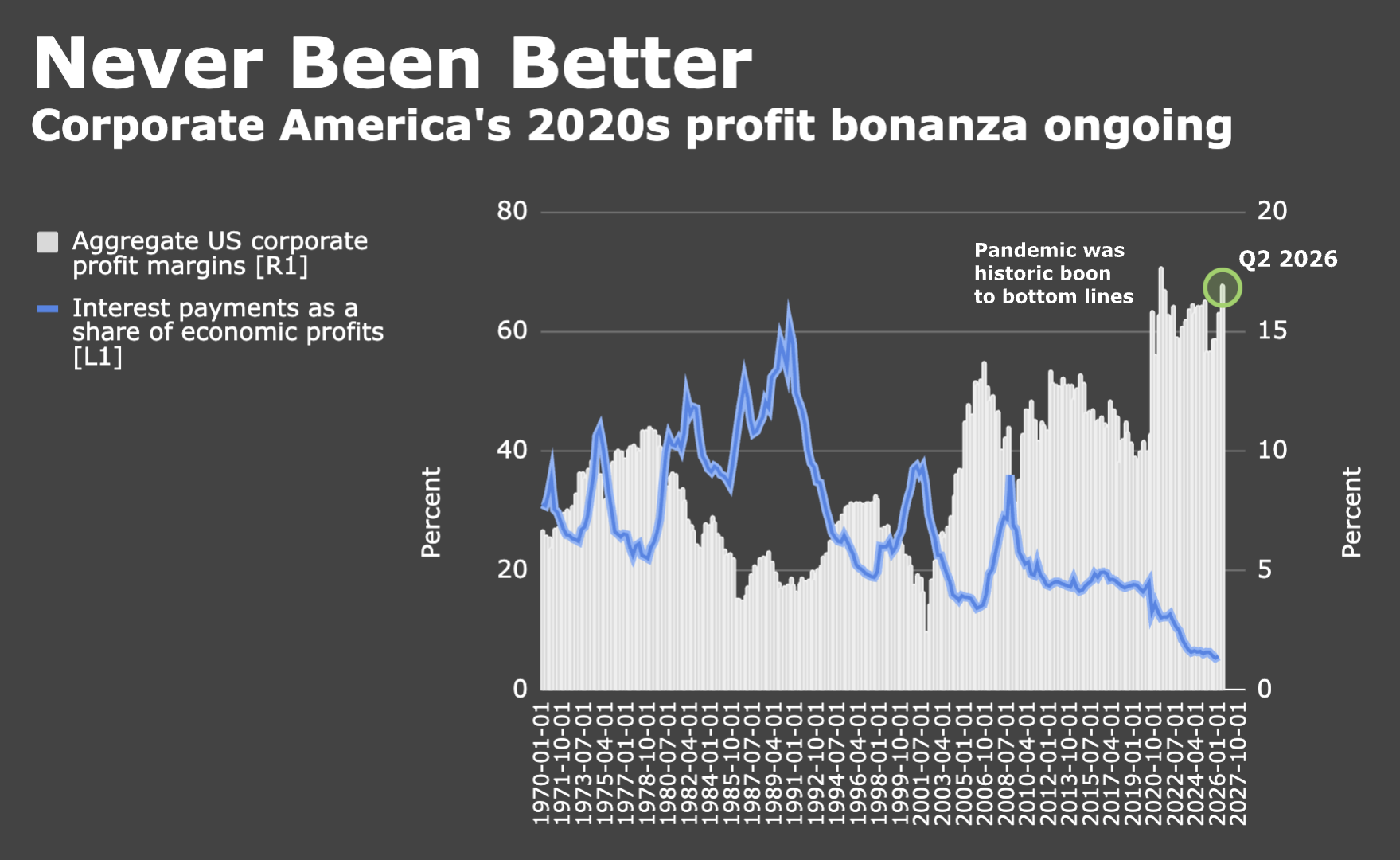
The good news is, margins remain at or near all-time highs both for S&P 500 companies and across the broader universe of profit-making American entities. So, while it’s “show me” time for the narrative and thereby for the “bubble,” corporate America will remain a going concern regardless.


I wouldn’t be surprised to learn that Ken Griffin is using AI to enhance his trading profits.
H, if you wanted to be famous, you would be so. Maybe it is better to be “Almost Famous”?
Probably when this is over, AI will make a lot of money somehow for a few, but much of the money spent building huge infrastructure will turn out to be wasted, and many companies and investors won’t do well. But society, maybe will be way better off.
So far, the AI implementation at my workplace is a giant waste of money. They ask us to run everything through it and it spits out garbage on the other side. Pretty close to useless, with no context applied like a person can do. I’d say the current ROI is a negative number.