

“To infinity and beyond!” Or whatever.
Elon Musk’s rocket-making, satellite-broadband company-turned-data-center REIT reported Q3 sales and adjusted earnings that topped estimates on Tuesday afternoon in the US.
Much as I’d rather not, these results are a must-cover from an editorial standpoint. My guess is that one way or another, Musk will find a way to make SpaceX the most valuable enterprise on Earth, and also on the moon, on Mars and wherever else he manages to land one of the company’s rockets.
In addition to being Elon’s flagship and the anchor for his personal trillion-dollar valuation, SpaceX is a bellwether for all things AI-related, including and especially the financing of data centers and related hardware.
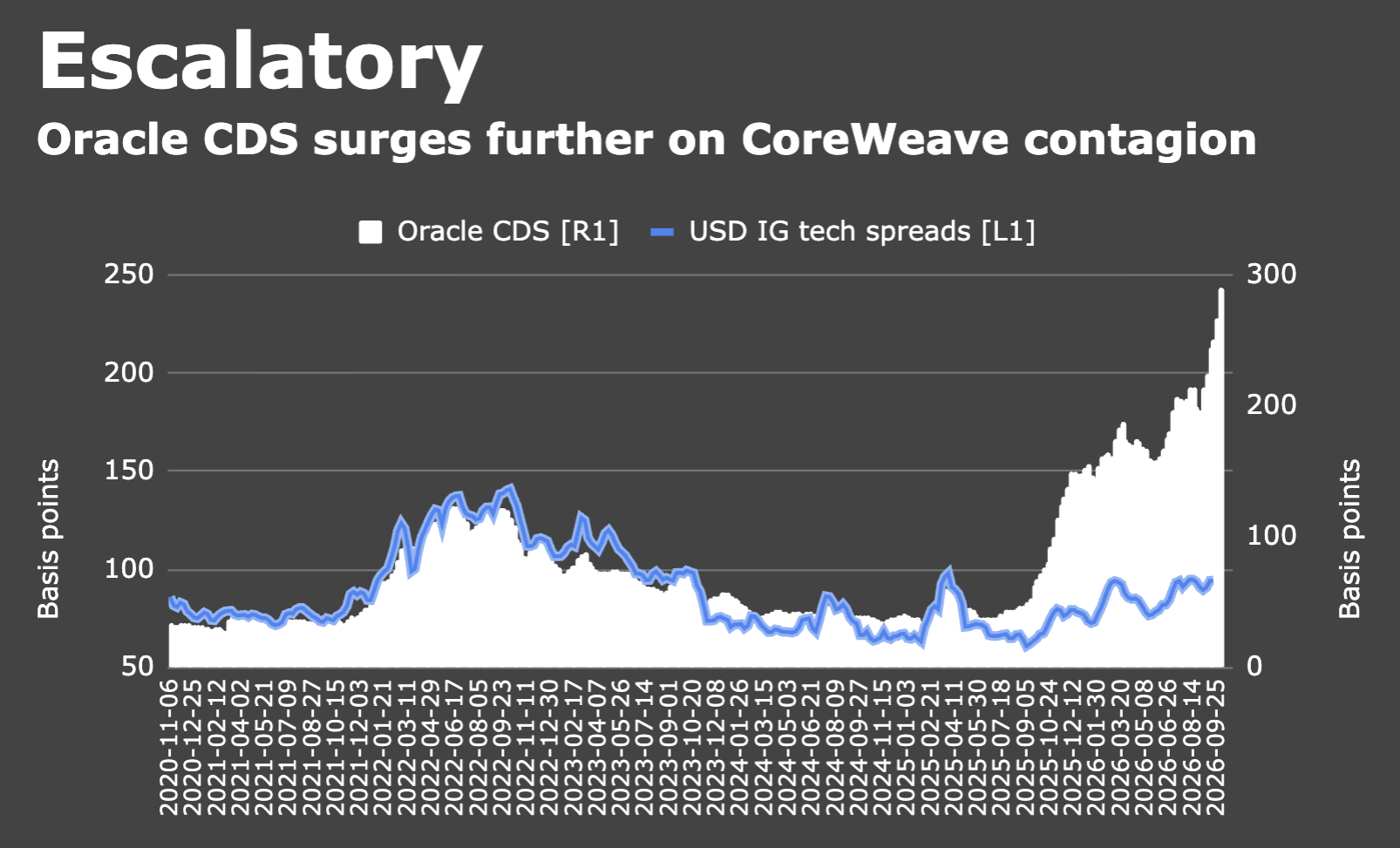
Earlier this month, reports suggested SpaceX is trying to arrange up to $40 billion in funding for the sole purpose of buying Jensen Huang’s latest chips and Musk’s been vocal on his social media platform amid the neocloud mini-panic, remarking on the plunge in CoreWeave’s bonds and editorializing around charts depicting the escalatory widening in data center CDS.
Last week, in a reply to that click-chasing, tabloid baron I used to work with (I don’t even care anymore, in case you haven’t noticed), Musk said supercomputer data centers remain in high demand. The issue is securing the financing.
“Getting money to build complex hardware systems with massive power, cooling and networking is not the same as doing it,” he told Dan. “SpaceX has a super cracked team and even we find it very difficult!”
Tuesday’s results showed AI sales — rechristened “SI” in accordance with Donald Trump’s unilateral rebranding initiative — nearly tripled QoQ to $7.56 billion. The segment turned a smallish profit of $431 million. The investor presentation described the surge in SI revenue as a “clear inflection.”

The connectivity segment, where Starlink lives and where almost all the profitability resides, brought in $5.25 billion during the quarter. Space chipped in $1.77 billion, or 12% of overall sales, the same share as last quarter.
So, the main takeaway’s plain enough, ain’t it? In Q2, Starlink sales were nearly double SI sales. In Q3, SI revenue was 44% higher than connectivity, even as the latter still comprised nearly all (~85%) of operating income.
As for capex, $19.59 billion was in line with consensus and up a modest 6.6% from Q2. Obviously, the vast majority of the spending is in the SI segment.

There’s the breakdown. The usual joke applies: The cost to acquire compute vastly outstrips the cost of building space ships and satellites.
CFO Bret Johnsen offered up some Jensen-style hyperbole. SpaceX, he said, is “building the infrastructure of the future while moving with the velocity to capture the opportunity in front of us.” He also emphasized that the company’s “focused [on] maintaining an investment-grade balance sheet. That’s good to hear in the current environment.
Just as the conference call was getting underway, The Wall Street Journal said it was Musk himself who throttled connectivity speeds in Ukraine this month.
The order, which “slowed a military-grade version of Starlink, sparked confusion inside the Trump administration,” the Journal‘s Alexander Ward, Natalie Andrews and Josh Dawsey wrote, citing unnamed US officials and the ubiquitous “people familiar with the matter.”
Some of the officials who spoke to the Journal claimed Musk “acted unilaterally,” but at least one source said he “talked to multiple senior administration officials, including Trump” prior to imposing the speed limit, which Ukraine blamed for “allow[ing] Russian missiles to evade their defenses.”
Talk amongst yourselves.


Good article
J#$@s, one man gets to decide the outcome of the first European war of consequence since WWII. “Gods” and Giants indeed. I hate it, but reality wins.
I warned everyone about this. Repeatedly. Remember my “Gods” series of articles from 2020/2021?
Here’s a quote from one of them:
“When one combines the exponential nature of wealth creation in a capitalist system with modern market structure and embeds that self-feeding loop in a world that’s becoming more dependent on many of the same businesses every day, the read-through is that these fortunes will become so large, so fast, that the people associated with them will become gods.”
Yep. Sadly, you were very prescient
Just after reading your comment, I wandered over to Reuters and read an article on visa revocations. That wasn’t what caught my attention. It was this one: “In announcing the latest number on X, State Department spokesman Tommy Pigott said the Trump administration “has revoked ?more visas at a faster pace than any administration in history.”
Why are official US Government announcements being revealed on X?
I saw how you used H’s technique to phrase it as a question to stay out of trouble…
I think of the Gods’ articles often …
great series. worth going back. supplement it with a screening of “Moonraker”
There’s no justice in the world, because the SOB deserves to die in prison. He’s got blood on his hands from Ukraine, Autopilot, etc..
USAID is the biggest one. Hundreds of thousands to millions of preventable deaths.
And above the law! Musk is gaining global power at a frighteningly fast pace. World leaders are forced to take a knee.
gods are one thing, as mankind has been subjected to the outsize power and wealth of certain individuals throughout the ages. Both the good and the bad.
However, descendants of gods are quite another, even scarier, matter. I largely agree with Obama on this one- upon death, their estate should substantially transfer to the government.
Then, we hope for the best.
This government? “Hope is not a strategy.”
I despise Musk as much as anybody and agree he most assuredly feels god-like, but there’s no way that even in a ketamine-fueled rage he would throttle Starshield without Trump’s approval. There’s also absolutely zero chance that Trump would find out that Musk did it unilaterally without throwing his Bic Mac at the wall and screaming for Natalie to fire off and immediate nasty tweet.
I agree, but then again, there’s this —-> https://www.newyorker.com/magazine/2023/08/28/elon-musks-shadow-rule
“To the dismay of Pentagon officials, Musk volunteered that he had spoken with Putin personally. Another individual told me that Musk had made the same assertion in the weeks before he tweeted his pro-Russia peace plan, and had said that his consultations with the Kremlin were regular. (Musk later denied having spoken with Putin about Ukraine.) On the phone, Musk said that he was looking at his laptop and could see “the entire war unfolding” through a map of Starlink activity. “This was, like, three minutes before he said, ‘Well, I had this great conversation with Putin,’ ” the senior defense official told me. “And we were, like, ‘Oh, dear, this is not good.’ ”
That’s worrisome. I can see Musk suggesting it, and the Don giving him a wink “Do what you have to do, I don’t want to know about it.”
There’s a Netflix series called ‘Altered Carbon,’ that is set in a future where a ‘cortical stack’ is implanted into the base of the neck that stores our thoughts, memories and soul. The ultra-wealthy basically never die, as the stack can be implanted in another body (a sleeve in the shows parlance), and the ultra-wealthy have personal satellites that back up their cortical stack and can download it to a new one in the event of their demise. So they are, essentially, immortal.
The show uses that premise to show what happens to people who become god-like. Needless to say probably, it’s very dystopian. The show revolves around a warrior who had his consciousness imprisoned for centuries and he’s tasked with a mission, so it’s full of gratuitous violence, which if this is not your thing you won’t enjoy the show. But it certainly hits the mark as a critique of absolute power and wealth. Sadly only 2 seasons, as Netflix found it too expensive to make.
I thought of exactly that series reading H’s “Gods” and linked articles … sometimes, Sci-Fi is prescient, if not always on the mark in the details.