

China’s still mired in a balance sheet recession. That much is clear.
What’s less clear is whether the Party’s powerless to address the situation or views it as tolerable (perhaps even desirable on some vectors) as long as booming exports and state-led investment are enough to keep up GDP appearances.
Data released on Monday showed real growth was 4.5% in Q3, marginally better than the prior quarter’s pace and quick enough to make the full-year target achievable.
That comes with an obligatory smirk to account for the fact that you’d have a hard enough time managing GDP to a predetermined target for a township of 10,000. The Party’s pretensions to macro-administrative omnipotence in a country of 1.4 billion are nothing short of laughable.
Recall that Q2’s headline growth pace was the slowest since Xi Jinping lifted COVID protocols in late 2022. So, central planning snark aside, the reported pickup in Q3 was welcome news, even as all evidence continues to suggest the world’s second-largest economy is hopelessly (irretrievably?) bifurcated.

Note that the deflator was positive again in Q3, underscoring the message from accelerating factory-gate inflation. PPI price growth ran 5% YoY in September, the quickest since June of 2022, on higher prices for energy and tech equipment.
But just as the upsurge in wholesale inflation isn’t mirrored by lively consumer prices, China’s optically decent GDP aggregates belie a moribund household sector.
Retail sales grew just 1.1% YoY in September, data released alongside the Q3 growth figures showed. In a testament to “where we are,” so to speak, that was actually the briskest pace in six months.
Industrial output, meanwhile, rose a respectable 5.5% in September from the same period a year ago.

The figure above gives you some context: Industrial production growth has outstripped retail sales growth every month since 2023 except one.
“Although the expenditure breakdown has yet to be released, the composition of growth likely followed a familiar pattern of resilient external demand and subdued domestic demand,” SocGen’s Michelle Lam and Wei Yao remarked, of Monday’s figures. “Based on household survey data, real household consumption growth (deflated by CPI) was unchanged at 2.7%, marking its slowest pace since the COVID period in 2022.”
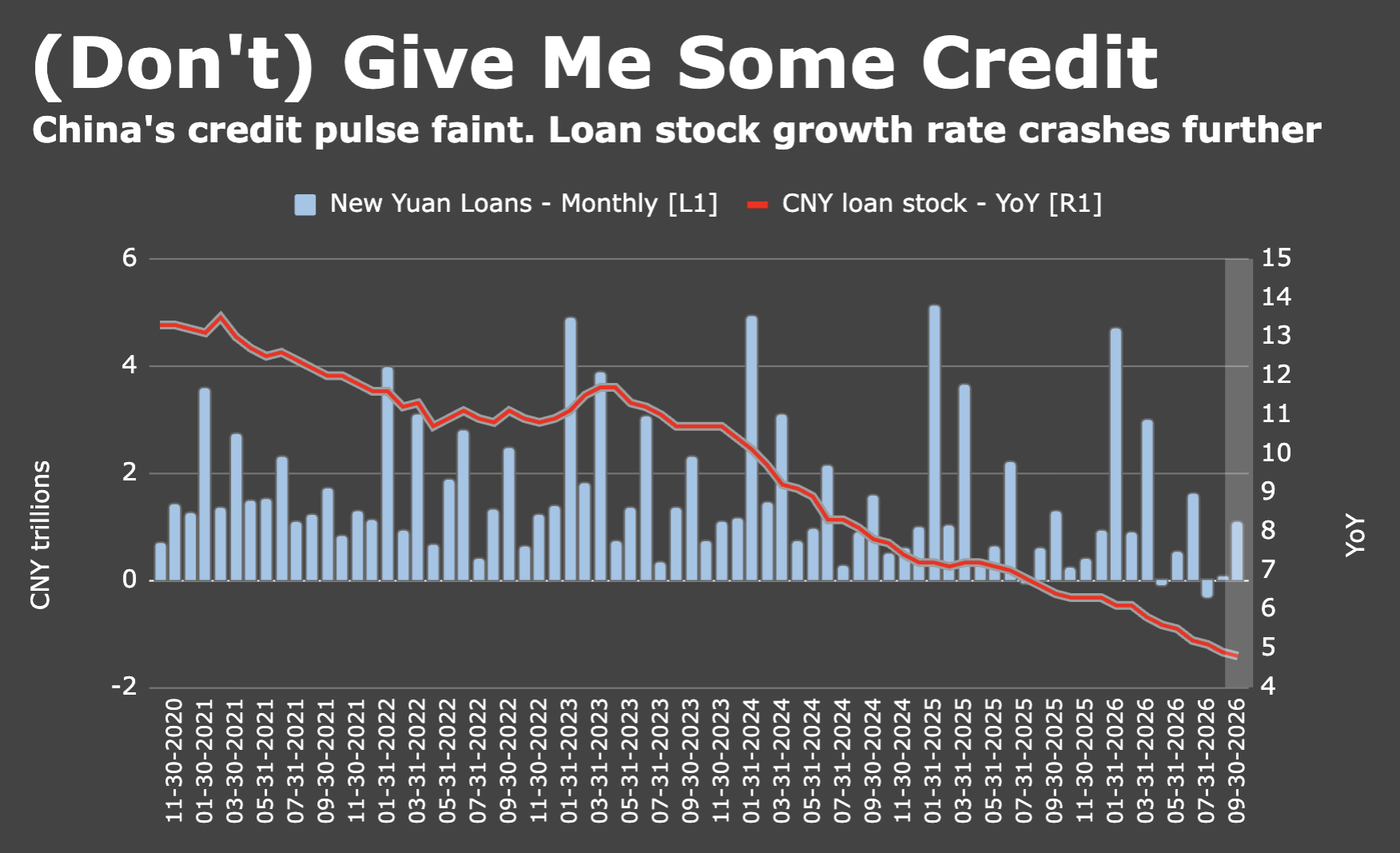
Although credit growth data released last week showed a rebound in new lending, loans to households were more or less unchanged from August (when they showed a contraction) and the growth rate for the total outstanding stock of CNY-denominated loans hit yet another record low (4.8%) at the end of Q3.
As for fixed investment, the cumulative YTD decline for the overall FAI metric at least didn’t get worse in September, but it didn’t improve either.

There’s the chart. 2025’s annual decline was the first in the history of modern Chinese macro data. So, 2026’s likely decline is a dubious encore.
The main culprit is, of course, property investment, which is down 21% YTD. That’s one of, and probably the, main factors holding back domestic demand. Until the Party stabilizes the real estate market, household sentiment’s unlikely to recover.
“The underlying growth mix [is] increasingly reliant on external demand [as] household consumption continues to lag, with income growth weak and the household savings rate rising,” SocGen’s Lam said Monday, in the same note mentioned above. “The property sector remains a drag, and credit growth continues to soften as households and firms remain in deleveraging mode.”
Like I said: China’s still mired in a balance sheet recession. That much is clear.


H, any idea what the real sentiment is for the ‘average’ Chinese (given it’s healthier to keep their thoughts to themselves). I can imagine that there’s plenty of state sponsored propaganda about the awful circumstances in the rest of the world and how lucky everyone is to be living under Xi.
To that latter point, I should be clear: There are worse places to live in the world than China. Hell, there are worse places to live in the developed, democratic world than China. Is it the Scandis? Well no, obviously not. But they’re doin’ ok.