

This’ll be a busy week on the US macro front, where a packed data docket may afford bond bears an excuse to push the envelope.
10-year US yields are just a handful of basis points from 5.20%, a level they briefly breached last week. Although equities are remarkably resilient, some worry it’s just a matter of time before the highest yields in decades undercut risk assets in earnest.
The marquee macro release is obviously the September jobs report. Consensus is looking for 95,000 (give or take) from the NFP headline on Friday. That’d be a solid encore from August’s barnburner, which recast what had been a deteriorating labor market narrative in America.

Naively assuming no revisions, a consensus print would bring the three-month moving average for the world’s most important data point to the highest since May and the second-highest of Donald Trump’s second term.
Of course, there will be revisions. And they’ll be eyed very closely following last month’s upward adjustments, which Cinderella pumpkin-coached July’s net loss into a 31,000-job addition.
Ahead of the government report, traders will get the usual labor market appetizers: ADP’s seen tipping a 70,000 gain for private payrolls on Wednesday and the Challenger release on Thursday should reflect the onset of holiday hiring plans.
Additional evidence to support the notion that the labor market firmed during the dog days of summer would bolster the case for back-to-back Fed hikes. On the heels of last week’s scorching read on US manufacturing activity, STIRs priced ~70% odds of a hike at the October FOMC meeting.
Speaking of manufacturing activity, Thursday’s ISM headline (seen at an eminently beatable 54.8) will be watched even more closely than usual in light of the blistering S&P Global readout.

The figure above shows you the two surveys. ISM’s printed in expansion territory every month this year. If the headline picks up steam to match the S&P Global print, look for the long-end to trade heavy into payrolls, assuming the balance of the week’s pre-NFP data doesn’t undercut the “overheat” story.
In light of the potential for payrolls and/or ISM manufacturing to put additional pressure on the Warsh Fed to deliver another rate hike posthaste, Wednesday’s already-crucial PCE price update will carry even more weight.
Recall that the BEA’s instituting annual methodology revisions this week. The tweaks, which include adjustments to the calculation for the suddenly-crucial computer software and accessories category, are seen pushing YoY core price growth on the Fed’s preferred measure lower by around two tenths.
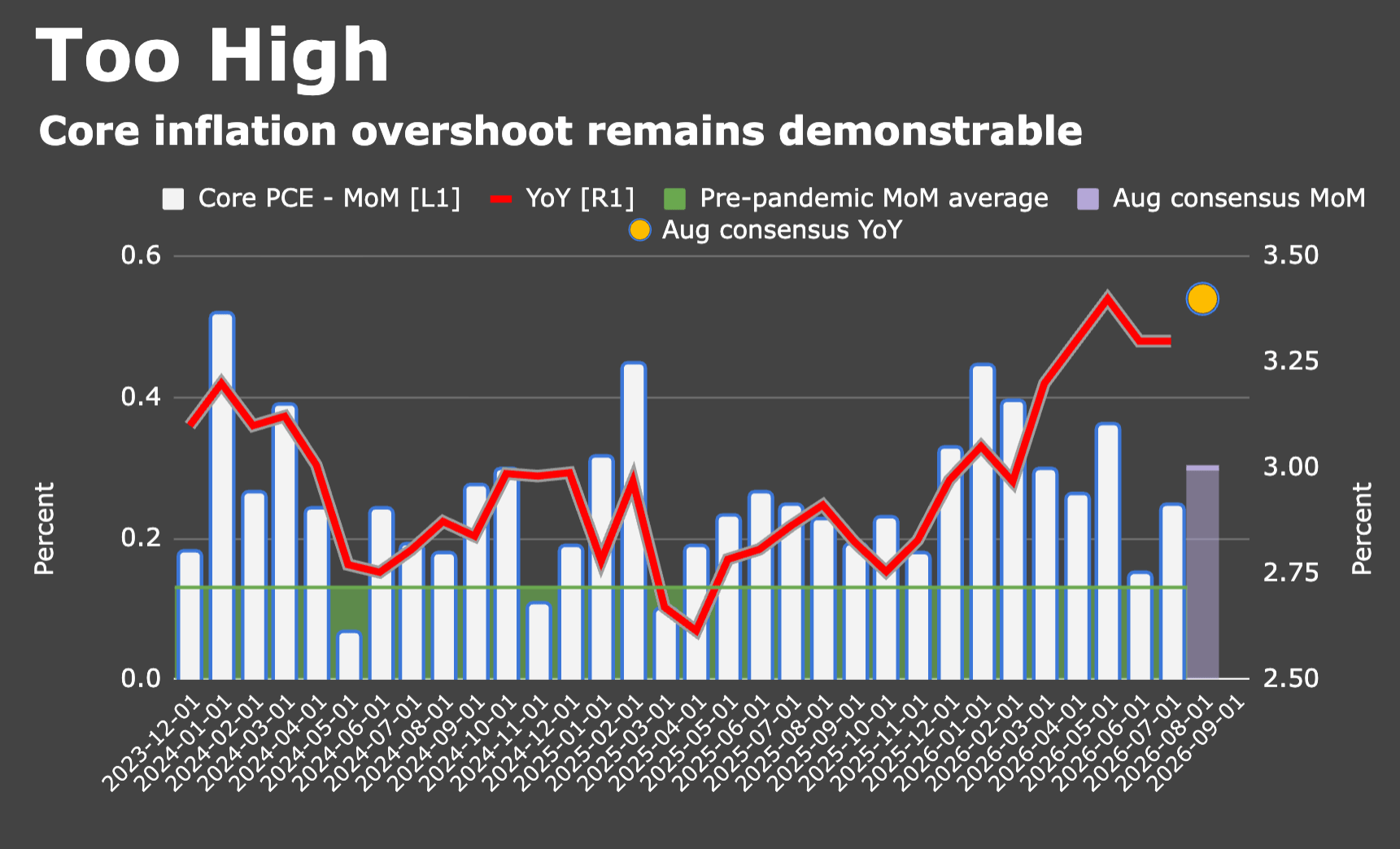
As the figure shows, consensus nevertheless expects the annual rate to come in between 3.3% and 3.4%, “slightly” above the Fed’s target. (“Juuuust a bit outside.”)
Over the weekend, Scott Bessent said Kevin Warsh should “let things run” à la The Maestro rather than hiking to curb supply-related prices pressures. “The board and the voters on the Fed should have an open mind,” Bessent told Fox. “Core inflation has been very quiescent,” he added, referring to core CPI. (Sunday marked the first time in the network’s history that a Fox guest used the word “quiescent.”)
Note that consumer spending’s seen very strong in Wednesday’s BEA release. Specifically, nominal outlays are expected to post a 0.9% MoM advance and real spending a 0.5% increase. If realized, those prints would underscore the idea that Americans are spending into the war-driven increase in headline inflation.
Also on deck in the US this week: Conference Board consumer confidence, JOLTS and updates on the Case-Shiller national home price indexes.


Good strategy Scott. If the trash talk doesn’t work, go the William F Buckley Jr route.