

On January 31, 2024, when he was still managing private capital as opposed to the public finances, Scott Bessent described the “significant” costs of then Treasury Secretary Janet Yellen’s maneuvering to placate a nervous US long-end.
“We believe that the Treasury had become uncomfortable with the bond market selloff and the tightening of financial conditions that resulted,” Bessent wrote to investors in his global macro fund. “Over the short-term, this change in issuance strategy has had the desired effect, with financial conditions easing materially since the November 1 announcement [but] over a medium-term horizon, we believe this is a risky strategy.”
“[T]he November 1 announcement” was a reference to 2023’s final quarterly refunding statement, which found the Yellen Treasury surprising markets with smaller-than-expected increases to coupon auction sizes. In the three months leading into that fateful QRA, long-end US yields rose sharply, as investors fretted over America’s fiscal trajectory in the wake of the Fitch downgrade.
Then, as now, oversupply concerns were exacerbated by the perception that a shift in the buyer base for Treasurys away from the price-agnostic bid (e.g., the Fed) and towards price-sensitive investors would lead to lower clearing prices and higher yields for US debt. The term premium climbed out of negative territory, the curve bear steepened and in late October of that year, 10-year US yields breached 5%, spooking markets and policymakers alike.
Yellen’s famous November 2023 QRA stanched the bleeding and set the stage for the long-end’s two best months in years.
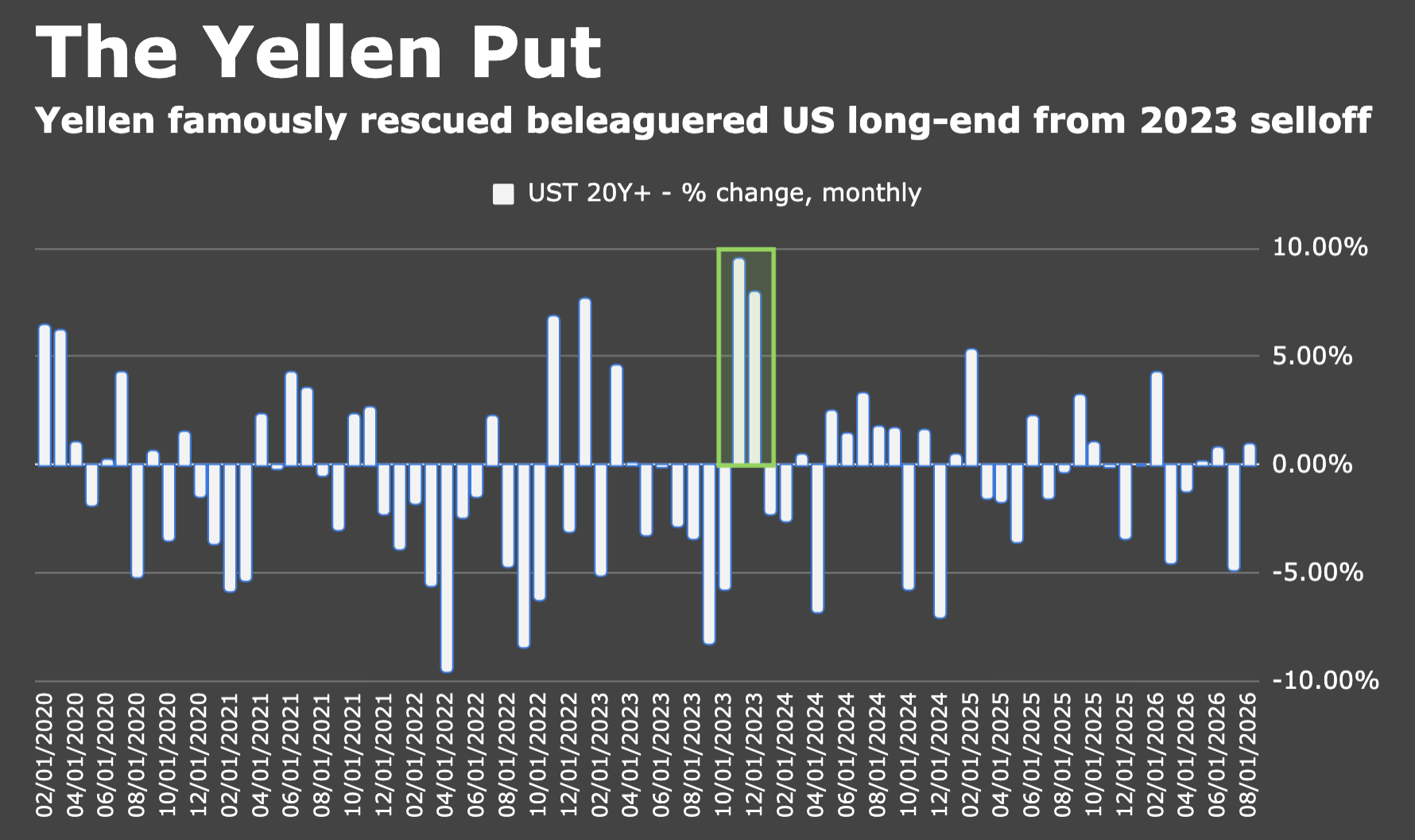
The rally illustrated above helped US Treasurys avoid what would’ve been an unprecedented third consecutive annual decline. It was accompanied by gains for equities and credit, as Jerome Powell pivoted dovish at the Fed.
The same day Bessent penned the client letter quoted here at the outset, Yellen tipped no additional increases to long-end auction sizes beyond those being announced at the January 2024 QRA, in the process inaugurating the forward guidance that’s been a fixture of every QRA since.
In and around that episode, Yellen was accused (and not for the first time) of attempting to bolster Joe Biden by tweaking Treasury’s issuance strategy. Bessent was among her critics. “In addition to a higher interest expense, concentrating issuance in short tenors exposes the Treasury to greater volatility via refinancing risks and creates the potential for a financial accident,” he wrote to clients.
To be fair, both the 2s30s and the 2s10s were inverted at the time, so it’s true that Yellen was in effect going the more expensive route by funding at the front-end. The curve’s not inverted today, so Bessent’s immune to that criticism, and if the Fed’s truly beholden to Donald Trump, then I suppose he doesn’t have to concern himself too much with refinancing risks via front-end vol either, notwithstanding any volatility Kevin Warsh might create by eschewing forward guidance.
But, as JonesTrading’s Mike O’Rourke wrote following Bessent’s mid-week intervention to bolster the beset long bond with stepped up buybacks from next month, Scott’s running the risk of being called a hypocrite.
“Bessent is risking his own credibility for a policy approach he criticized before he entered public service,” O’Rourke remarked. “The question is will Bessent continue to go down the path he criticized” by leaning even harder into bills to fund even bigger buybacks out the curve in the event the bear steepener resumes.
As O’Rourke went on to point out, Bessent’s “Operation Twist” (as markets were quick to dub Treasury’s stepped-up buybacks, a callback to the Fed’s 2012 program of the same name) is far smaller than the Fed’s selling of short-term US paper and buying longer-dated notes and bonds. “The average monthly amount we’re talking about is approximately one-third of the size of the 2012 Operation Twist, but the amount of total federal debt outstanding is 150% larger,” O’Rourke said, calling Bessent’s bond gambit “the equivalent of policy jawboning with superficial capital behind it.”
Without exception, everyone who weighed in on Bessent’s decision to upsize buyback operations for long-end US debt said this is a Band-Aid, not a solution, even if it helps stabilize markets.
“Fiscal consolidation is required for a more sustainable recovery in the bond market, but news that the US Treasury is going to be more vigilant about the long-end has been welcomed,” ING’s Chris Turner wrote. “‘The Bessent Put’ reduces one of the key threats to risk assets this summer.”
“The decision to boost buybacks outside of the US Treasury’s regularly scheduled quarterly announcements is a clear signal that the bond selloff had reached a significant pressure point for the Trump Administration, rais[ing] questions about the lengths Bessent is willing to go to bring down longer-dated yields moving forward,” BMO’s Ian Lyngen remarked. “While such speculation may serve as an inhibition to shorting the long-end of the Treasury market, the buyback move didn’t necessarily change the broader fundamental backdrop that was responsible for pushing 30-year yields to their highest levels since 2007 this summer.”
In the same note, Lyngen was keen to point out that the buyback announcement makes the innocuous tweak to the QRA language (Bessent’s latest refunding announcement introduced two-way risk to future QRAs by replacing “increases” with “changes” in Yellen’s long-end guidance, opening the door to actual cuts to coupon auction sizes next year) seem much more deliberate. “Bessent has made it abundantly clear that the Treasury Department will be taking a more active approach to its WAM management with a bias to shorten it in response to higher borrowing costs in the long-end,” he said.
Of course, there’s no free lunch. If Bessent floods the market with Bills to pay for his long-end buybacks, he risks creating indigestion in O/N funding, which no one wants. Warsh would have to step in to mop up any associated mess with more of the Fed’s “reserve management purchases.”
As far as the fiscal “fundamentals” go, O’Rourke put it best. “The obvious answer, and one our friends in Japan also need to learn, is that once you start acting responsibly, markets will begin to trust you and expect more responsible decisions in the future,” he wrote. “Once markets enslave you, then you are their servant forever, and gaining that trust becomes a longer, volatile and painful experience, usually under new leadership.”


If fiscal responsibility is what is truly needed- then there are really only two options: Cut spending (never going to happen) or raise taxes.
Blasphemy to think one of the solutions is to ‘Tax the Rich’. After 40 years of lowering taxes for the rich and raising taxes on the poor there is only one place to look for raising taxes.