

My ghetto’s not your culture, people really die here
So hard to say goodbye, is the only lullaby here
Kilos turning boys to men, gotta pick a side here
Section 8 living, we treat it like a timeshare
Mother, auntie, cousin, couldn’t tell you who reside there
When kings can’t raise a young prince, the doves cry here
Candy lady right there, zombieland right there
These apartments are the perfect backdrop for any nightmare
— Gene Elliott Thornton Jr.
I / Nirvana
I didn’t realize it at the time, but that was as good as it was ever going to get.
That’s the cruelest part of life if you ask me: We don’t recognize our best days until they’re long gone. Just as youth’s famously wasted on the young, our personal halcyon periods (which sometimes, but not always, overlap our youth) are wasted on all of us, their singularity revealed only in hopelessly belated epiphanies. Trying to reclaim those days later, after the epiphanal moment, only makes them seem more distant — beckoning echoes that run further away the faster we chase.
He put a fortune into that Chevelle. Or what for him was a fortune. A lot of money any way you look at it. It was electric blue with white racing stripes. Maybe they were black. I can’t remember. The interior was professionally refurbished and smelled like an auto parts store, the angry snowman air freshener that hung from the rearview mirror having long since lost its bouquet.
I never knew how impressed to be with his roaring antique. The consensus among muscle car connoisseurs — of whom there were plenty in that town — was favorable, and then some. I was “lucky” even to ride in such an exemplary machine, apparently. Exemplary of what I wasn’t sure. Americana, I suppose.
He was the size of an NFL linebacker and his skin was an eumelanin mural of guns, psalms, eulogies, more guns and zodiac crabs inked such that their claws grasped at healed bullet wounds. We made for an odd pair unless you knew us, in which case it was odd to see one of us without the other. And when you saw us, it was a movie.
Time braked when we thundered onto a scene, drawing the attention of every background character in earshot of the Chevelle’s rumble. Rapt eyes peering curious from turned heads saw us step out in slow motion, flicked Bic to Black & Mild, struck Zippo to Camel.
“You doin’ brown or white tonight?” I could barely hear him over the engine, but I knew what he said. He asked the same question every Friday afternoon. I don’t know why. I only drank dark liquor back then. Whiskey, cognac, scotch. Always straight. Straight from the bottle. “Neat” in the formal parlance, a term I both love as an entreaty against adulterants and find ironic given that very little “neat” comes of drinking liquor straight.
He answered his own question: “I know you goin’ brown.” “Might go cheap too,” I thought out loud, doubling a rubber band around the stack of parlay cards in my lap. “Jim Beam Black or somethin’.” He mulled that over, gunning the Chevelle down a winding country byway. I put the parlay cards in a paper bag with the rest. “Why? You thinkin’ white?” The corners of his mouth turned up, composing a revelatory smile. “I’m thinkin’ white.”
We turned onto a newly-completed stretch of suburban sprawl. The city was expanding in every direction. An octopus reaching asphalt arms into a rural river valley. Within 15 years, the metro population would grow to nearly a million.
“You thinkin’ chicken or fish?” I pursed my lips and inhaled sharply, a metabolic gesture of respect for the significance of the question. In that context — the context of September cookouts — no decision’s more important than what to put on the grill. I dug deep for a theatrical timbre. “You know what?” I took off my Ray-Ban aviators for dramatic effect. “I’m thinkin’ both.”
Two stoplights later we pulled into the parking lot of a brand new Kroger. It was the centerpiece of a contemporary strip mall. They were sprouting daily from so many cow pastures-turned concrete farms, and they were all the same. Taupe brick. Dark grey trim. Starbucks. Great Clips. A package store. Upscale (“elevated”) Tex Mex. You’ve been there.
We parked and got out. Lights, camera, action. “You remember Adam?” he mumbled, his mouth multi-tasking around a Black & Mild tip. I lit a Camel, drew in poison and exhaled. “Steroid Adam?” “Yeah, my trainer.” I shook my head dismissively. “He’s not a trainer. He’s a steroid addict.”
Two pairs of bought-that-day Air Force Ones, white as the powder that fed us, strode across fresh pavement, gum soles falling in unison. The theme song to the Sopranos played in the key of life on my mental piano.
“Aaaanyway,” he laughed me off, “Adam works here now.” “At Kroger? This one? Doing what?” “He’s their head meat guy–” he stopped on a dime. I turned and looked back. “What?” He lowered his Versace Medusa Biggies, the only pair of sunglasses he owned and the only pair he ever wanted to own. His countenance was meditative and urgent all at once. I laughed: “You thinkin’–?” “Yep.” We said it together: “Chicken, fish AND steak.”
An hour later we were back at his house, a modest brick ranch on a little less than an acre. Everyone else’s cars — my Acura TL, her Lexus GS, his wife’s Camry, a cousin’s Monte Carlo — were lined up on the right side of the driveway, leaving a path for the Chevelle which we pulled under the attached carport.
The door off the carport led directly into the kitchen, where his wife Whitney was giving my new Bonnie Parker a lesson in soul food preparation. Bishop, a $10,000 XL Bully, struggled to find enough space among shuffling feet. “Did y’all get chicken or fish?” Whitney called back over her shoulder, her hands busy in a bowl of breading flour. “Both,” I grinned. “AND steak.” “My lawd Jesus,” she sighed.
The girls went about the side dishes, he prepped the meat and the cousin played video games in the living room, where his son sat on the floor crashing toy cars. I got to work on a fifth of Beam.
Once the grilling commenced, I went outside and took up my usual spot in a folding lawn chair, close enough to take in the divine smell of barbecue chicken blackening over charcoal, but not so close that he might ask me to help. Once the chicken and fish were done and the steaks were on, he pulled up a chair beside me. We lit cigars. He sipped Belvedere and lime tonic from a rocks glass like a regular sophisticate. I swigged bourbon from the bottle like an Appalachian viking.
Out in the yard, his son whiffed with a toy bat. The wind from near misses swept a plastic ball off a rubber tee. The cousin replaced it, replaced it and replaced it again. “This is it right here,” he said. “What?” I asked, unmindful. “This,” he traced an invisible oval in the air, making a lasso motion with his cigar hand. “What we doin’ right now. This is livin’.” “I’m just glad you’re alive and free,” I told him. (He’d been shot earlier that summer, and had only recently completed an intermittent sentence arrangement which required him to spend weekends in jail.)
According to the National Bureau of Economic Research’s cycle-dating committee, the worst economic downturn since The Great Depression ended three months earlier. According to Main Street, it was ongoing. Most Americans were still feeling it. We weren’t most Americans. Our business was vice. And vice is historically, reliably and famously recession-proof.
Not to confuse. We were sentimental all the same, alert as the graduate student side of my personal dichotomy was to the impact of Lehman, and in touch as he was with the harsh economic realities of life as a minority in America. But the will to gain’s every bit the anesthetizing agent as any drug. That’s the paradox which blurs the line between dealers and addicts.
Besides, brighter days lay ahead on Main Street. Or so vowed a savior whose business model wasn’t so different from ours, peddling hope as he did to the hopeless. “Yes,” America’s deliverance steadfastly insisted, to a crowd estimated at nearly a quarter million gathered in Chicago’s Grant Park the previous November, “we can.”
He got up to tend the steaks. In the kitchen, the soaring politico-street anthem “My President” played on repeat. Like the man it exalted, the song implored everyday people, and particularly black people, to dream: “Today was a good day, hope I have me a great night / I don’t know what you fishin’ for, but catch you a great white.”
II / Hope’s not a strategy
“I think he gave us hope,” Jay Wayne Jenkins told Genius, on January 10, 2017, reflecting on Barack Obama’s legacy 10 days before he left the presidency to Donald Trump. “He showed people how to strive and that was more [important] than Obamacare or anything else he could’ve done.”
Nearly two decades on from penning what NPR described in 2008 as “something of an election anthem,” Jenkins, now 47, still expresses deep reverence for Obama. But he no longer waxes rhapsodic about America’s first black president. Certainly not in any fashion that recalls the euphoria which permeated “My President.”
Age is a factor. As we grow old, we begin to appreciate how naive we were to hope, hope being famously deficient when employed on its own, as a strategy. And Jenkins, having become comparatively deliberative in middle-age, simply isn’t the same gung-ho twenty-something whose brash ad-libs defined a genre and served as the backdrop for some of the 21st century’s largest records, including Kanye West’s “Can’t Tell Me Nothing.”
But the attenuated character of Jenkins’s remarks about Obama’s two terms in the Oval Office reflects far more than the jaded solemnity conferred by the aging and maturation processes. It speaks to a disillusionment shared by many African Americans who, while in many cases recognizing Obama as a singularly estimable president who did everything in his power to make good on the promises implicit in his rhetoric, nevertheless overpromised and underdelivered.
Late in 2016, The Atlantic published “My President Was Black,” a short history of Obama’s presidency by MacArthur Fellow Ta-Nehisi Coates, along with a series of response essays. One of the responses was penned by long-time reparations champion Sandy Darity Jr., who The New Yorker aptly described in 2021 as “perhaps the country’s leading scholar on the economics of racial inequality.”
Darity, whose academic resume’s nothing short of staggering, recalled the unqualified elation at Obama’s election. And a generalized unwillingness, even among the otherwise dubious, to entertain any doubt. His father, a “usually deeply cynical” man when it came to politicians, was “absolutely thrilled” and “viewed any criticism of Obama as bringing aid and comfort to white supremacists.” Black Americans of all ages exhibited “near complete unanimity,” Darity went on, recounting an unrestrained adoration which “carried with it absolute resistance to any complaints about the black president,” whose election was “equivalent to the moment of jubilee.”
That “near complete unanimity” was reflected in black support for Democrats, which peaked at 96% in 2008. It’s been down hill since then. Indeed, by every available estimate and metric, Democratic presidential candidates have received a lower share of the general election black vote each year since 2008.

The figure above gives you a sense of that drop-off among African American males. According to Catalist’s data, support fell 16ppt from 2012 to 2024, and nearly 20ppt over the same period among young black men.
The drop-off rate for all African Americans (i.e., women and men of all ages) is less pronounced, but at 11pt, it’s still highly disconcerting for Democrats, particularly considering the Democratic candidate in 2024 was black.
You don’t have to be Nate Silver to intuit why this is a big deal, but just in case, he walked through the math in a recent article discussing the Catalist figures. The upshot is that a decline in the net contribution to Democrats’ support among minority voters explains the party’s struggles, not turnout and not Trump’s ability to galvanize whites.
“Trump actually gained less from white voters overall in 2024 than Mitt Romney did,” Silver noted, adding that black turnout was “only slightly lower for Harris as a proportion of the electorate than for Obama in 2012.” The problem for Democrats: Harris’s margin among black voters was only 70ppt compared to Obama’s 91ppt a dozen years previous.
As David Drucker put it, in a June Op-Ed for Bloomberg, “the Democratic nominee garnering three-quarters of the vote, and better, with any particular demographic might not sound like anything to fret about, but what matters is how the electoral performance of black men compares to 2020 and prior presidential contests.”
It might seem odd to place blame for Democrats’ fading support with black voters at the feet of a man who, even in 2012, after it was clear the promises implicit in the lofty rhetoric which delivered The White House four years previous wouldn’t be kept, nevertheless commanded near universal support from African Americans in the general election. But as an Emory political scientist told Drucker for the Bloomberg piece, “the movement of black men” away from Democrats is in part attributable to “a general feeling of being taken for granted by the Democratic Party.” It’s fair to ask if that sense of betrayed presumption is a residual of broken promises from the Obama years.
Americans, and particularly African Americans, are accustomed to being let down by politicians. No one expects much from their elected representatives, and most everyone knows political messages are exploitative by their very nature, just like any other ad campaign. That’s particularly true when the message is tailored to specific constituencies. Again: Most people accept, understand and even welcome that, despite knowing all too well that what’s being sold won’t live up to the marketing pitch. Think of all the tailored credit card offers you get. You know the pitch is wildly exaggerated — perfect people lounging on a perfect beach all because they got triple the travel rewards — and you know the card company just wants to exploit you, but you’ll entertain the pitch because every now and again, it’s good and it works out.
But there’s something uniquely galling about the suspicion you’ve been “assumed” based purely on the shade of your skin, and something even more vexing in the inkling that such assumptions stem not from stereotypes about what your skin color conveys regarding your socioeconomic lot and thereby your political leanings, but rather from presumptions about tribal loyalty. Like a consumer products company assuming you’ll always buy their brand — never, ever a competitor’s — because the CEO’s black. Or was black at one time. Even when the product fails again and again to perform as advertised.
That sort of presupposition borders on being itself racist, if mostly by accident. It robs black voters of the agency inherent in a franchise their fathers, grandfathers, mothers and grandmothers fought and died to secure. The whole point of the franchise is that it confers upon people the right to vote freely. From Obama forward, Democrats’ message to black voters was essentially this: When there’s a person of color anywhere near the top of the ticket, that’s the only thing you need to know. As if the entire constellation of factors voters would normally weigh when considering such a serious matter as a ballot for President of the United States, are now every one irrelevant for African Americans because Democrats have twice nominated a person of color for the highest office on Earth.
That’s bad enough on its own. It’s made immeasurably worse when the assumption is sustained despite very little in the way of evidence to support the notion that unflinching, race-based loyalty to Democrats has actually paid dividends for Black America.
In August of 2015, when Trump was still an “ever-opinionated billionaire candidate for president,” as NBC put it at the time, the man who would go on to define American politics for the next decade declared that Obama “has done nothing for African Americans.” Like most everything Trump says, that was a cartoonishly exaggerated generalization, which is a polite way of saying it was a lie. However… however.
In his profile of Obama, Coates mentions a number of quantifiable socioeconomic indicators which he says paint a picture of a rigged system. Perhaps the most important point to grasp in any discussion of such metrics is that the overall racial wealth disparity in America is vast enough to constitute a verdict in and of itself. As Coates put it in the context of household wealth, the differences are “so large as to make compari[sons] meaningless; they’re simply not comparable.”

The figure above, which uses the Fed’s Distributional Financial Accounts data, underscores the point. It shows that under Obama, the percentage gain in total assets for African Americans was much more pronounced (22ppt) than for whites. But the sheer vastness of the disparity ($86.15 trillion for whites as of Q4 2016 versus a paltry $5.46 trillion for blacks), makes this apples to oranges.
You can observe a similar dynamic in any number of other aggregates. The ratio of total white-to-black net worth, for example, fell more than 4ppt under Obama, which sounds good until you consider that it was still more than 18:1 when he left office. (It’s 24 today. It peaked at 27 in 2000.)
The Survey of Consumer Finances, a separate Fed report, suggests the ratio of median net worth by race actually got worse (i.e., became more unequal) during the Obama years. Specifically, it was 8.17 in 2007 and nearly 10:1 in 2016 as illustrated in yellow, below.

The chart gives you some additional numbers. The median net worth for white households during Obama’s final year in office was $210,000 give or take. For black households, that figure was a mere $21,000.
The median income disparity was most unchanged under Obama using the same Fed dataset. In 2016, the median before-tax family income for black households was about $44,000 compared to $75,000 for white households. By implication, black households would’ve needed to save every penny of their annual income for more than four years to close the net worth divide, versus five years before Obama took office.
Darity’s research draws similar conclusions. In order to close the wealth gap in America, “the average black household would have to save 100% of its income for three consecutive years,” he remarked, in his response essay to Coates’s Obama retrospective. The point, obviously, is that the wealth gap can never close purely as a result of savings. (Nationally, the personal saving rate’s 5% on frugal days.)
I’d be remiss not to note that there’s every reason to believe the very same racial disparities on display across every wealth and income metric apply to savings too, and because savings are multiplicative (through the miracle of compound interest), its almost surely the case that savings dynamics in America work to perpetuate inequality, just like every other facet of the system. Indeed, the Fed data suggests just four in 10 black households have a savings account.
The figure below shows a metric called “liquid asset poverty.” As the National Community Reinvestment Coalition, a consortium committed to promoting inclusive economic opportunity, explained, it uses checking and savings account balances from the Fed series to calculate the share of households which could “subsist entirely on liquid assets at the federal poverty level for three months without an income.”

About 69% of black households lived in liquid asset poverty when Obama took office. When he left office, that figure was 72%.
As the NCRC wrote, “without sufficient liquid funds available, families are highly vulnerable to predatory and/or value-stripping sources of quick cash such as payday lenders, car title companies and even housing cash buyers.” That’s not a good position to be in, and going by the figure above, black households remain about twice as likely to find themselves so situated.
Notably — and this is a truly damning indictment of the system — education, while crucial for African Americans, is no panacea. In 2016, Obama’s final year in office, there was nothing close to wage equality when broken out by educational attainment. “While a college education results in higher wages — both for whites and blacks — it does not eliminate the black-white wage gap,” The Economic Policy Institute wrote at the time, adding that African Americans “are still being paid less than whites at every education level.”
The figure below, which utilizes EPI data, gives you some historical context for the evolution of the black-white wage gap for new-entrant males, which is to say it traces the path of pay disparities for inexperienced workers entering the labor force with different levels of educational attainment.

It’s the same story: To the extent you can spot progress during the Obama years, it’s trivial, certainly in the context of the overall disparity.
At the same time, disparities in the unemployment rate suggest that when Obama left office, African Americans were jobless at similar rates to whites despite having achieved far more in the way of education. Coates noted, for example, that the jobless rate for black college graduates in late 2016 was 4.1%, just five-tenths lower than the rate for whites with only a high school diploma. For context, that gap for all Americans has averaged 2.8ppt in government data back to 1992.
In a 2015 study entitled “Umbrellas Don’t Make It Rain,” Darity and four other academics showed that, among other alarming statistics, “black families whose head earned a college degree have only two-thirds of the wealth of white families headed by a high school dropout.”

The figure above’s astounding, even as visuals depicting egregious inequality go. Median wealth for black families where the head of household earned a post-graduate degree was roughly the same in 2011 as households headed by a white high school graduate.
And we wonder why it’s so hard to sell young African Americans on the idea that it’s worth the trouble to pursue college. Insult to injury: African Americans typically end up in a worse position vis-à-vis student debt.
In 2009, Obama gave a nationally-televised speech to a group of high school students in Arlington, Virginia. His message was simple: Go to college because “no matter what you want to do with your life, you’ll need an education to do it.” That, he said, is a “guarantee.”
Over the ensuing seven years, student loan debt among African Americans rose 24% compared to 16% for white borrowers.

As the figure shows, the share of those loans where the current balance exceeded the original balance more than doubled by the time he left office, and although the same was true for white students, that share was nearly 20ppt lower.
In a 2021 piece documenting the same figures, Brookings was unsparing. “A college degree does not eliminate income gaps between white and black workers [and because] black students finance their education through debt, college degrees actually further contribute to the fragility of the upwardly mobile black middle-class,” the authors wrote.
To be sure, exactly none of this is Obama’s fault. But that goes without saying, just like it goes without saying that addressing the kind of endemic issues which explain the disparities illustrated above and so many others like them can’t be addressed (let alone redressed) by one man in four or eight years. But Obama promised we’d get there.
“The road ahead will be long. Our climb will be steep,” he told the crowd at Grant Park in the early hours of November 5, 2008. “We may not get there in one year, or even one term, but America, I have never been more hopeful than I am tonight that we will get there,” he went on. “I promise you: We as a people will get there.”
He didn’t say, specifically, where “there” was, nor was he clear on who was going, but it’s fair to say African Americans weren’t “there” in 2012, nor in 2016. Indeed, it wouldn’t be entirely inaccurate to suggest that no progress was made on the economic front for black voters under America’s first black president. And you’d be wholly justified in suggesting that to the extent there was any progress, it wasn’t pronounced enough to move the needle for young black men, who wouldn’t be blamed for asking what, exactly, there was to be so “hopeful” about.
III / Hopeless
I remember the worst day of my life. And unlike the best days, I didn’t need hindsight to recognize its particularity. It revealed itself in the moment.
That it unfolded, in part anyway, on the same hallowed ground where I somnambulated heedlessly through a southern-fried version of the Arcadian idyll was more than a little ironic. It was a tragicomic admonishment from the gods. Karmic comeuppance for letting nirvana slip through my fingers without even once appreciating my proximity to an earthly, vice-themed Elysium.
It was 2012 and I was hating every second of it. It wasn’t that I wanted to move on but couldn’t. It was that I had to move on but didn’t want to. Worse was the creeping realization that nobody else wanted to move on either, necessarily, but I’d left them little choice. The dream — my dream — seemed to them irretrievably adrift, lost with me on a sea of liquor. So, it ended. And a transition to my short-lived stint as a regular nobody began.
Most of the businesses were still going concerns even as the denouement drew near. But I’d sold them something far grander: A fantasy where my eclectic melange of character traits transformed his otherwise unremarkable (and lamentably stereotypical) hustle into a Hollywood narco blockbuster. More than that, I’d implied I could freeze the film in the middle, sparing us the inevitable downfall and forestalling, in perpetuity, the consequences of the illicit millions we’d probably never make in the first place.
Far-fetched as it was by nature, my fifth-a-day liquor habit pushed the delusion even further out of reach. I was relentlessly capable even on paralytic days (I effortlessly completed two years of graduate school contemporaneously), but I wasn’t sharp. To keep the vision alive I needed to raise the stakes. But raising them any further required a kind of ascetic lucidity unavailable to an alcoholic, no matter how high-functioning. Realizing even a scaled-back version of the fantasy demanded sobriety. Lest I should cost us our freedom. Or our lives.
However badly they wanted to stay with me there, in what’s now a crumbling dreamscape, population: one, they had to let go. Even if I never would. It wasn’t going to get any closer to my grandiose ideal and more importantly, they didn’t think it needed to. That I couldn’t appreciate what we already had was as damning as my refusal to sober up so we could have more.
The inherent, pitiable tragedy was lost on me then and remains elusive even now, probably because it’d be too painful to accept: They didn’t even want what I was too drunk to keep chasing. They were there with me, sharing in the fantasy to their own potential ruinous detriment, the same way people are always willing to suspend disbelief when someone they love’s running down a dream.
I don’t know why I brought my new romantic interest out there. She was determined I wasn’t who I was and that no one who participated in my self-delusion had a place in my life. “Our life,” as she’d already taken to calling it. We’d known each other for all of three or four months but that was enough, apparently, to conclude that I was a victim.
She saw in me not a seller of dreams to a dozen people who were in one way or another vulnerable to the manipulative behavior of an exploitative narcissist. And certainly not an enthusiastic peddler of hope to countless hopeless, most of whom I’d never meet. But rather a hostage to an improbably varied clique of bad actors and enablers, all of them shameless enough to let me destroy my own future, but none so deserving of disapprobation as the imposing black man. None so despicable, in her estimation, as my best friend. That he happened to have very dark skin had nothing to do with it, she insisted.
On most conventional vectors, she was an all-around good person. At times to the point of caricature. (She once found a newborn puppy, eyes still closed, in a dumpster and bottle-fed it back to health, beating survival odds described by a pair of vets as hopelessly long.) That made her a reliable shepherd for my trip down the unromantic path to socioeconomic normality. Or at least that was the idea.
More germane to the immediate, that-day circumstances, she was a hyperactive Democratic booster and an Obama super-fan. I assumed her loud and proud political predilections conveyed a receptiveness to multicultural social settings. Or at the least, a disinclination to racial typecasting. I was wrong on both counts.
“I don’t want you to think we’re going to do this again.” She drove painfully slow in a posture that evoked Floridian retirees: A forward lean that nearly touched her chin to the top of the steering wheel, which she gripped with a textbook 10 and two. Call it the farsighted flamingo. “I know,” I said, disconsolate from the passenger seat. “Because we’re not.” “I know,” I said again, inflectionless.
Her nondescript, burgundy Corolla whispered along the same country road where the Chevelle once bellowed. It was well past grilling season, but I wanted to attend one last Friday dinner before fading into pedestrian obscurity. She’d reluctantly agreed, but only because it was on the way to an event which was supposed to serve as my introduction to her world: A party in Gatlinburg, where her sister (a school teacher), brother-in-law (a real estate agent) and a dozen of the whitest, most homogenously suburban people I’d ever seen, were gearing up for a Clue-themed couples night.
The Corolla labored up the driveway. We parked behind his Denali. The Chevelle was gone, sold months previous to a hayseed who promised to “take good care of her.” The door off the carport was locked. Not on purpose but it felt symbolic. The wormhole back to better days was closed. I was shut out of the past.
We went around to the front like regular houseguests. She glanced disapprovingly at the mulch and flowers, and made a point of looking up at a second story that wasn’t there. Her gait was pretentious. As if we hadn’t just pulled up in a Corolla — motorized mediocrity.
He opened the door and engaged me with the customary multi-step hand shake culminating in a mutual single-armed, back-slapping hug. She exuded disapproval. Although they’d met before, it was only in passing. I introduced them formally. He stuck out his hand. She gave him the deadest of dead fish.
I beckoned her along into the kitchen to meet Whitney, who was busy breading something: “Is this Sarah?! Look at her, she’s beautiful!” I smiled and nodded. “I’d give her a hug but my hands is messy.” “Oh, that’s ok,” she nearly sneered, with barely-veiled disdain.
She didn’t offer to help, an unforgivable lapse in an insular social context where gender roles still mattered and the kitchen doubled as a gossip parlor for the wives and girlfriends.
As we walked back into the living room, I could almost hear the childlike conviviality from yesteryear’s girls-only kitchen revelry, a soft resonance from a time not-so-far gone: Mischievous giggles and flour-assisted parodies of the business which put food on our table and took it off someone else’s. Ski.
There was no one else there. Just the four of us and his son, who was old enough by then to know his parents weren’t getting along. And old enough to know this Sarah character wasn’t his “Auntie E,” the familial title of endearment he bestowed, as a toddler, on my ex. The cousin was in jail for heroin distribution and everyone else had long stopped caring enough to show up to any cookouts.
It was late-ish October, cloudy and barely too cool to eat on the deck. There wasn’t a formal dining area, so we ate on TV dinner trays in the living room. She picked at her food superciliously. They tried to get a sense of her, but she made a point of being unreceptive. It would’ve been unbearably awkward were it not for his son, who she talked to more than she did the adults in the house, including me. She took a lot of pride in being good with children and he was blameless, by definition. It’s hard to be sanctimonious towards a child.
By the time we left I was furious. “You’re part of the problem, you know that?” I chided, as we backed down the driveway. She started to say something but I cut her off. For the first time all day I was something other than despondent. “Do you not think they noticed how miserable you were to be there? And you barely ate anything.” “She wasn’t wearing gloves to bread the chicken,” she offered. “Who wears gloves to bread chicken?!” I half shouted.
She proceeded to deride their house — something about it not being as nice as she thought it should be compared to her sister’s tract-build. Righteously indignant as I was, I didn’t have the energy to explain that a brick ranch on an acre, modest or not, was surely worth double the vast majority of partially-prefabricated boxes in the city’s by-then sprawling suburbs, and anyway, “What does that have to do with how you treat people?!”
“You don’t need those kind of people in your life,” she said, adopting a definitive cadence as though she’d said something self-evident. “Those kind of people? Black people, you mean?” Now she was mad. “Fuck you. At least I voted. At least I’m voting,” she enunciated, referencing Obama’s reelection campaign, which would deliver him a second term just a few weeks later.
“Oh, here we go,” I groaned. “It’s the old ‘I voted for Black Jesus’ trump card. Do you think anything’s actually changed for Black America since 2008? Do you think they don’t see it when people like you are on the high horse? How are they supposed to ‘hope'” — I gesticulated air quotes to be sure she got the Shepard Fairey reference — “when every time they turn around a white person accuses them of stealing, dealing or” — my voice crescendoed — “handling the fuckin’ chicken wrong in their own kitchens?!”
Then, silence. I had more to say and so, I’m sure, did she. But somehow, it felt otiose. A minute or two passed. “I don’t want us to be fighting when we get to the cabin.” “Yeah,” I muttered. She turned on some music. Adele hollered at me from the Corolla’s inadequate speakers, which struggled with the unrelentingly overwrought mezzo-soprano. (“Shut up,” I pleaded, in my head. “Please, Adele: Shut up.”)
We pulled into a Weigel’s to get gas. It was the same Weigel’s where he and I used to stop for Black & Milds and Camels. She went inside to get beer for the cabin party, and I got out to fill up her tank. On the other side of the pump was a new body Camaro with blackout tint. It was idling. I looked too long. The driver’s window came down and a kid, maybe 20, maybe younger, did his best Taxi Driver impression. “Sup witchu? Watchu lookin’ at?” I smirked and went about opening the gas cap on the Corolla.
“Oh, you laughin’?” he wondered, his voice rising in anticipation of the violence he was keen to instigate. I sighed and looked up. “Do you know who the fuck I am?” I wanted to say. But my past, like the exemplary aesthetics of a classic muscle car, was lost already on posterity. They didn’t know who I was. And standing there, putting gas in a Corolla on my way to a Gatlinburg cabin party, it occurred to me that I didn’t know either. Not anymore.
“I just like your car is all,” I told them. “Aight,” the driver said, still plainly wanting some type of confrontation. I wasn’t biting. He gave up: “‘Preciate that.” I nodded.
As they pulled away into a falling dusk, the menacing, unmistakable synths of “Love Sosa” palpitated from the Camaro’s speakers. This wasn’t Jenkins’s “My President.” There was nothing hopeful about Keith Cozart’s murderous hymn to Chicago gang culture.
Less than four years previous, the street anthem was a buoyant ode to the dawning of a brighter day. “Love Sosa,” by contrast, was a dark, bleeding composition — a baleful ballad that seemed to say, to Illinois’s most famous former senator and anyone else who might be listening, “Hope doesn’t live here.”
IV / The streets
Everything starts with economic opportunity. If you don’t have economic opportunity, a lot else is beside the point.
White America’s beginning to understand that. You can scarcely read the mainstream financial media in 2025 without coming across a distraught jeremiad for the macroeconomic plight of the youngest Millennials and particularly GenZers. Inadvertently or not, that sort of overwrought grousing concerns itself primarily with middle- and upper middle-class whites.
The subconscious message seems clear enough: When an archetypal twenty-something white person pursuing, or already possessed of, a four-year college degree, sees no readily-accessible path to gainful employment and financial stability, it’s more than a tragedy, it’s an existential emergency. And the 911 line’s out of order. As Meta alumnus-turned self-described “news personality” Emily Sundberg put it, in a discussion with Bloomberg’s Odd Lots podcast over the summer, “nobody’s coming to save GenZ.”
Kyla Scanlon, of “vibecession” fame, has made herself almost synonymous with this discussion. In a recent interview with Ezra Klein, a famous Millennial, Scanlon, an almost-famous GenZer, captured the zeitgeist. “There are so many think pieces about how the kids are not all right,” she said. “There’s a lot of nihilism, concern, fear and anxiety.”
The Klein-Scanlon discussion’s quintessentially emblematic — an accidentally immaculate encapsulation of the chasmic disconnect between the socioeconomic discussion as it unfolds in Democratic (large “D”) policy circles and the street-level reality of the black experience in America.
Before I go any further, I want be to clear: I’m a fan of Klein’s podcast. In my judgment, it’s the best podcast on the planet, bar none. I’m also a fan of Scanlon’s. I was reading her work when almost no one else was. So, nothing I say here should be construed as criticism. More people will read Klein’s and Scanlon’s socioeconomic commentary this week than will read mine all year.
As a matter of editorial course, Klein goes out of his way to present himself as way left-of-center and he’d surely scoff at the idea that he subscribes to any sort of “groupthink.” But as one Progressive put it to me this year, referencing an admittedly unfair gibe at Klein, his interactions with lower economic and social castes in America are by and large confined to tip-leaving. Maybe that’s true maybe it’s (completely) false, but if you’ve ever listened to Ezra, you’ll agree it seems like it could be true.
I’ll put it this way: Klein’s life work makes him intimately aware of the socioeconomic disparities that make America so unequal, and as a secular American Jew critical of the Netanyahu regime, he’s intimately aware of apartheid dynamics. But I wonder if he’s aware — really aware — of how similar the lived experience of some underserved black communities in America is to the plight of West Bank Palestinians.
Much is made of falling violent crime rates in America. Justin Fox, the former editorial director of the Harvard Business Review, went so far as to describe a “great American murder decline” in a recent Op-Ed (the picture his analysis paints isn’t nearly as sanguine as his title suggests, which is to say he’s apparently not that naive). Regardless of what the national statistics show, and however you want to explain favorable trends in a handful of the most dangerous metro areas, homicide rates in several American cities remain “appallingly high,” as Fox put it. For our purposes here, the key point is that rates for young black men are off the charts, both in absolute terms and particularly relative to whites.

As the figure shows, black men aged 18-24 are some 22 times more likely to be shot dead in America than white males of the same age. That metric for black males under 18 is 14.5 times.
Overall, African Americans were 14 times more likely to be a victim in a firearm homicide in 2021 than whites. If your question is whether blacks were also more likely to be the shooter in a firearm homicide, I’d respond with a question of my own: If your odds of being shot and killed just for stepping out the door in the morning were higher than the odds of, say, being struck by lightning, would you carry a gun?
Consider this: Black males aged 15-34 make up just over 2% of the US population. That demographic accounted for more than one in three of all gun-related homicide fatalities in 2021. Gun violence is the leading cause of death for young African American males.
Importantly, seeing these statistics on a chart — or being able to recite them for the purposes of public policy debates — is something different from experiencing the reality behind the numbers. As a white man who didn’t grow up in the projects, I’ve never been a black man shot in them. But I’ve been in the hospital with a black man who was, and counted as friends others who weren’t lucky enough to make it to the hospital.
Suffice to say young black men in America are every day compelled to deal with a reality that’s every bit as violent as some of the most dangerous locales on Earth excluding, for obvious reasons, active war zones. That’s what Cozart spoke to in the sonnet of macabre nihilism that made him famous.
Scanlon, elaborating on the mood among GenZers in the interview with Klein said that “when you talk to people, they don’t really know what to do.” The path to college, a good job and homeownership now seems “out of reach.” GenZers, she went on, are “facing rejection after rejection.” She waxed contemplative: “Always being rejected from everything — or at least feeling like you’re being rejected from everything — creates elements of nihilism.”
Yes indeed. But, again, that’s only new if you’re white. If you’re black, it’s all you’ve ever known and odds are, it’s all you’ll ever know. Scanlon delineated, precisely and perhaps without realizing it, the lived experience of young black males in America not just today, and not just yesterday, and not just last year, and not just a decade ago, and not just 50 years ago, but for the entire lifespan of a republic founded in one of human history’s most wickedly heinous contradictions: Slaveholders availing themselves of the “self-evident” proposition that “all men are created equal” in the course of declaring their “inalienable” right to self-determination.
America’s failure to provide for economic equality of opportunity should be exculpatory vis-à-vis the sometimes extreme lengths young African American males go to in pursuit of economic advancement. Obama seemed to recognize that. For example, he embraced not only Jenkins’s unofficial election anthem, but in fact Jenkins himself quipping, at the 2012 White House Correspondents Dinner, “In my first term I sang Al Green, in my second term, I’m going with Jeezy.”
Jenkins didn’t grow up aspiring to become an entertainer. Rather, he happened upon the entertainment business while allegedly working in mid-level management for Demetrius Edward Flenory and his brother Terry Lee Flenory. In September of 2008, when Jenkins released The Recession, the album which featured “My President” as its fourth single, the brothers Flenory were sentenced to three decades each in prison for running what the DEA described as a “multi-state, multi-million dollar criminal enterprise with direct links to Mexican-based drug trafficking cartels.”
In addition to the stage name Obama mentioned, Jenkins has another nom de plume. “Shout out to Barack Obama,” he tweeted, responding in 2012 to the then-President’s Correspondents Dinner mention. “You know they love the snowman in The White House.”

Despite Obama’s tacit abiding of the hustle motif which was central to a hip hop culture he openly embraced, his critics on the Democratic side very often accused him of preaching to young black men and, in some cases, blaming them (rather than the system) for their regrettable economic circumstances.
For Darity, that alleged habit of Obama’s was “a deal breaker.” In his response to Coates’s “My President Was Black” piece, Darity charged Obama with “den[ying] the centrality of American racism in explaining sustained black-white disparity,” “consistently traffick[ing] in the tropes of black dysfunction” and demonstrating an unfamiliarity with “evidence that undercuts the black behavioral deficiency narrative.”
In the same vein, Coates described a system which elevates, economically, deadbeat whites such that they manifest as white collar criminals and oppresses “black layabouts” (that’s his terminology) such that they become clichés. “If black men were overrepresented among drug dealers and absentee dads of the world, it was directly related to their being underrepresented among the Bernie Madoffs and Kenneth Lays of the world,” Coates wrote, in the course of leveling the same criticism: That Obama dealt, as a matter of course, in poisonous notions of black fault and white blamelessness.
I don’t agree with that critique of Obama entirely, but I sympathize with it, and that’s enough. Where it goes astray is in insisting, in most cases explicitly, that despite suffering under what to this day is a de facto apartheid regime which only looks equitable by comparison to Jim Crow (which was only an improvement in the context of chattel slavery), African Americans, and particularly young black males, are wrong to flout laws as a means to economic advancement. That assertion, where it’s in fact asserted, seems especially specious in cases where the law’s of questionable merit in the first place. (For example, when a given law runs afoul of libertarian demands that personal freedom shouldn’t be impeded as long as, in exercising my freedoms, I don’t prevent someone else from doing the same.)
I should mention that although I’m as familiar with his work as someone like me would naturally be, I haven’t read Darity at any great length and as such, I’m in no position to comment authoritatively on what he does or doesn’t believe about the “rightness” or “wrongness” of illicit activities in circumstances were all other avenues to prosperity are either closed off or so cluttered with artificial barriers as to require the agility of a gymnast, the endurance of a distance runner and the patience of a saint, to successfully navigate. The same applies to most academics I cite.
With that, nearly every critique of Obama’s “preaching” to young black men seems to stumble into the very same tendency to moralize, unawares of the narrative inconsistency. If the primary explanation for black underachievement isn’t any sort of race-specific “dysfunction,” to employ Darity’s term, but rather cruel, systemic oppression in direct violation not only of America’s meritocracy promise, but too in fact of the supposedly “self-evident truth” that all men are created equal, well then what sort of behavior, besides that which directly and immediately infringes upon another’s natural rights, is properly “wrong” and thereby deserving of the sort of highfalutin, condemnatory caveats which typify academic and journalistic discourse on the subject?
Simply put: Not a lot of young black men in the projects want to hear a chronicle of the black experience in America which doesn’t recognize the internal inconsistency in a narrative that says although white people persist in an oppressive conspiracy affronting the most basic of all natural laws, African Americans are wrong to engage in economic activities which violate the arbitrary laws of a nation their ancestors were brought to in chains, on slave ships.
When white youth are faced with hopelessness — nihilism born of constant rejection and a complete dearth of economic opportunity — it’s a calamity and an epoch. Ingenuity in the service of ameliorating the situation’s celebrated as “entrepreneurial,” even when the enterprise is digitally-mediated vice. When black youth, confronted with the same hopelessness only augmented by substandard housing and other grim environmental reminders that the same plight has defined their communities for generations, avail themselves of the only economic remedies at their disposal, they’re ostracized and criminalized.
Eventually, the cumulative psychological and physical burden is too heavy for people to bear. Intergenerational, systemic oppression drives people to increasingly desperate measures and in extreme cases, to violent cynicism. The Democratic party has lost almost all capacity to speak to the streets. The cultural ravine separating young African American males from the black political leaders with whom they supposedly share a heritage and a lived experience as people of color in a racist nation, is by now unbridgeably vast. The notion that one of today’s street icons might pen a hit record in honor of Hakeem Jeffries, Cory Booker or even Kamala Harris, is risibly preposterous.
Earlier this year, George Albert Stone III who, like Scanlon, hails from Louisville, Kentucky, was asked in an interview why him, why now? What is it about this moment, the interviewer wondered, that allowed someone so morbidly resigned to the futility of life as a black man from the projects in America to become one of the most influential, not to mention feared, entertainers in the music industry?
Stone, reputed boss of Louisville’s most powerful street gang, delivered an incisive assessment. “Whether it’s real or fake, the music’s supposed to be a reflection of the streets,” he said. “In the 2000s and in the 90s it was about money — who had the biggest chain, and that type of thing,” he went on. “Right now, the streets are controlled by murder.”
V / Based on a true story
When the opportunity presents itself, I make a point of seeing for myself the uncomfortable social adjacencies that define transitional gentrification in America.
The awkwardness of the strained repartee between otherwise far-removed social strata testifies not just to manifold “two Americas” critiques, but also to lingering notions of racial and ethnic superiority which are laid bare in interactional discomfiture so acute it often borders on the tangible.
Admittedly, the term gentrification’s a bit exhausted. It suffers from the vacuous imprecision that comes about as a result of ubiquity and misappropriation. That’s common among social issues that morph into causes célèbre. Public awareness of deleterious societal trends is a double-edged sword. Too much publicity — “cause commercialization,” so to speak — cheapens the message, and the associated vocabulary becomes hackneyed as a result. That works to the ironic detriment of the cause.
The gentrification debate’s a good example of that dynamic. Much of the related lexicon is comprised of what, through overuse, have become banal tropes — clichéd motifs rendered “functionally useless,” as one Columbia PhD candidate put it, in a 2021 article for Shelterforce, an affordable housing nonprofit publication.
Still, you know gentrification when you see it. Me especially, as an expert on the introduction of false white hope to low-income, dilapidated environs. Gentrification can be beneficent, but there’s a thin line between mutually-beneficial neighborhood rejuvenation and self-serving gentrification. Put as a question: Is it “urban renewal” or is it colonialization on the way to forced expulsion? I’d be inclined to say it’s usually the latter. The language of the gentrifiers subconsciously (or deliberately) recalls that of the colonial era. It’s patronizing even when it doesn’t mean to be. “Improving,” after all, is a synonym for “civilizing.”
Here locally, in a South Carolina downtown area undergoing a multi-year, multi-million dollar gentrification push, I can confidently say the intent of local planners and developers is magnanimous. Or as magnanimous as it can be given that any public-private partnership has to include a profit incentive for the portion of the investment not sourced from taxpayer funds. This is a genuine rejuvenation initiative, the most important facet of which is the simplest: By revitalizing the downtown area, city officials are giving African Americans in the surrounding neighborhoods something to do.
That may seem trivial, but the impact can’t be overstated. The difference between having decent restaurants, well-kept public parks and an array of miscellaneous shops all within walking distance (or at least very short driving distance) and not having them, can be the difference between life and death for underserved communities.
You can see it here on Friday and Saturday nights, when the two upscale (for the area, anyway) restaurants stay on hour or more waits right up until closing. There’s a relatively pricey steakhouse and what counts as a farm-to-table spot, both of which are expensive enough that I eat there, but not so pricey as to make the menu totally prohibitive in a city where the typical household income is meaningfully lower than the national median.
A majority of diners are black, and at those tables and bar spots, you can see and hear something that vaguely approximates hope. It’s not pride, exactly. Not yet, because there’s still a foreignness to it — as if they don’t recognize these business as belonging in, let alone to, their community. But there’s a dignity in putting on your nicest clothes and availing yourself of good food served to you rather than by you.
It’s not frictionless. The bartenders I speak to complain quietly about black people “not knowing how to tip,” a stereotype as old as the desegregated restaurant industry. I remind them of the chicken-egg problem: If African Americans don’t tip as well as whites it’s in part because they don’t get the same service, and if the poor tips bias the waitstaff against the next black diners, they’ll get even worse service, leading to even lower tips and so on forever.
More broadly, there’s a generalized mistrust along racial lines. City residents from the suburbs frequent the same two upscale establishments, but local demographics, and in particular the proximity of downtown to low-income neighborhoods, means whites are outnumbered three-, four- or even five-to-one on any given night. That creates a palpable sense of angst among the colonists — as though they suspect they might be robbed at gunpoint by the black couple sitting one table over.
On the whole, I think it’ll work out. And I know the African American communities around downtown will be immeasurably better off if it does especially if, as planned, the two good downtown hotels (one a chain, the other a boutique) are eventually joined by upmarket apartments and condos. Admittedly, expensive housing risks the sort of affordability crises so often blamed on gentrification initiatives, but downtown ecosystems need more to thrive than a monopoly on local date night destinations. They need sustained foot traffic, ideally from semi-affluent residents with the spending power to support coffee shops, lunch spots, gyms and the like. Moreover, the best deterrent to crime very often turns out to be the presence of regular, everyday people doing regular, everyday things. Normality has a way of perpetuating itself.
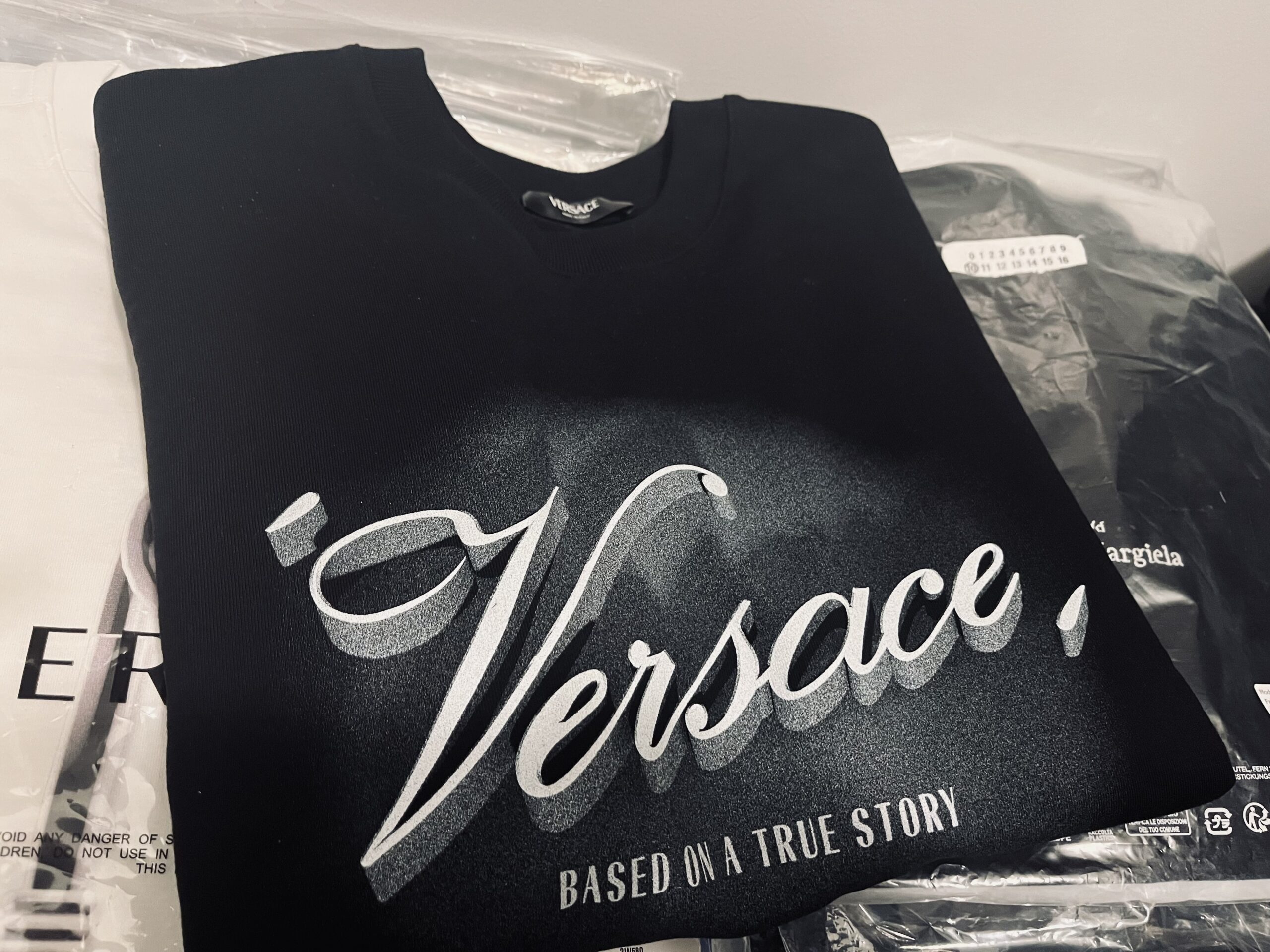
They noticed my clothes. That’s always the first thing people notice these days. I don’t know what that says about me. Nothing good, probably. I was wearing my second-favorite sweater that evening: A relatively subtle, black Versace piece with a Hollywood-inspired print that conjures my penchant for cinematic self-aggrandizing. “Based on a true story” it reads. They were an older couple, or older than me. They owned a bed and breakfast in a small town I’d never heard of, let alone been to. A 45-minute drive, they said. Over the river and through the woods. They came all that way just to sample passable restaurant fare.
“Where’d you get it?” the man, white as the driven snow, wondered, pointing to my sweater. “From Versace,” I said, flatly. “Oh. Well check this out.” He opened the photo album on his iPhone. His wife, an outwardly haughty but otherwise completely pleasant woman, rolled her eyes: “He loves this story.”
The man regaled me with the tale of a shopping trip to a Golden Goose store, where he and his daughter clinked champagne flutes with employees while spending what he imagined was a lot of money on the customizable “Star” sneakers that made the brand a hit. He had at least a dozen pictures. I did my Donnie Brasco-at-the-bar-with-Lefty impression. “Hey pal, you wanna see something?” I reached into my shoulder bag, pulled out my phone, opened the Golden Passport app and scrolled through my order history, a testament to a Golden Goose addiction which at one point turned unhealthy. There was the “Venice Loves Paris” tee, the “aged white” sweater with the inside-out embroidered rose, the quilted bomber, the medium-wash denim jacket and on and on. “There you go. That’s a beautiful thing,” I said, sliding my phone back into my bag.
He was pleased. It was nice, he suggested without saying as much, that someone like me — a white man with resources who wears Golden Goose — decided to buy property in a town like this. I wanted to tell him it wasn’t as much about believing in the town as it was about an idle, mindless scroll through South Carolina real estate listings while perched at a bartop in another state turning up a place I judged to be a good value. But that would’ve made me sound like a speculator, so I nodded and said something about “liking what they’re doing downtown here.” “It is nice,” his wife interjected. “What they’re doing here.” She too was quintessentially white, and plainly proud of it.
We talked at some length. They were Democrats, but “not Liberals,” whatever that meant. I asked if they were liberal democrats, “small ‘l,’ small ‘d’.” They were unfamiliar with the term and I explained it basically just refers to the tenets and principles nearly all Americans claim to live by, despite habitually falling short of the ideal (condemned as we are by the country’s original sin). “You’re liberal democrats,” I assured them. They thanked me, as if I’d bestowed an honorific.
We split a dessert: Banana pudding cinnamon rolls served inexplicably as a dinner afters. The bartender offered Sambuca, we all declined and they settled their check, bidding me a fond goodnight. It was past 10 and the crowd was thinning. I paid my tab and left.
When I walked out, they were standing on the curb, waiting on something. They didn’t notice me at first. “They’re never going to make this place nice with these kind of people walking around,” the wife told her husband, referring to a group of younger black men walking across the street. “You folks have a good evening,” I said, sharply to let her know I’d overheard. They turned around, startled. “Oh! You too!”
I found my way to the car, got in and pulled away down a side alley. A quarter mile in any direction from downtown puts you on dark streets bisected by other dark streets. A grid of empty melancholy, monochromatic but for barber poles swirling red, white and blue to match the here and there flicker of police cruiser sirens.
I sat at a stoplight. A smoke grey Dodge Charger pulled up on my passenger side, the driver’s window cracked just enough to let the ghostly warble of Stone’s “Get Down” escape into the night air. “Bleed from my stomach and my face, but I’m straight,” he says, emotionless, recalling the 2019 shooting that left him partially blind in one eye. “You can tell the difference between blood and sweat by the taste.”
When the light turned, I went straight, towards the suburbs. They made a right to nowhere.


Wow! Thanks Walt.
Peter
I am thinking you must be thinking of one day publishing – book length, hard copy. Your education (formal and informal) experience, subsequent perspective and talent almost demands it, you know. It must be cathartic, getting things in black and white and pushing it out to be interpreted, outside of your control. Perhaps redemptive (not suggesting that is needed or wanted) but at the very least, it is a gift, and I appreciate it. Thank you.
Great!
Great article, H!
Not many people can incorporate a thoughtful and educational discussion around racial disparities with BMF, Jeezy the Snowman, and EST Gee.
Thanks!
I applaud Walt and all he says about this serious societal problem.
But I do wonder how those same Black voters feel now with the hard crackdown and end to DEI, Affirmative Action, Critical Race Theory (haven’t heard that term in awhile) and other attempts at righting past wrongs. Whether you like these attempts or not, at least they tried to do something about this issues raised, and the conversation and awareness were growing because of them.
Or are Black people just happy there will be fewer Brown people?
And I applaud gdhalpha, for this demonstrated ability to lump people by color so neatly after H tried so hard to disaggregate them for us, into individuals, into friends and family, into characters instead of caricatures.
Ease up, Btfl. That’s not the intent of the comment. Since you have insight into Black issues, my question remains: how do Black Trump voters view what’s happening to programs that were designed to right some wrongs?
I have insight into my own views, no one else’s, let alone some grouping as nebulous and undoubtedly diverse as Black Trump Voters.
I feel like you didn’t actually read this piece. At least, I hope you didn’t actually read it.
Thank you sir. Very well written and it engendered some deep reflections on my part while reading.
Great timing Walt as I just broke my coffee cup of 10 years! Look forward to receiving it.
I need to do rocks glasses. I don’t know why that hasn’t occurred to me until just now.
Or a Stanley (that’s all I heard grandkids talk about at Christmas). And I add my thanks and appreciation, hoping this vein has more life. Enjoy hearing the counterpoints of the left and right hand.
I’d be first in line for rocks glasses etched with the ballerina from Hustle.
Without the red hair, I can tell my wife I bought it because it reminds me of her. Wouldn’t even be lying.
Thanks Walt.
For better or worse I could identify with much of what you wrote about and unlike many of our compatriots I was able to take advantage of my privilege to
come out the other side relatively unscathed.
As your subtitle for section III is headed, the problem truly does feel “Hopeless”.
The chart that you included of the net worth divide between blacks and whites in America going back to 1983 is embarrassing for our country- and “says it all” in one chart.
I don’t know what the answer is; but clearly what our country is doing and/or has tried during the past 50 years is not working. Time to try something else.
I looked at your current Tshirt offerings- I am proud to say that I own a Heisenberg “vintage” edition Tshirt (a style no longer offered). I will say it washes well. I use the dryer, too.
Yeah, that one sold out finally. I’m doing some 10th anniversary stuff that’ll be available later this month and next, as I get it. 2026 makes 10 years of Heisenberg Report! I was going to roll the anniversary merch out all at once, but the logistics are tricky on that. So I’ll put it out periodically in the store. I’m going to put more effort into keeping new stuff in the store going forward. It has a lot of potential, but like anything else, it has to be done predictably, regularly and right.
Amazing piece with so many insights to you as a person and how you view the world…I truly love your monthly’s and as others have said your writing style in this format lends itself to publishing a book which I would read by the way!
You often talk about being “reformed” from distributing hard right propaganda in years past. Given what sounds like real personal accounts of interactions with folks from all races and socioeconomic backgrounds I’m curious how you ended up creating and distributing the right-wing propaganda that you did in the first place?
Did you agree with some of the dog whistle racism often implied in the content and subsequently become reformed or was it just for a paycheck at the time?
From you writings you seem to have such a rich and varied lived history shrouded in a bit of mystery and I’m genuinely interested to learn more if you’re willing to share.
Purely paycheck. And it was 95% geopolitical propaganda. It wasn’t really cultural propaganda. I mean, it was, but only when that angle helped push a geostrategic agenda. It was a lot of anti-USD, anti-West type of “analysis.” By early 2016, that stuff was what I’d call “MAGA adjacent,” but that wasn’t necessarily because the people who paid me were Donald Trump supporters. They just saw, in his candidacy, a way to make money and a way to advance the same geopolitical narrative they wanted to advance.
I talked about it in two Monthlies. You might’ve read them already, but here they are in case you missed them:
https://heisenbergreport.com/2024/12/12/the-consultant/
https://heisenbergreport.com/2024/07/17/dances-with-wolves/
That was a very short interlude in my life’s legend, which is why there are only two Monthlies about it, as opposed to dozens about everything else. That period was 2015/2016. It lasted approximately 16 months.
“Baby gotta eat”
-Antwon Patton & Andre Benjamin
Understood H-man. As you could see by the timestamp on my question I couldn’t stop until I finished. 🙂
I appreciate the response.
Glad it was a good read. The point with these — particularly this one — is to really put people into those rooms (or in those cars, in this case, or at the bar tops, etc.) so you can almost “see” it and almost feel it like you’re actually there.
At some point the unequal, and growing, distribution of wealth plays a significant role in this. As one cross section of the bottom moves up to the middle, the numerical trends show another takes its place. At least since civilization became a thing, humans have fought over rungs on the wealth ladder. While some part of the middle tries to right a few injustices further down, the majority of the top tier continue to focus on acquiring more wealth. I might be losing hope.
As a foreigner I can’t necessarily relate to the specifics (I’ve been to the US a few times at most) but we have comparable, if lesser, social fabric issues in Sweden, albeit with rather different immediate causes. In particular, being a racist anti-racist (or is it the reverse?) has been a thing here. As far as sweeping generalizations go, Swedes were generally extremely positive towards immigration until recently, and Sweden has ranked as the “least racist country in the world” in dubious polls I don’t care to look up for a one paragraph online post. However, when push came to shove, Swedes weren’t willing to live next to (especially non-white non-English speaking) immigrants at scale. What’s worse, Swedes weren’t self-conscious of this ahead of time and attributed it to being better than everyone else. That exemplary sanctimony finally started to shift with the Syrian refuge crisis.
And of course, thanks for the great read, if that was not implied.
And now we’ve come full circle. Apparently, “Love Sosa” — the song immortalized dubiously in this article — is the go-to soundtrack for America’s military. Here’s Anna Paulina Luna celebrating it: https://x.com/RepLuna/status/2012214537248784472
This is a good time to go back and read this piece, folks. The shift in culture I discussed here has now spilled over into the MAGA sphere, and the irony’s completely lost on them: They’re celebrating the song which, 14 years ago, put Chicago gang culture on the map, the same culture Trump and his top brass and acolytes on the Hill habitually cite as an excuse for militarizing Chicago’s streets.
It’s incredible how surreal some of these Monthlies end up sounding, not so much in the sense that they’re prescient, per se, but just in the sense of being eerily in tune with — I don’t know — eerily in tune with something.