

Four months ago this week, I was busy putting the finishing touches on “Holistic People,” a deep-dive into the evolution of perceptions around the value of four-year humanities and social science degrees in America.
The article, which doubled as a whimsical reflection on a campus speaking tour I led many years ago, was meant to be published as May’s monthly letter. Alas, it was pushed back. More urgent matters demanded I pen an ad hoc monthly mourning the latest evidence of institutional decay in America, “shining city on a hill”-turned dysfunctional dystopia.
At the time, the raucous faction of hard-right US lawmakers who in January secured disproportionate leverage over America’s legislative process in exchange for making Kevin McCarthy the third-ranking US government official, looked poised to test the waters on a technical US default. There was a link between the debt ceiling standoff and the unfortunate (to employ a polite euphemism) events of January 6, 2021. I elaborated on that link in “Deterioration, Dissolution And Default,” which became May’s monthly letter.
As I readied the latest monthly (an account of the socioeconomic conditions perpetuating America’s homelessness crisis), it became apparent that developments in D.C. would once again derail the best laid editorial plans, to my deep dismay. For the second time in four months, I was compelled to stop the presses (literally) in order to highlight the latest episode in America’s ongoing institutional credibility crisis.
Although right-wing zealots in the House of Representatives ultimately failed to force a government shutdown, the mere fact that it was on the table given market dynamics and geopolitical realities evinced an unconscionable obliviousness vis-à-vis current events (or unconscionable apathy, and I’m not sure which is worse), to say nothing of the imbecilic, counterproductive Machiavellianism on display towards McCarthy who, for all his concessions and pandering, somehow still isn’t viewed as obsequious enough by the tormentors who live on his right shoulder.
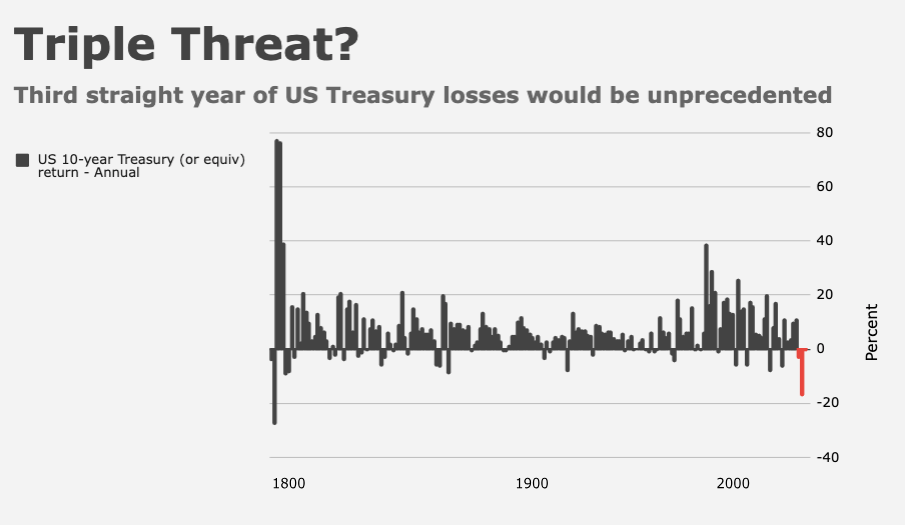
Some of the holdouts on McCarthy’s far-right flank would not-so-gently suggest it’s everyone else who’s oblivious. If you can’t see the debt and deficit writing scrawled in red ink on an unfinished section of border wall, there’s no hope for you, they’d say. Assuming they’re aware that US government bonds are on track for an unprecedented third consecutive annual loss, and assuming they’re apprised of the extent to which Fitch’s summer downgrade likely contributed to a snowballing selloff for Treasurys in August and September, those lawmakers would sarcastically ask if anyone’s considered addressing the fiscal trajectory that ratings agencies and investors habitually cite when discussing the (allegedly baleful) outlook for US government bonds.
As far as immigration’s concerned, disinflationary math (which virtually every rational conservative concedes, begrudgingly or not) takes a backseat to demagoguery every, single time for the far-right. You’re not going to score points with the Donald Trump faithful by pointing out that the majority of labor market normalization in the post-pandemic era is attributable to foreign-born workers, for example. You score points with those voters by posting night vision footage of “illegals” running across the desert to your social media account.
To the extent you care what the ratings agencies say about America’s creditworthiness (and I don’t necessarily think you should), both Fitch and, in a somewhat foreboding FAQ published on September 25, Moody’s, were clear that although they’re obliged to focus primarily on the numbers, governance is an issue in America. Indeed, you could plausibly argue that both ratings agencies believe the bigger problem isn’t America’s fiscal trajectory, but rather mounting evidence to suggest that in the exceptionally unlikely event circumstances conspired to revoke or water down the “exorbitant privileges” which afford the US virtually unlimited monetary and fiscal policy latitude, the US government would prove utterly incapable of taking steps to win back those privileges.
In the Moody’s FAQ, the agency posed a simple question: “What impact could [a government shutdown] have on the US sovereign credit profile?” If America’s fiscal trajectory were the main concern, the answer to that question might go something like this. “A shutdown would demonstrate that only a handful of US lawmakers take seriously the prospect of a fiscal and/or debt crisis.” But that wasn’t the answer from Moody’s. Instead, the agency said a shutdown “would underscore the weakness of US institutional and governance strength relative to other Aaa-rated sovereigns [and] demonstrate the significant constraints that intensifying political polarization continue to put on US fiscal policymaking during a period of declining fiscal strength, driven by persistent fiscal deficits and deteriorating debt affordability.”
The problem is first and foremost political polarization, something Moody’s underscored again and again. “After having negotiated a contentious bipartisan debt limit deal in June, the US Congress is yet again renewing internal party disagreements that threaten a government shutdown and clearly reflect the political hurdles to US fiscal policymaking,” the same bulletin said. “In particular, aligning political support around a comprehensive, credible multi-year plan to arrest and reverse widening fiscal deficits through measures to increase government revenue or reform entitlement spending, appears extremely difficult in the current highly polarized political environment.”
This isn’t lost on the rest of the world, nor is it lost on markets. I’m not suggesting the daily price action in US Treasurys is somehow a reflection of the ebb and flow of America’s crisis of government. That’d be absurd. If investors sold Treasurys every time someone from the Trump wing of the Republican party posted something untoward, uncouth or outright bizarre on social media, US government bonds would be having an even worse time than they already are. But make no mistake: The never-ending chaos in D.C., and particularly the perception that the brinksmanship is being perpetuated by completely irrational actors, is a psychological albatross for holders of US government debt.
It’s important we aren’t obtuse. There may be irrational people “on both sides” (to clip one of Trump’s most infamous soundbites), but it’s disingenuous to stitch together ostensibly extreme social policies favored by Progressives and trot them out as a Frankenstein monster that needs a reactionary, right-wing counterbalance, lest it should escape the lab, run down the hill and corrupt the townsfolk. Dance around it as you will, but the reactionary right actually tried to burn down the village. It wasn’t transgender immigrants in drag at the Capitol on January 6, 2021, after all, and it wasn’t an African American A.P. history teacher egging them on.
We talk frequently about “the insurrection,” and we prosecuted dozens of people in connection with it. We’re in the process of prosecuting the ringleader. And yet, on most days, it feels like we haven’t really come to terms with what happened that day: The last US president and his allies conspired to overthrow the government, usurp the country’s system of governance and they were aided and abetted in that conspiracy by irrational actors on the right, some of whom voted in sympathy with the scheme, even after witnessing an armed rebellion. Many of those irrational actors continue to perpetuate the conspiracy to this very day.
The idea that there’s an equivalence with “extreme” liberals is ludicrous. Further, the idea that anyone who voted to sustain an objection to states’ 2020 election results after witnessing a riot in the very same building just hours previous, should be permitted to hold government office (any government office) ever again, is manifestly insane. Again: It’s important we aren’t obtuse.
More broadly, the same irrational actors on the right are turning what was already an acute sociopolitical crisis into an existential problem. At every turn, that faction seeks desperately to sow distrust, discord and division. The urgency of that effort never seems to wane for them, which is understandable: Their relevance depends entirely on the perpetuation of identity politics, which in turn means every issue has to be reframed and contextualized by the culture wars.
Identity politics is inherently divisive, and almost always corrosive. When wielded by demagogues and opportunists, it’s ruinous. Disconcertingly, “demagogues and opportunists” gives too much credit to the faction of US lawmakers holding the legislative process hostage in D.C. Without mincing words, some of them are just ignorant simpletons. Identity politics in the hands of ignorant simpletons is like loaded revolvers in the hands of toddlers.
During an interview with CNN last week, New York Republican Mike Lawler called the shutdown debate “a clown show.” “You keep running lunatics, you’re going to be in this position,” he said. Lunatics. His word. Not mine.
There are 18 House Republicans who represent districts that went for Joe Biden in 2020. Lawler is one of them. But those lawmakers aren’t alone among Republicans frustrated with what, increasingly, looks like an out-and-out attempt to sabotage the US Congress in the name of an almost anarchical brand of Podunk populism that bastardizes libertarianism and preys on the insecurities and legitimate concerns of the same vulnerable Americans brainwashed by Trump’s messiah message.
The New Yorker‘s daily cartoon from September 29 captured the situation with humor. It depicted the Founders seated around a table, drafting documents. “So we agree that the whole government can be shut down by a consensus of Congress’s ten biggest weirdos?” read the caption.
I’m not sure “weirdos” is the best word, though. Nor do I necessarily prefer “lunatics.” McCarthy’s rebels are agents of chaos for whom disarray is an end in itself to the extent it keeps America in a state of perpetual, angry churn. There can be no resolutions (continuing or otherwise), let alone solutions. The day problems get solved is the day the rebels have no cause. What happens to grievance politics when the grievances die away? It dies too, along with the political careers of those who have nothing else to offer.
That (il)logic extends to their surrogates outside the halls of power. I spoke once to a man who runs one of the most highly-trafficked, non-mainstream web portals in the world. It owes most of its success to reactionary, tabloid-style content, the thrust of which is that the entire Western world is broken. I asked him if he wants to see it fixed. His answer, paraphrased, was, “No. If it’s ever fixed, our traffic will fall.”
So, the “lunatics” and “weirdos” stoke the fire. It’s not so much a manifestation of psychosis as it is a matter of self-preservation. And, as we’ve learned time and again over the past three years, the ones we allowed into Congress are willing to burn it all down, whether that means forcing the US into default, shutting down the government with no real demands or even intimating that sacking the Capitol is a legitimate way for voters to express frustration with the results of an election.
There’s a name for people who try to sabotage their own governments from the inside, and unfortunately, the label applies not just to today’s GOP radicals but also to the entire party both for empowering the radicals in the first place and for failing to unequivocally disavow the man on whose blueprint the radicals’ behavior is modeled. I don’t think I have to spell it out further, but I will anyway, because the stakes are as high as stakes get (and also because the shutdown threat inconvenienced my editorial efforts, which I don’t appreciate).
For many commentators (and for a lot of American conservatives), the reality of this situation is difficult to accept. The reality that says one party in America’s political duopoly is beyond saving. That party was complicit in setting the stage for what’s now an overt attempt to incapacitate, completely, the nation’s government, just as that party was complicit in setting the stage for an overt attempt to usurp the will of the electorate in January of 2021. There’s no coming back from that. Of course, America has committed any number of irredeemable sins, many of them repeatedly, and many of them perpetrated against its own citizens. But this one — an ongoing conspiracy to sabotage the government and a willingness to disavow democracy itself if it means holding onto power — threatens not just to make a further mockery of the nation’s absurd pretensions to the moral and ideological high ground, but to in fact destroy the country as we know it.
Before anyone accuses me of catastrophizing the situation, consider how awkwardly politicized the most routine social interactions have become. We always knew it was best to “not mention politics” at barbecues and Little League games, but now such silences are deafening. “Is Bob a ‘Let’s go Brandon’ guy? God, I hope not.” “Does Tom actually like ‘Joe and the Hoe?’ I can’t have him around my kids.” What’s that going to be like in the event of another Trump presidency? Is it really far-fetched to suggest he might set up, for example, a hotline for “concerned citizens” to report instances of “anti-American” behavior? Would I be crazy, in another Trump presidency, to stop writing about Trump just to be on the safe side?
The backstory (the “How we got here”) isn’t difficult to recount. The blue collar degradation which began in the 1980s morphed, over the years, into wholesale middle-class depravation. The deleterious domestic side effects of hyper-capitalism and globalization created tens of millions of disaffected Americans looking for someone to blame. The upper-middle-class, and certainly the rich, didn’t see it. Trump’s victory in 2016 was a wake up call.
Republicans rely on a strange bedfellows coalition that fuses the business class with the working white poor. It’s possible to convince the economically disadvantaged to vote against their own self-interests by cynically leveraging religion and social conservatism. Before Trump, the punch was typically spiked with a dash of tacit racism and a hint of anti-liberal vitriol — not enough to make anyone fail a breathalyzer, just enough to create the kind of light buzz you need to vote for someone who has absolutely nothing in common with you economically. Trump poured a gallon of Everclear into the punchbowl.
When economically disadvantaged voters’ fortunes are decimated by trickle-down policies and other GOP supply-side gimmickry, it’s difficult for them to assign blame. After all, they’ve been poor under Democrats too, so what’s the difference? At least with Republicans they have Jesus and guns. (And what else do you need at the end of the day, right?)
The problem for Republicans is that those voters now belong to Trump, not the party. If you’re not Trump, you can’t depend on them. Indeed, as the 2022 midterms suggested, you can’t depend on them to show up in sufficient numbers even if Trump openly endorses you. For many voters, Trump has to be on the ballot personally if you want them to show up in force. The corollary says that if you go against Trump as a Republican, those voters will turn on you. Automatically. They don’t need (or want) to hear your pitch. The GOP is thus beholden to a cult of personality. Yes, that cult mentality was a loser in 2020 and again in the midterms, but as September’s GOP debates amply demonstrated, there’s no viable alternative.
More importantly, Republicans know this is a road to ruin for the country. Sure, American empire was in decline before Trump and his 2016 victory was a testament to just how deep-seated the discontent was for tens of millions of people in what’s supposed to be the most prosperous nation on Earth. But the road Republicans are on now is, at best, a kamikaze mission presaging the kind of government dysfunction with the potential to irreparably harm America’s already abysmal international reputation. At worst, it’s a road to fascism, civil war or one on the way to the other.
This comes at a time when the US is staring down the first real threat to its global dominance since the Cold War (in China) and a ground war on NATO’s doorstep (in Ukraine). Crucially, those challenges are an opportunity for Washington. Xi Jinping is in the process of squandering decades of Chinese economic advancement and Vladimir Putin’s “special military operation” is quite plainly a debacle.
Xi’s bungled COVID response and his delusions of “common prosperity” together constitute a case study in central planning gone awry. And Putin accidentally validated suspicions that the Russian military is a paper tiger. Relatedly, even if the wildest conspiracy theories about Yevgeny Prigozhin (that he’s not actually dead, and that the entire mutiny was staged so that Putin could identify disloyalty in the Defense Ministry) are true, his “complicated fate” (as Putin put it) still underscores the notion that Russia is a hopeless, oligarchical kleptocracy.
Through that lens, the bar to clear for retaining US hegemony isn’t actually very high. All America has to do is show up, as it were, where that basically just means making good on commitments both international and domestic, and avoiding unforced errors. Unforced errors like voluntary defaults (akin to deliberately hitting the ball into the net in tennis) and government shutdowns for the sake of them.
In a testament to the kind of dejected apathy that sets in when a country is in terminal decline, Americans actually didn’t seem to care all that much about the looming shutdown. “Judging by Google search trends, at least, Americans in the days leading up to the shutdown-that-wasn’t were more curious about who shot Tupac Shakur, who might win ‘The Golden Bachelor’ and who would claim the giant Powerball jackpot,” Peter Baker wrote, for The New York Times. “America, it seems, has come to expect crisis. Dysfunction is the new normal.”
In the linked article, Baker quoted David McLennan, a political scientist at Meredith College in Raleigh, North Carolina. “There is no demographic group where the majority of people think things are going well in the country,” McLennan said. “Partisans, Democrats, Republicans and unaffiliated voters all think things are going poorly.”
Spoiler alert: The solution probably isn’t more dysfunction, division and dystopia.


Thank you, sir, for once again treating us to your superior skills for integrating and summarizing data, events, and trends. To my mind, the current GOP was founded on the back of Nixon and his never-ending quest for personal recognition and power. He didn’t care much about the US, only about his personal glory. To me the only thing that saved Nixon at all was that he found and employed Henry Kissinger. The GOP reveres Ronald Reagan, whose wunderkind was Arthur Laffer, who no one understood, whose theory has never actually worked, but who is still getting republicans elected today. Reagan is the guy whose warped vision of the Monroe doctrine involved a plan to import drugs to sell to our children to raise money to finance a tinpot war Congress wouldn’t support and also the guy who probably slept through much of his second term, while suffering from the beginnings of dementia. At this point, both parties have their crackpots, are supported by totally different constituencies than they were during the Korean War. But the switches of party constituencies in the US is like the regular switching of the earth’s magnetic poles, back and forth in cycles. Lincoln was a republican, Ike was a republican, Trump was a democrat first then switched to the folks more willing to Kowtow. Down the line the principles we revere in the myth that is the US, were just a way to control a disagreeable population and we’ve always been about who gets to be in charge. It’s not really business, folks, it’s always been personal.
The possibility of Civil War is truly frightening to me. Simultaneous infrastructure attacks from both sides of the spectrum would quickly create starvation on a level not seen in this county, nor should ever be witnessed. Anarchy begetting base brutality.
Chaos accelerationists. Inside and outside of government.
But,wtf can we do to help either build bridges or reverse this negative doomsday narrative?
Nothing until it finally dawns on voters that 75% of the electorate has economic precarity in common. At the end of the day, all that matters is whether the checkbook balances, and for the vast majority of Americans it doesn’t. There are politicians in Washington who want to actually address that. But, tragically, the establishment on both sides of the aisle has convinced 300 million people that a policy platform built on economic dignity for everybody is a “radical” idea. And, from what I’ve heard, America’s would-be revolutionary has now settled into a comfortable life and is already resigned to the notion that the Democratic machine is never going to let her run for president. If that’s even a semblance of accurate, then she should indeed stay on the sidelines. Revolutionaries and agents for real change don’t “ask” for permission to run for elected office.
Walt’s coming in hot!!
WH ’24