Do we even want a good reporting season from corporate America?
Arguably not. Or at least not to the extent resilient profits are a function of pricing power.
On some levels, it’s comforting that consumers can still absorb price hikes, but there’s a limit, even if we don’t yet know where it is. “Greedflation” and “profiteering” are just derisive terms for companies’ natural tendency to push the envelope until management discovers the limit — the threshold beyond which demand destruction sets in and market share is lost.
The problem with that from a macro perspective is straightforward: It’s inflationary. Consumers pay up for goods and services, conveying to the C-suite the limit hasn’t been reached, which prompts management to raise prices further, particularly given higher wage bills. Workers are consumers on their days off, so the people asking you for a raise when they’re on the clock are the same people you’re raising prices to when they’re not at work. It’s silly. But it isn’t funny.
The only way that dynamic doesn’t net to a stalemate is if management succeeds in raising prices in excess of what’s needed to offset higher input costs, including wage bills, something they’ve generally been able to do post-pandemic. That’s Greedflation, and ideally, market forces will put the brakes on it.
One concern heard from voices as diverse as America’s Progressive left and SocGen’s Albert Edwards, is that Greedflation will persist, leading to more societal unrest. In that context, you could certainly argue that a lackluster showing from corporate America wouldn’t be the worst thing in the world.
Even if you don’t care about societal cohesion, the persistence of the Greedflation dynamic could compel the Fed to lean more hawkish than they otherwise might, prolonging the period of policy ambiguity, and threatening asset prices.
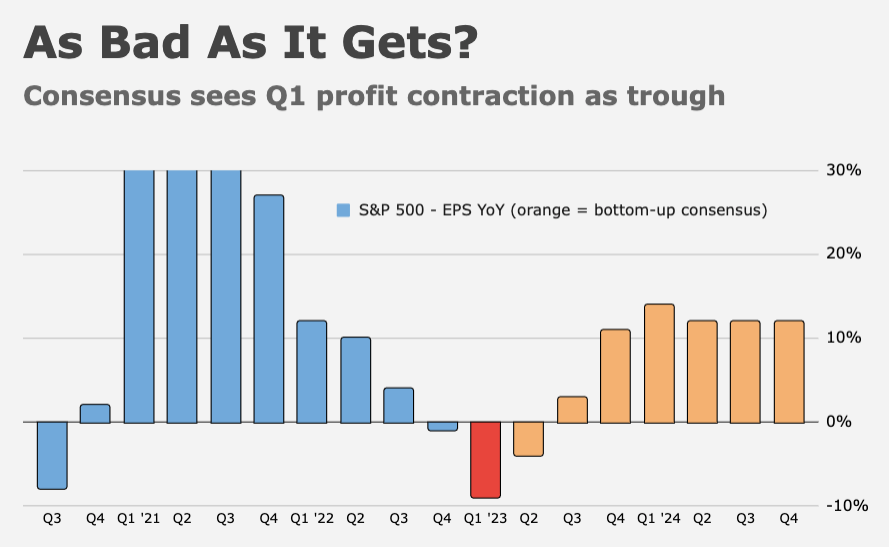
This week is obviously key when it comes to determining how Q1 results will be remembered — i.e., whether this will indeed be the trough for negative YoY profit growth, or whether it’s another clear-the-bar, kick-the-can quarter. The simple figures below show expectations for top-line growth.

“Operating leverage is working against the market with Q1 sales expectations at +5% YoY growth but consensus simultaneously expecting a -9% EPS decline,” Morgan Stanley’s Mike Wilson remarked on Monday. “Large-cap companies recently announced a number of layoffs and cost-cutting programs and Q1 offers the first check-in on whether more belt-tightening will be needed.”
If earnings hold up due to better cost management, that’s certainly “fine” (with the scare quotes to denote that “fine” is a little uncouth when we’re implicitly referencing job losses), but resilient profits due to pricing power would be more worrisome.
“Earnings seasons are designed to bring positive news, which is why you typically see forecasts adjusted downward in the run-up, so companies can beat,” SocGen’s Andrew Lapthorne said. “Nonetheless, a resilient earnings outlook — particularly if driven by robust sales growth — would be inconsistent with a rapid reduction in inflation, so in this perspective, the upcoming Q1 reporting season could matter more for rates than equities,” he went on, adding that “should Q1 prove strong, equities may get hit by renewed inflation and rate-hike fears.”